


If you own South Bay industrial property today, you’re probably feeling the shift from the ultra-tight 2021–2022 market into a more “normal” industrial cycle with higher vacancy and more tenant choice. At the same time, you’ve likely noticed that aerospace, defense, and hard-tech manufacturing groups keep touring, signing, and expanding while some logistics and e‑commerce occupiers step back. In this article, I’ll walk through why aerospace and defense are now the key to South Bay industrial stability, and how you can position your building, lease terms, and tenant mix to lock in that resilience going into and beyond 2026.
Key Takeaways
- Aerospace and defense users are now the anchor South Bay industrial tenants keeping occupancy, rent, and cash flow more stable, even as other segments soften.
- Hard-tech manufacturers in El Segundo, Hawthorne, Torrance, and Long Beach are expanding footprints, supporting rent growth for well-located bay industrial assets.
- For 2026, owners who tailor small-bay and multi-tenant industrial space to aerospace and defense requirements will outperform the broader industrial market.
South Bay Industrial in 2025–2026: From Frenzy to Durable Demand

The South Bay industrial market has moved off the near‑zero vacancy environment we saw before 2023, but it remains one of the most resilient industrial submarkets in Greater Los Angeles. Countywide industrial vacancy in Los Angeles climbed into the mid‑4% range by mid‑2025, and South Bay’s industrial vacancy rate pushed into the mid‑6% range by Q3 2025, still tight by historical standards but meaningfully higher than in the prior cycle. For owners, that means more competition on lease-up, more pressure on concessions, and a bigger gap between best‑in‑class assets and commodity product.
At the same time, net absorption has turned positive again across Greater Los Angeles, with South Bay continuing to benefit from its proximity to the ports, LAX, and a deep industrial labor pool. However, the tenant base driving that absorption looks different: big‑box distribution centers are no longer the only story, and many industrial tenants in 100,000‑plus square foot buildings are right‑sizing or rethinking their footprints. That’s where aerospace and defense come in as a stabilizing force for South Bay industrial owners who are willing to adapt.
Aerospace & Defense: The Key to South Bay Industrial Stability
Hard-tech and “SpaceX effect” tenants are reshaping the submarket
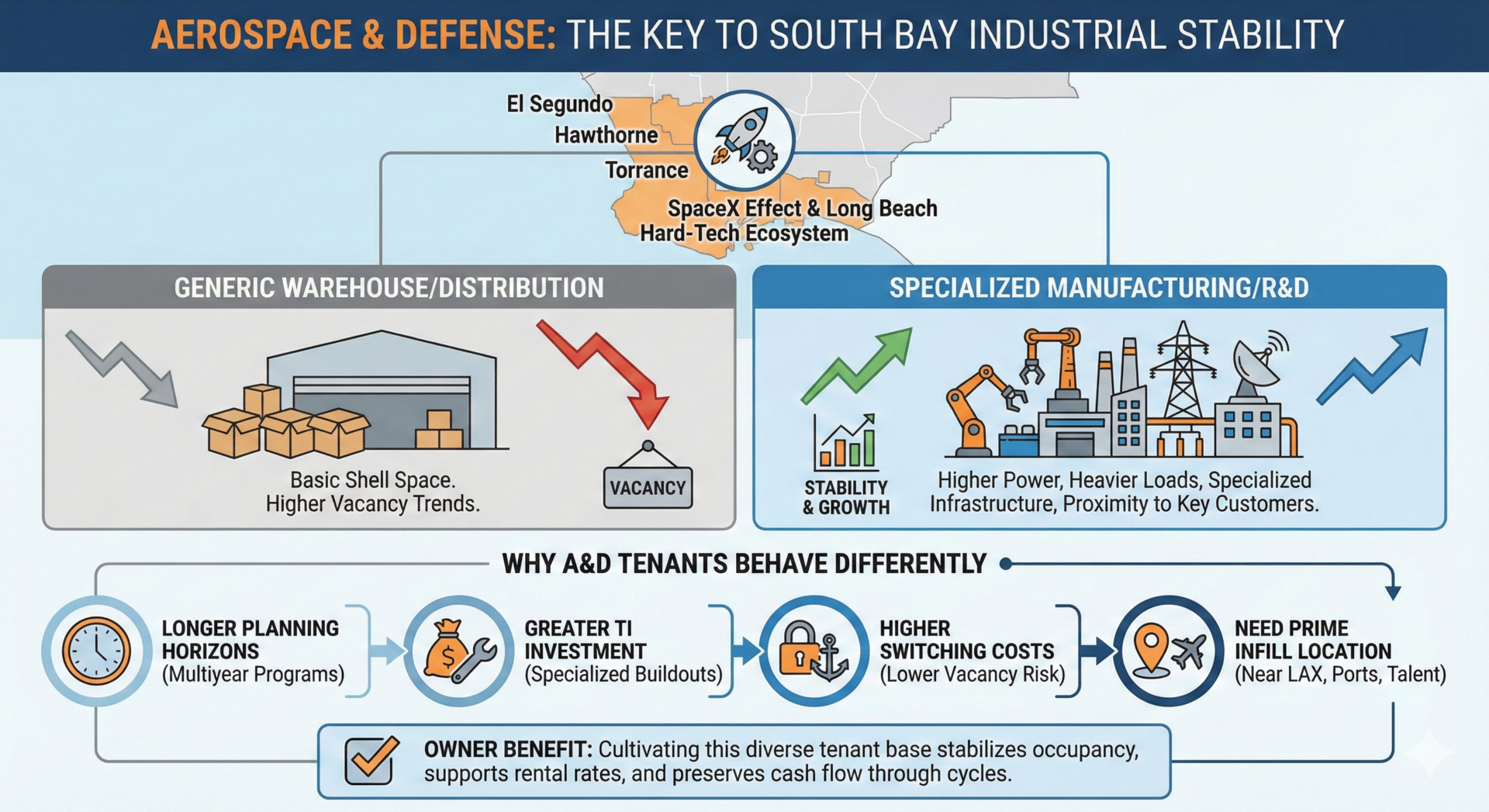
South Bay, particularly El Segundo, Hawthorne, Torrance, and Long Beach, has become “ground zero” for hard-tech manufacturing tied to aerospace, defense, and space technology. The SpaceX effect has created a dense ecosystem of engineers, suppliers, and spin‑off companies that continue to found new ventures and scale up manufacturing footprints in nearby bay industrial submarkets.
These occupiers are not looking for generic warehouse shell space; they need industrial properties that support manufacturing, R&D, and assembly: higher power, heavier floor loads, specialized infrastructure, and close proximity to key customers and contract work. As a result, manufacturing‑oriented industrial buildings and multi-tenant industrial space configured for production are seeing stronger rent growth and more consistent leasing activity than pure distribution boxes in some broader market submarkets.
Why aerospace & defense tenants behave differently
Aerospace and defense South Bay industrial tenants often bring:
- Longer planning horizons tied to multiyear defense and aerospace programs.
- Greater willingness to invest in tenant improvements and specialized buildouts.
- Higher switching costs, which lower the risk of sudden vacancy.
- A need for infill, prime location industrial space near LAX, ports, and engineering talent.
Even as industrial vacancy rates in Los Angeles and the broader U.S. have trended higher since 2023, hard-tech and aerospace-related occupiers in the South Bay continue to expand, including notable examples of firms tripling their industrial square footage through long-term leases. For owners, this means that cultivating a diverse tenant base anchored by aerospace and defense can stabilize occupancy, support rental rates, and help preserve cash flow through the cycle.
Rent, Vacancy, and Small-Bay Industrial: What’s Really Happening
Vacancy is up, but not all space is equal
After years of sub‑1% industrial vacancy in parts of the South Bay, vacancy has normalized and risen into the mid‑single digits, with availability higher once you include space being marketed for lease ahead of move‑outs. Larger logistics facilities in the 100,000–500,000 square foot range have seen the sharpest increases in vacancy and softer rent growth, mirroring broader U.S. industrial market conditions and slower e‑commerce expansion.
By contrast, small-bay industrial and small bay multi-tenant industrial properties in infill locations close to aerospace and defense clusters remain in high demand. South Bay industrial tenants in hard-tech manufacturing often prefer smaller but highly specialized industrial space where they can iterate quickly, add or subtract square footage within an industrial park, and stay near related suppliers and contractors. This is especially true in submarkets such as El Segundo’s Smoky Hollow district and surrounding infill industrial assets.
Rental rates, NNN structures, and year-over-year trends
Average asking rents in core South Bay submarkets remain among the highest in the Greater Los Angeles industrial real estate market, with El Segundo commanding a premium over other South Bay locations like Torrance. For example, recent market commentary shows average asking rents around the low‑to‑mid‑$2 per square foot NNN range in El Segundo versus lower NNN rents in Torrance, reflecting the intense competition for hard-tech space in El Segundo’s limited inventory.
In 2025, year-over-year rent growth cooled from the double‑digit peaks of 2021–2022 but remained positive for well-located bay industrial properties with strong tenant demand. With high interest rates and rising construction costs constraining new development and limiting new supply, existing assets that already offer manufacturing‑friendly infrastructure are positioned to hold rents more effectively, even as some broader market categories see slower rent growth.
Snapshot: South Bay Industrial Metrics and Positioning
You can use this quick table as a mental model for how different South Bay assets are performing in 2025–2026:
| Asset type / submarket focus | Typical tenant profile | Vacancy / demand trend | Rent positioning | Notes for owners |
|---|---|---|---|---|
| Large distribution (100k+ SF) | Logistics, 3PL, e‑commerce | Softer demand, higher vacancy than peak years | Flat to modest growth | Focus on competitive lease terms and concessions. |
| Manufacturing‑ready South Bay industrial | Aerospace, defense, hard-tech manufacturing | High demand, limited new supply | Strong rent growth, premium rents | Target value-add upgrades for power and infrastructure. |
| Small-bay industrial / multi-tenant | Local fabricators, suppliers, early‑stage hard-tech | Low vacancy, strong leasing activity | Healthy rent growth, stable cash flow | Emphasize flexibility and short expansion options. |
| Older, generic warehouse in non-core pockets | Commodity users, overflow storage | Higher vacancy risk | Discount to market | Consider repositioning to appeal to manufacturing. |
How South Bay owners can align with aerospace & defense demand
1. Upgrade infrastructure where returns justify it
A key distinction in today’s South Bay industrial market is the mismatch between buildings optimized for distribution (dock‑heavy, high clear, truck courts) and the growing demand from manufacturing and hard-tech users. To compete for aerospace and defense tenants, consider targeted upgrades that directly support manufacturing:
- Increased power capacity and upgraded panels.
- Reinforced floor loads for heavier equipment.
- Improved ventilation, loading flexibility, and secure yard or fenced parking where feasible.
Not every industrial property warrants a full manufacturing conversion, especially under high construction costs. But value-add improvements on existing assets can justify higher per square foot rents, reduce downtime between leases, and make your building stand out versus generic industrial properties in the South Bay market.
2. Lean into small-bay and multi-tenant strategies
Because many aerospace and defense occupiers in the South Bay start small and scale quickly, multi-tenant industrial parks with small-bay options and clear expansion paths are especially attractive. As an owner, that means:
- Designing lease terms that allow tenants to take adjacent bays as they grow.
- Staggering expirations across your multi-tenant industrial portfolio to reduce rollover risk.
- Structuring NNN leases that push operating expenses appropriately while keeping total occupancy cost competitive for small-bay tenants.
This approach helps you maintain occupancy and capture strong rent growth year-over-year as successful occupiers expand within your industrial park rather than relocating to another landlord’s property.
3. Prioritize location and ecosystem over pure rent maxing
In 2026, South Bay industrial tenants in aerospace and defense are choosing space based on ecosystem and efficiency, not just headline rent. Being near major anchors, key contractors, and transportation nodes often matters more to these occupiers than securing the absolute lowest rent per square foot.
For you as an owner, that means:
- Positioning your marketing to highlight proximity to LAX, ports, and major aerospace campuses.
- Showcasing existing manufacturing users in your building or industrial park to reinforce the ecosystem story.
- Being realistic on asking rents relative to submarket benchmarks while not underestimating the premium some tenants will pay for the right South Bay industrial location.
Strategic Leasing Moves for 2026 and Beyond
Smarter lease terms in a maturing cycle
With industrial vacancy moving off the floor and more options on the market, lease terms matter just as much as asking rent. For aerospace and defense tenants, consider:
- Securing longer base terms (7–10 years) in exchange for TI packages or early‑move allowances where the credit profile supports it.
- Tiered rent growth, with higher bumps after the initial years once the tenant is established and buildout is complete.
- Clear language for heavy equipment installation and restoration obligations to protect your base building.
Thoughtful lease structuring can help you manage cash flow, protect asset value, and reduce leasing friction down the road while still giving South Bay industrial tenants the flexibility they need.
Reading The Signals: When to Pivot Your Strategy

If you own a single-tenant industrial building that feels more like yesterday’s logistics product than tomorrow’s manufacturing hub, pay attention to early warning signs: shorter renewal requests, slowing tour activity, or feedback that your space lacks the power or layout aerospace and defense users expect. In those cases, it may be time to evaluate:
- Repositioning toward multi-tenant industrial with small bay configurations.
- Adding basic infrastructure upgrades that open the door to a broader industrial tenant base.
- Exploring a phased value-add plan that balances capital spend with expected rent and occupancy gains.
Owners who adapt fastest to evolving South Bay industrial market conditions—rather than waiting for the broader market to “come back”—are more likely to capture the most durable tenant demand in aerospace and defense.
FAQs
How are South Bay industrial vacancy rates trending in 2026?
South Bay industrial vacancy moved from well below 1% earlier in the cycle to the mid‑single digits by late 2025, and early 2026 conditions still reflect a more balanced but landlord‑competitive environment. Vacancy is higher for large distribution space and lower for manufacturing-ready and small-bay industrial properties in prime South Bay submarkets.
Are aerospace and defense tenants really more stable for landlords?
Aerospace and defense tenants tend to sign longer leases tied to multiyear programs, invest heavily in buildouts, and rely on specialized labor pools, making them less likely to churn compared to commodity logistics users. That combination often translates into more predictable occupancy and cash flow for South Bay industrial owners who secure these users.
What size and type of industrial properties do hard-tech users prefer?
Many hard-tech and aerospace manufacturers in the South Bay prefer small-bay industrial and mid-size manufacturing buildings with strong power, heavier floor loads, and flexible layout options. Multi-tenant industrial parks that allow growing tenants to add square footage in phases are especially attractive.
How are rental rates holding up for South Bay industrial tenants?
After explosive rent growth in 2021–2022, South Bay industrial rental rates have moderated but remain among the highest in Greater Los Angeles, particularly in El Segundo and similar infill submarkets. Manufacturing-ready space geared toward aerospace and defense continues to command premium per square foot NNN rents compared with generic warehouse product.
What’s the biggest mistake South Bay owners can make in this market?
The biggest mistake is assuming the old distribution‑only playbook still works, without upgrading infrastructure or repositioning to serve aerospace, defense, and hard-tech demand. Owners who delay these moves risk higher vacancy, slower leasing activity, and weaker rent growth compared with peers who proactively align their industrial assets with the region’s strongest occupier base.
Conclusion
The South Bay industrial market in 2026 isn’t the same environment we saw during the logistics boom, but it offers something potentially more valuable for long-term owners: durable demand anchored by aerospace, defense, and hard-tech manufacturing. The owners who recognize this shift early and adapt their assets accordingly will be the ones who thrive through 2026 and beyond.
If you’re ready to explore how your South Bay industrial property can better align with aerospace and defense tenant demand, I’d welcome the opportunity to discuss your specific situation. With over 18 years of experience representing landlords and business owners in commercial real estate leasing and sales, I can help you assess your building’s potential, identify value-add opportunities, and develop a leasing strategy that fits today’s market realities. Schedule a consultation with Tolj Commercial, and let’s work together to position your asset for stronger cash flow, lower vacancy risk, and long-term stability in the evolving South Bay industrial landscape.


