Most investors and shop owners I speak with assume their auto body facility is just another retail or service property. But here’s what caught my attention: under current tax law, collision repair shops that cut, weld, and refinish metal may actually qualify as “manufacturing buildings.” This isn’t just semantics—it’s a classification that can unlock massive first-year tax deductions that most shop owners never realize they’re eligible for, according to commercial real estate analysis (Source: Own Your Building, “Why an Auto Body Shop Can Qualify as a Manufacturing Building”) of the OBBB Act’s impact on auto body facilities.
Key Takeaways
- Auto body shops often qualify as manufacturing facilities under the One Big Beautiful Bill (OBBB) Act, unlocking 100% first-year depreciation on Qualified Production Property instead of the standard 39-year schedule
- The “manufacturing” classification stems from fabrication activities like cutting, welding, and refinishing metal that transform raw materials into finished products
- Strategic property classification can dramatically reduce tax liability for owner-operators, potentially saving hundreds of thousands in the first year of ownership
Why Auto Body Shops Aren’t What You Think

The Manufacturing Definition That Changes Everything
The IRS doesn’t classify businesses based on what you call yourself. They look at what you actually do. When I explain this to auto body shop owners, most are surprised to learn that their daily operations—cutting damaged panels, welding frame sections, applying primer and paint in spray booths—constitute manufacturing activities under federal tax code.
The One Big Beautiful Bill (OBBB) Act introduced the concept of Qualified Production Property (QPP), which covers facilities primarily engaged in manufacturing, production, or refining in the United States. Here’s where auto repair shops get interesting: if your shop transforms raw materials through substantial physical processes, you’re creating a “new” product. That bent fender you’re replacing? You’re not just swapping parts—you’re fabricating, refinishing, and producing a restored vehicle component.
What Qualifies as Production Activities
According to tax guidance on QPP, manufacturing involves substantial transformation of materials. For auto body shops, this includes:
- Metal fabrication: Cutting and shaping replacement panels
- Welding operations: Joining frame components and structural repairs
- Surface preparation: Grinding, sanding, and priming surfaces
- Paint application: Using spray booths to apply finish coatings
- Assembly work: Installing fabricated components
The key distinction is that you’re not merely performing a service—you’re physically transforming materials into a finished product. This is fundamentally different from, say, an oil change shop that swaps fluids without manufacturing anything new.
The Tax Deduction Most Shop Owners Miss
Understanding Qualified Production Property
Under the OBBB Act, property used in a qualified production activity may be eligible for 100% first-year depreciation. Let me break down what this means in real numbers.
Traditionally, commercial real estate depreciates over 39 years for tax purposes. If you purchase a $2 million auto body facility, you’d typically deduct roughly $51,000 annually through depreciation. But if your building qualifies as QPP, you could potentially deduct the entire eligible portion in year one.
The QPP Calculation for Auto Body Facilities
Not every square foot of your building will qualify as Qualified Production Property. The IRS distinguishes between production areas and support spaces. Here’s how it typically breaks down:
Qualifying spaces:
- Repair bays with lifts and equipment
- Spray booth areas
- Welding and fabrication zones
- Parts preparation areas
Non-qualifying spaces:
- Front office and reception
- Retail display areas
- Break rooms and restrooms
- Administrative offices
A cost segregation study can identify which portions of your building and improvements qualify for accelerated depreciation. For a typical auto body shop where 60-70% of the space is dedicated to production activities, this could mean immediate deductions on the majority of your facility’s value.
How Section 179 and Bonus Depreciation Work Together
Maximizing Equipment Deductions
Most auto repair shop owners already know about Section 179 deductions for equipment. In 2026, you can deduct up to $2,560,000 for qualifying equipment placed in service, with the phase-out beginning at $4,090,000 in total purchases.
Here’s what qualifies for Section 179 in an auto body shop:
- Hydraulic lifts and alignment racks
- Frame straightening equipment
- Spray booth systems
- Air compressors and tool systems
- Diagnostic equipment and software
- Business vehicles used for parts pickup or mobile repair
The Strategic Deduction Sequence
Smart tax planning means using these deductions in the right order. I typically recommend this approach to shop owners:
- Apply Section 179 first to equipment purchases up to the $2,560,000 limit, subject to taxable income limitations
- Use 100% bonus depreciation for remaining eligible equipment and qualified production building components
- Depreciate non-qualifying portions of the building over the standard 39-year schedule
This layered strategy can dramatically lower your taxable income in the year you acquire or substantially improve your facility.
Real-World Application: The Corner Lot Opportunity
Case Study Framework
Let me walk you through how this works with an actual property. The facility at 7028 Canby Ave in Reseda, California, perfectly illustrates the manufacturing classification concept.
The property features:
- 6,847 square feet of industrial space
- M1 light manufacturing zoning
- Five repair bays equipped with four lifts
- Fully permitted spray booth (permit transfers with sale)
- 40+ parking spaces for customer and work vehicles
- Clean Phase 1 environmental report
Why This Property Fits the Manufacturing Model
The M1 zoning designation itself recognizes this as light industrial property, not retail or service space. The core of the building—those five bays, the spray booth, and the production equipment—exists solely for fabrication and refinishing activities.
For a qualified buyer using SBA 504 financing with as little as 10% down, this property could offer:
- Ownership with payments comparable to high-end commercial rent
- 100% first-year depreciation on the qualifying production portions
- Section 179 deductions for equipment and improvements
- Long-term equity building in a specialized facility
The Location Advantage for Auto Body Operations
Corner locations with good visibility matter for customer-facing auto repair shops. But from a tax planning perspective, what matters more is the facility’s production capacity and proper classification. When you combine a well-located property with manufacturing tax treatment, you’re optimizing both operational performance and tax efficiency.
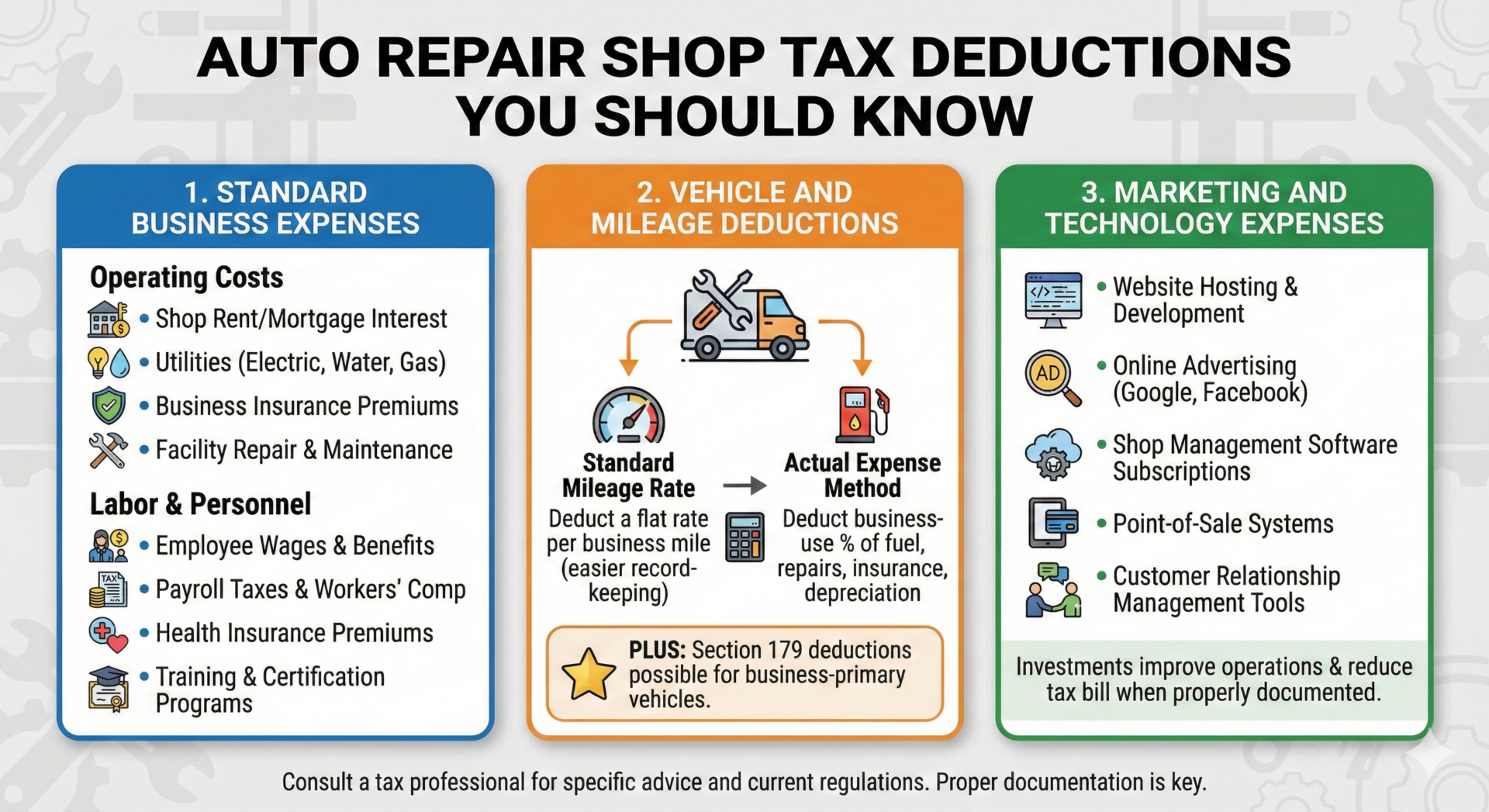
Other Auto Repair Shop Tax Deductions You Should Know
Standard Business Expenses
Beyond the big-ticket building and equipment deductions, auto repair shop owners can deduct numerous ordinary and necessary business expenses:
Operating costs:
- Shop rent or mortgage interest
- Utilities including electricity, water, and gas
- Business insurance premiums (liability, garage keepers, property)
- Repair and maintenance of the facility itself
Labor and personnel:
- Employee wages and benefits
- Payroll taxes and workers’ compensation
- Health insurance premiums
- Training and certification programs
Vehicle and Mileage Deductions
If you use a vehicle for business purposes—picking up parts, mobile repairs, or shop errands—you have two deduction methods:
- Standard mileage rate: Deduct a flat rate per business mile (easier record-keeping)
- Actual expense method: Deduct the business-use percentage of fuel, repairs, insurance, and depreciation
For vehicles used primarily for business, you may also qualify for Section 179 deductions on the vehicle purchase.
Marketing and Technology Expenses
Self-employed shop owners often overlook deductible marketing costs:
- Website hosting and development
- Online advertising (Google Ads, Facebook)
- Shop management software subscriptions
- Point-of-sale systems
- Customer relationship management tools
These technology investments not only improve your operation but also reduce your tax bill when properly documented.
Planning Your Tax Strategy for Tax Season
Working with Tax Professionals
The complexity of manufacturing classification and QPP eligibility makes working with a tax expert essential. A qualified tax professional can help you:
- Determine if your facility qualifies as Qualified Production Property
- Order a cost segregation study to maximize depreciation
- Navigate the Section 179 deduction limits and phase-outs
- Calculate your optimal mix of immediate expensing and depreciation
- Ensure compliance with IRS tax code requirements
Documentation Requirements for Business Tax Returns
The IRS requires documentation for all deductions claimed on your tax return. For auto repair shops, this means maintaining:
- Receipts for all equipment and tool purchases
- Detailed records of facility improvements
- Mileage logs if claiming vehicle expenses
- Invoices for supplies and materials
- Insurance premium statements
- Proof of business purpose for claimed expenses
Using a shop management system can streamline this record-keeping and ensure you’re capturing all deductible business expenses throughout the tax year.
Timing Considerations for Tax Planning
Tax planning isn’t just a tax time activity. Strategic decisions about when to place equipment in service can optimize your deductions. Under Section 179 rules, property must be placed in service during the tax year to qualify for that year’s deduction.
If you’re considering a major equipment purchase or facility acquisition, running the numbers with your tax preparer beforehand can help you understand the immediate tax benefit and plan accordingly.
The Self-Employed Mechanic’s Tax Position
Schedule C Filing for Auto Repair Business
Self-employed mechanics and shop owners typically file business taxes using Schedule C of Form 1040. This form reports your business income and allows you to deduct ordinary and necessary business expenses that directly relate to your auto repair business.
As a self-employed individual, you’ll pay self-employment tax at 15.3% on your net business income, covering Social Security and Medicare contributions. However, you can deduct the employer portion of this self-employment tax, which reduces your adjusted gross income.
Maximizing Your Tax Return as a Shop Owner
The combination of depreciation, Section 179 deductions, and standard business expenses can significantly lower your taxable income. For many auto repair shop owners, strategic use of these deductions means keeping more cash in the business for growth and operations rather than sending it to the IRS.
Here’s an example: If your auto repair shop earns $400,000 in annual revenue with $200,000 in operating expenses, your net income before depreciation is $200,000. If you purchase $150,000 in equipment and qualify for $100,000 in building depreciation under QPP rules, your taxable income drops to $50,000—a massive difference in your tax bill.
Common Mistakes That Reduce Your Tax Savings
Overlooked Tax Deductions in the Repair Industry
Through my work with collision repair operators, I’ve noticed several commonly overlooked tax opportunities:
Tools and equipment maintenance: The cost of maintaining and repairing your existing equipment is fully deductible as a current expense, not a capital improvement.
Safety supplies and PPE: Masks, gloves, safety glasses, and protective equipment are deductible business expenses.
Professional development: Certifications, training programs, and industry conference attendance qualify as deductible education expenses.
Home office deduction: If you handle administrative work from home—managing schedules, ordering parts, or handling accounting—you may qualify for home office deductions even if you have a separate shop location.
Misclassifying Your Property Type
The biggest mistake I see is automatically accepting a “retail” or “service” classification for an auto body facility without exploring whether manufacturing treatment applies. This single misclassification can cost you hundreds of thousands in lost first-year deductions.
If you own or are considering purchasing an auto body facility, ask your tax advisor specifically about QPP qualification. Don’t assume they’ve already considered this—the OBBB Act provisions are relatively new, and many tax preparers aren’t proactively analyzing manufacturing classifications for collision repair properties.
Understanding the One Big Beautiful Bill Impact
How OBBB Changed Commercial Real Estate Taxation
The One Big Beautiful Bill Act restored 100% bonus depreciation permanently for qualified property, reversing the phase-down that had been occurring under previous tax law. This creates a powerful incentive for U.S.-based manufacturing operations, including those in the auto repair industry that qualify under the production property definitions.
For property placed in service after January 19, 2025, eligible QPP can receive full first-year expensing. This means auto body shop owners making facility purchases or improvements in 2026 can immediately benefit from these provisions.
Long-Term Tax Planning Implications
While the immediate tax savings from 100% first-year depreciation are attractive, there are long-term considerations. When you take accelerated depreciation upfront, you’re reducing your basis in the property, which could increase capital gains when you eventually sell.
This doesn’t make the deduction bad—it’s simply a timing difference. You’re getting the tax benefit now when it helps your cash flow, rather than spread over decades. For most business owners, this is far more valuable than gradual deductions over 39 years.
Making the Manufacturing Classification Work for You
Steps to Qualify Your Auto Body Shop
If you’re an auto body shop owner or considering purchasing a facility, here’s how to pursue manufacturing classification:
- Document your production activities: Create a detailed description of your fabrication, welding, and refinishing processes
- Calculate production space percentage: Measure how much of your facility is dedicated to manufacturing versus office/retail
- Consult with a tax expert: Work with a professional experienced in QPP qualification and cost segregation
- Consider property improvements: Investments in spray booths, frame equipment, and production areas strengthen your manufacturing classification
- File the appropriate elections: Your tax preparer must make irrevocable elections to claim 100% bonus depreciation on QPP
When Manufacturing Classification Makes Sense

Not every auto repair operation will benefit from pursuing QPP status. The analysis makes most sense when:
- You’re purchasing or constructing a facility (not leasing)
- A substantial portion of your space is dedicated to production activities
- You have significant taxable income to offset with depreciation
- You’re committed to long-term ownership rather than a quick flip
For shops that primarily perform quick services like oil changes or tire rotations without significant fabrication work, traditional depreciation methods may be more appropriate.
FAQs
How does the manufacturing classification affect my auto body shop tax deduction?
When your auto body shop qualifies as a manufacturing facility under the OBBB Act, the production portions of your building may be eligible for 100% first-year depreciation as Qualified Production Property, rather than spreading deductions over 39 years. This classification is based on fabrication activities like cutting, welding, and refinishing that constitute substantial transformation of materials.
Can I deduct both Section 179 and bonus depreciation in the same tax year?
Yes, you can use Section 179 deductions first (up to $2,560,000 in 2026) and then apply 100% bonus depreciation to remaining eligible equipment and qualified production property. This layered approach maximizes your first-year deductions, though Section 179 has taxable income limitations that don’t apply to bonus depreciation.
What auto repair shop expenses are often overlooked during tax season?
Self-employed mechanics and shop owners frequently miss deductions for safety supplies and PPE, tool maintenance costs, shop management software subscriptions, marketing expenses like website hosting, and home office deductions for administrative work done at home. Insurance premiums for general liability and garage keepers policies are also fully deductible but sometimes forgotten.
Do I need a cost segregation study to claim manufacturing depreciation?
While not legally required, a cost segregation study is highly recommended for auto body facilities pursuing QPP classification. The study identifies which portions of your building qualify as production property versus non-qualifying spaces like offices and retail areas, ensuring you maximize eligible depreciation while maintaining IRS compliance.
How do I know if my collision repair shop qualifies as manufacturing?
Your facility likely qualifies if a substantial portion of operations involve physical transformation of materials through cutting, welding, fabrication, and refinishing activities. Shops with spray booths, welding equipment, and frame straightening capabilities typically meet the manufacturing definition, while quick-service shops focused on simple part replacement may not. Consult with a tax professional familiar with QPP requirements to evaluate your specific situation.
Conclusion
The intersection of commercial real estate and tax law creates opportunities that most auto body shop owners never fully explore. Understanding that your collision repair facility might qualify as manufacturing property under the OBBB Act could unlock immediate tax benefits that transform your financial picture.
If you’re tired of writing rent checks and ready to explore ownership—or if you already own your building but haven’t optimized your tax position—let’s have a conversation. At Tolj Commercial, I specialize in helping auto body shop owners navigate these exact opportunities. Whether you’re looking for owner-user opportunities like the 7028 Canby Ave property or need guidance on optimizing an existing facility, schedule a consultation with Tolj Commercial. Let’s make sure you’re capturing every deduction you’ve earned and building equity in a property that works as hard as you do.