If you’re thinking about securing a craft brewery lease in Eagle Rock, you’re stepping into one of the most storied beer corridors in all of Southern California. This neighborhood — and the northeast LA pocket that surrounds it — helped put L.A. on the craft beer map. But passion for great beer and knowing how to navigate a commercial lease are two very different things. The lease you sign will shape every operational and financial decision your brewery makes for years to come, so it pays to get it right from day one. Here’s what you need to know before you sign.
Key Takeaways
- Eagle Rock and the surrounding northeast LA neighborhoods have a rich craft beer history, but leasing a brewery space here requires understanding specific zoning, permitted use clauses, and ABC licensing requirements before signing anything.
- Build-out costs, tenant improvement allowances, and CAM fees can significantly impact your startup budget — knowing what to negotiate upfront is the difference between a thriving taproom and a costly mistake.
- Working with a commercial real estate broker who specializes in brewery and small business leases in the LA market gives you a genuine edge in securing the right space on the right terms.
Table of Contents
- Why Eagle Rock Is a Craft Beer Destination
- The Craft Beer Scene in Northeast LA Today
- What a Craft Brewery Needs to Know Before Leasing in Eagle Rock
- Common Mistakes Craft Breweries Make When Leasing
- FAQs
- Conclusion
Why Eagle Rock Is a Craft Beer Destination

Eagle Rock sits in the heart of northeast Los Angeles, right around the corner from Glassell Park, Highland Park, Atwater Village, and Silver Lake — a cluster of neighborhoods that collectively became one of the hottest craft beer scenes in California during the early 2010s.
The name most associated with this area’s brewing legacy is Eagle Rock Brewery, the microbrewery founded in 2009 by husband-and-wife team Jeremy Raub and Ting Su, along with Jeremy’s father Steven Raub, in Glassell Park. They famously touted it as the first brewery with full operations based in Los Angeles in over 60 years — a claim that resonated deeply with beer fans who had long felt L.A. was underserved by the craft beer movement. The early days of ERB drew lines out the door, helped shape the city’s beverage culture, and ignited an entire wave of artisanal brewing across LA County. For many, it became an iconic symbol of what a passionate, community-first little brewery could accomplish.
Sadly, after nearly 15 years in business, Eagle Rock Brewery announced its closure, with its taproom serving its last pours by the end of June 2024. But that closure didn’t dim Eagle Rock’s appeal as a craft beer destination — if anything, it opened up new opportunities for the next generation of brewers looking to plant their flag in this iconic neighborhood and carry that beer culture forward.
The Craft Beer Scene in Northeast LA Today
The broader northeast LA corridor — stretching from Atwater and Glassell Park through Eagle Rock into Highland Park and Silver Lake — remains one of the most active pockets for craft beer culture in all of Southern California. Local breweries, bottle shops, and taprooms continue to attract a loyal base of beer fans who genuinely care about what’s in their glass.
What made this area special wasn’t just the beer itself, but the community built around it. Eagle Rock Brewery Public House helped establish a culture where a taproom or pub was more than just a place to drink — it was a gathering spot that shaped the neighborhood’s identity. The idea that a small, independently owned brewer could become a cornerstone of its community resonated throughout the early 2010s and inspired a broader movement of California craft beer startups across LA and beyond.
That energy still exists in these streets today, and a new craft brewer entering this market can absolutely tap into it — provided the business foundation is solid. If you’re eyeing a space along Colorado Boulevard, Fletcher Drive, or anywhere in the Glendale-adjacent or San Fernando-facing corridors of northeast LA, you’re looking at a market that genuinely values great beer and supports local. That’s a real asset. But it doesn’t replace the need to get your lease right.
What a Craft Brewery Needs to Know Before Leasing in Eagle Rock
Zoning and Permitted Use in Los Angeles
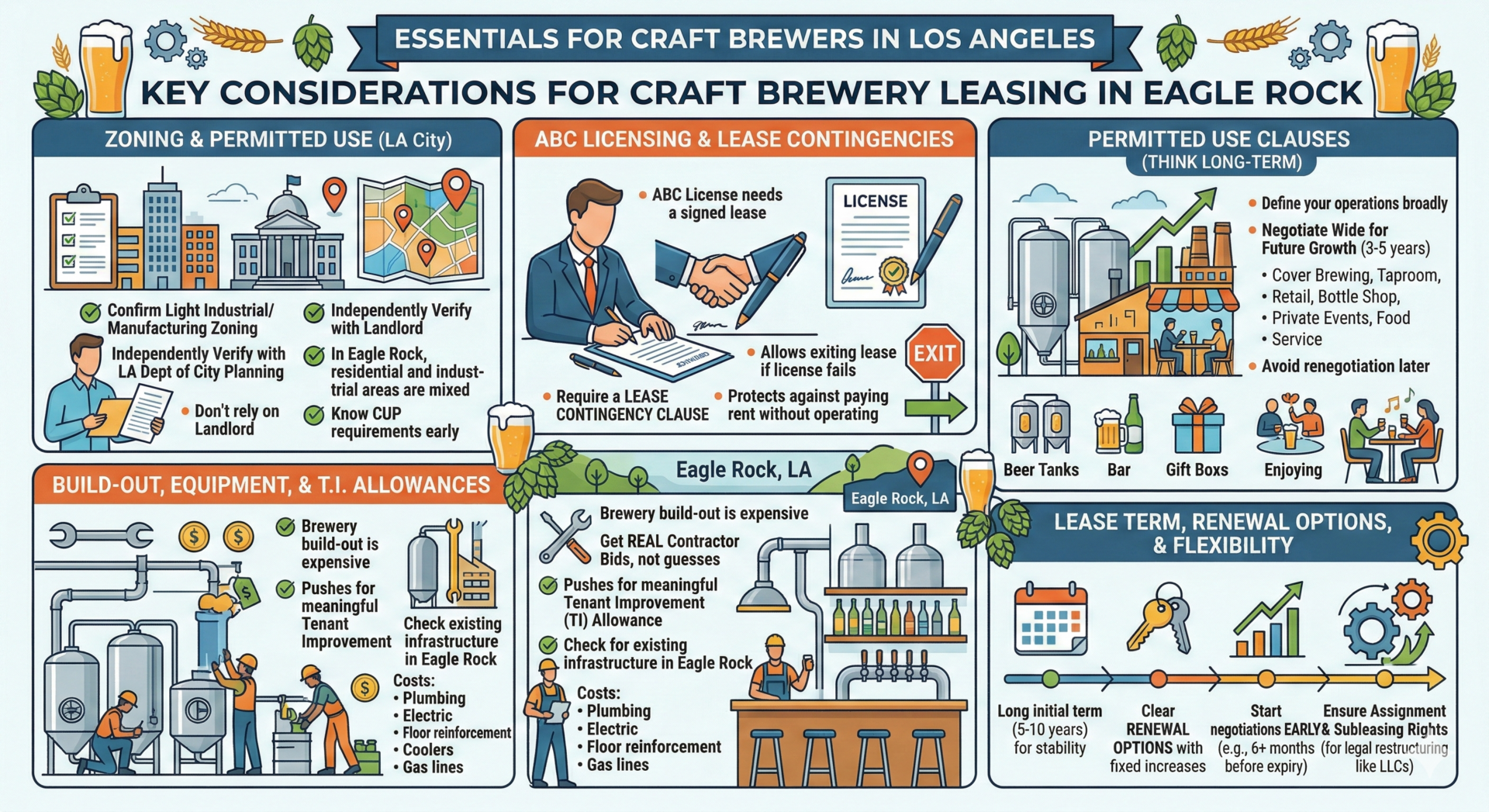
Before anything else, you need to confirm that your intended space is properly zoned for brewery operations. In the City of LA, brewing is generally classified as light industrial or manufacturing use, which means your space needs to be in a zone that explicitly permits that activity. Don’t rely solely on what a landlord or listing agent tells you — independently verify the zoning with the LA Department of City Planning and confirm that your full scope of operations (brewing, taproom, retail sales, possible food service) is permitted under that designation.

This matters especially in Eagle Rock and Glassell Park, where you’ll find a mix of industrial corridors sitting right next to residential blocks. The City of LA has specific requirements around conditional use permits (CUPs) for alcohol production and on-site consumption, and navigating that process takes time. Starting early — ideally before you’ve committed to a space — can save you from a costly surprise down the road. Factor in the permit timeline when building out your opening schedule, because the CA licensing process rarely moves as fast as you’d like.
ABC Licensing and Lease Contingencies
Getting your ABC (Alcoholic Beverage Control) license is non-negotiable, and it directly affects your lease. California’s ABC often requires a copy of your signed lease as part of the licensing application — which puts you in a tricky spot if the lease doesn’t include a proper contingency clause.
Make sure your lease contains a contingency that allows you to exit the agreement without penalty if you fail to obtain the necessary ABC licenses and permits. Without that language, you could find yourself on the hook for rent in a space you legally cannot operate in. This is one of the most common — and costly — oversights for startup craft breweries and small business owners entering the CA market for the first time. It’s also one of the easiest issues to prevent when you have experienced legal and real estate backing before signing.
Permitted Use Clauses: Think Long-Term
A permitted use clause defines what you’re legally allowed to do in your leased space. For a craft brewery, this needs to be written broadly. Even if your plan on day one is simply to brew and sell beer, you’ll likely want to add a bottle shop, expand your taproom, host private events, bring in food service, or open a full tasting room down the line.
If those activities aren’t explicitly covered in your lease’s permitted use language — or written broadly enough to encompass future growth — you’ll need to go back to the landlord and renegotiate, which gives away leverage at the worst possible time. Negotiate wide from the start. Think about where your brewery could realistically be in three to five years, not just where it is on launch day. A well-written permitted use clause costs you nothing upfront but protects everything you’re building long-term.
Build-Out, Equipment, and Tenant Improvement Allowances
Brewery build-outs are expensive. Between plumbing for floor drainage, electrical upgrades for brewing equipment, floor reinforcement for heavy tanks, refrigeration systems, CO2 and gas lines, and the taproom or tasting room finish-out, costs can climb quickly and exceed early estimates if you’re not careful. Before you finalize any lease terms, get real contractor bids — not ballpark guesses — so you know exactly what you’re walking into.
Tenant improvement (TI) allowances are a negotiable component of most commercial leases, and landlords offering brewery spaces in LA know that a quality tenant who improves a space adds meaningful long-term value to the property. Push for a meaningful TI allowance, especially if the space requires significant infrastructure work. Also budget for common area maintenance (CAM) fees, utilities, and any equipment acquisition if you’re taking over a space from a prior brewer. Some spaces in the Eagle Rock and Glassell Park area come with existing production infrastructure — drainage, plumbing rough-ins, or a prior tasting room layout — which can reduce your build-out costs significantly if negotiated correctly.
Lease Term, Renewal Options, and Flexibility
For a craft brewery, stability matters more than almost any other factor. Build-out costs are high, brewing equipment is fixed in place, and your brand becomes deeply tied to a physical location. A short lease term might feel like lower risk on paper, but if you invest heavily in a space and your landlord doesn’t renew, you lose not just your investment — you may lose your business entirely.
Aim for a longer initial term — typically five to ten years — with renewal options clearly built into the agreement. Negotiate fixed-rate annual rent increases so you can forecast your operating costs with confidence. And start renewal discussions early, ideally six months or more before your lease expires, so you’re negotiating from a position of strength rather than desperation or fear of displacement.
One more consideration that craft brewers often overlook: make sure assignment and subleasing rights are clearly addressed in the lease. Many craft breweries launch as sole proprietorships or partnerships and later restructure as LLCs or corporations. If your lease doesn’t allow for assignment to a new legal entity, that restructuring could technically trigger a lease default — even when nothing else has changed. Get this language sorted at the first step, not after the fact.
Understanding the Market: Comparable Rents and Leverage
Industrial and flex spaces in Eagle Rock and the surrounding northeast LA neighborhoods — Atwater, Glassell Park, Highland Park — have seen consistent demand from food and beverage operators, creative tenants, and light manufacturing users. That competition means available spaces don’t sit long, and landlords know it. Knowing what comparable spaces are actually renting for gives you real negotiating leverage at the table.
If a landlord is quoting above-market rates, you need hard data to push back effectively. If you’re taking over a space that requires significant investment, that investment is a legitimate bargaining chip for rent concessions, a free-rent period during build-out, or a reduced base rent in the early years of your term. A commercial real estate broker who genuinely understands the LA craft brewery landscape — not just general commercial leasing — can be invaluable here. Not just for finding available spaces, but for structuring the deal so it actually works for your business, not just the landlord’s bottom line.
Common Mistakes Craft Breweries Make When Leasing
- Signing without ABC contingencies — If your license falls through, you need a clean legal exit from the lease. Always build this language in before signing.
- Underestimating build-out costs — Brewery infrastructure is complex and expensive. Get real contractor bids before you finalize lease terms, not after.
- Accepting a narrow permitted use clause — This limits your growth options and forces costly renegotiations at exactly the wrong moment.
- Skipping independent zoning verification — Don’t take a landlord’s word that your use is permitted. Verify it yourself directly with the City of LA.
- Negotiating too close to lease expiration — Waiting until the last minute hands your landlord all the leverage on renewal terms. Start early.
- Ignoring assignment and sublease rights — Business structures change. Make sure your lease allows for entity restructuring without triggering a default.
FAQs
What zoning do I need for a craft brewery in Eagle Rock?
Brewery production typically requires light industrial or manufacturing zoning. In the City of LA, you’ll also likely need to address conditional use permits for on-site alcohol consumption in a taproom or public house setting. Always verify zoning directly with the LA Department of City Planning before committing to any space — don’t rely on a landlord’s representation alone.
Do I need my ABC license before signing a lease?
California’s ABC often requires a copy of your signed lease as part of the licensing application, so the two processes overlap in a way that can feel like a catch-22. The practical solution is to include a lease contingency clause that lets you exit the agreement penalty-free if you don’t obtain the required licenses and permits within a specified timeframe. This protects you from being locked into a space you legally can’t operate in.
How long should a craft brewery lease be in Southern California?
Given the high cost of brewery build-outs in the LA market, a longer lease term — typically five to ten years with clearly defined renewal options — is generally in the tenant’s best interest. It protects your capital investment, gives you operational stability, and ensures your brand has time to take root in the neighborhood before you face another round of lease negotiations.
What should I negotiate beyond base rent?
Focus your negotiation on tenant improvement allowances, free-rent periods during the build-out phase, fixed-rate annual rent increases, renewal options with predetermined terms, broad permitted use language that covers brewing, taproom operations, bottle shop retail, and potential food service, and clear assignment rights in case your business structure changes down the road.
Is Eagle Rock still a good market for a new craft brewery?
Yes — the neighborhood and the northeast LA corridor have a deeply established craft beer culture and a loyal community of beer fans who actively support local businesses. The closure of Eagle Rock Brewery after nearly 15 years actually created an opening, both literally and figuratively, for new brewers to enter a market that still has strong, genuine demand for local, artisanal craft beer. The backing of a strong neighborhood identity is already there. The opportunity is real.
Conclusion
Craft brewery lease Eagle Rock isn’t just a real estate transaction — it’s the foundation your entire business is built on. Get it wrong and the costs compound fast, often in ways that are hard to recover from. Get it right and you’ve got a stable, well-structured platform to build something great in one of LA’s most exciting craft beer neighborhoods. I’ve spent over 18 years helping business owners and landlords navigate commercial real estate across Los Angeles, and I know what these deals look like from both sides of the table — what landlords are actually willing to give, and where tenants consistently leave value on the floor.
If you’re ready to explore craft brewery spaces in Eagle Rock or anywhere else in the LA market, let’s have a real conversation about it. No pressure, no fluff — just straightforward guidance from someone who’s done this for a long time. Schedule a consultation with Tolj Commercial today and let’s make sure your next move is the right one.