If you’re a small business owner eyeing a retail space in Eagle Rock, you already know this neighborhood isn’t what it used to be. Colorado Boulevard is buzzing, foot traffic is growing, and landlords know it. That’s exactly why walking into a lease negotiation without preparation can cost you thousands, sometimes over the entire lease term. I’ve seen it happen too many times. The good news? When you know what to demand, the lease can work for you, not just the landlord.
Key Takeaways
- Eagle Rock’s growing mixed-use corridor means retail tenants have real negotiating power, but only if they know what to ask for before signing.
- Small businesses should always negotiate base rent, tenant improvement allowances, renewal options, and triple net lease obligations before committing to any retail space.
- Working with an experienced commercial real estate broker gives tenants a significant advantage, from initial analysis through final transaction.
Why Eagle Rock Is a Retail Market Worth Fighting For

Eagle Rock has quietly become one of the more competitive retail corridors in Northeast Los Angeles. Positioned between Glendale, Pasadena, and Highland Park, the neighborhood attracts a steady mix of local shoppers, young professionals, and foot traffic from nearby strip centers and mixed-use developments.
Retail spaces along Colorado Boulevard and Eagle Rock Boulevard range significantly in price; available listings have shown asking rents anywhere from around $27 to over $60 per square foot annually depending on size, visibility, and building condition. That wide range matters because it tells you that not every property is priced the same, and there is room to negotiate. Understanding this is step one of any smart retail lease negotiation in Eagle Rock.
The neighborhood is also seeing continued redevelopment interest, with building permits and property values trending upward in recent years. For retail tenants, this is a double-edged sword. Desirable locations attract competition, but a strong market also signals that landlords want quality, long-term tenants. That gives you more leverage than you might think.
Understanding the Lease Structure Before You Negotiate
Before you sit down at the table, you need to understand what kind of commercial lease you’re being offered. Most retail leases in Eagle Rock fall into a few common structures, and each carries very different financial obligations.
A gross lease is simpler: you pay one flat rate, and the landlord covers most operating expenses. A triple net (NNN) lease, on the other hand, passes property taxes, insurance, and maintenance costs directly to the tenant in addition to base rent. For small businesses in particular, a triple net lease that isn’t carefully reviewed can mean unexpected expenses that quietly eat into margins month after month.
There’s also the percentage rent structure, where your rent is tied in part to a percentage of your gross sales. This can actually work in your favor during slow periods, but it needs to be negotiated carefully so the breakpoint, the sales threshold above which percentage rent kicks in, is set realistically for your business model. Understanding which structure the landlord is offering, and why, is foundational to everything else that follows.
What Small Businesses Should Demand in a Retail Lease
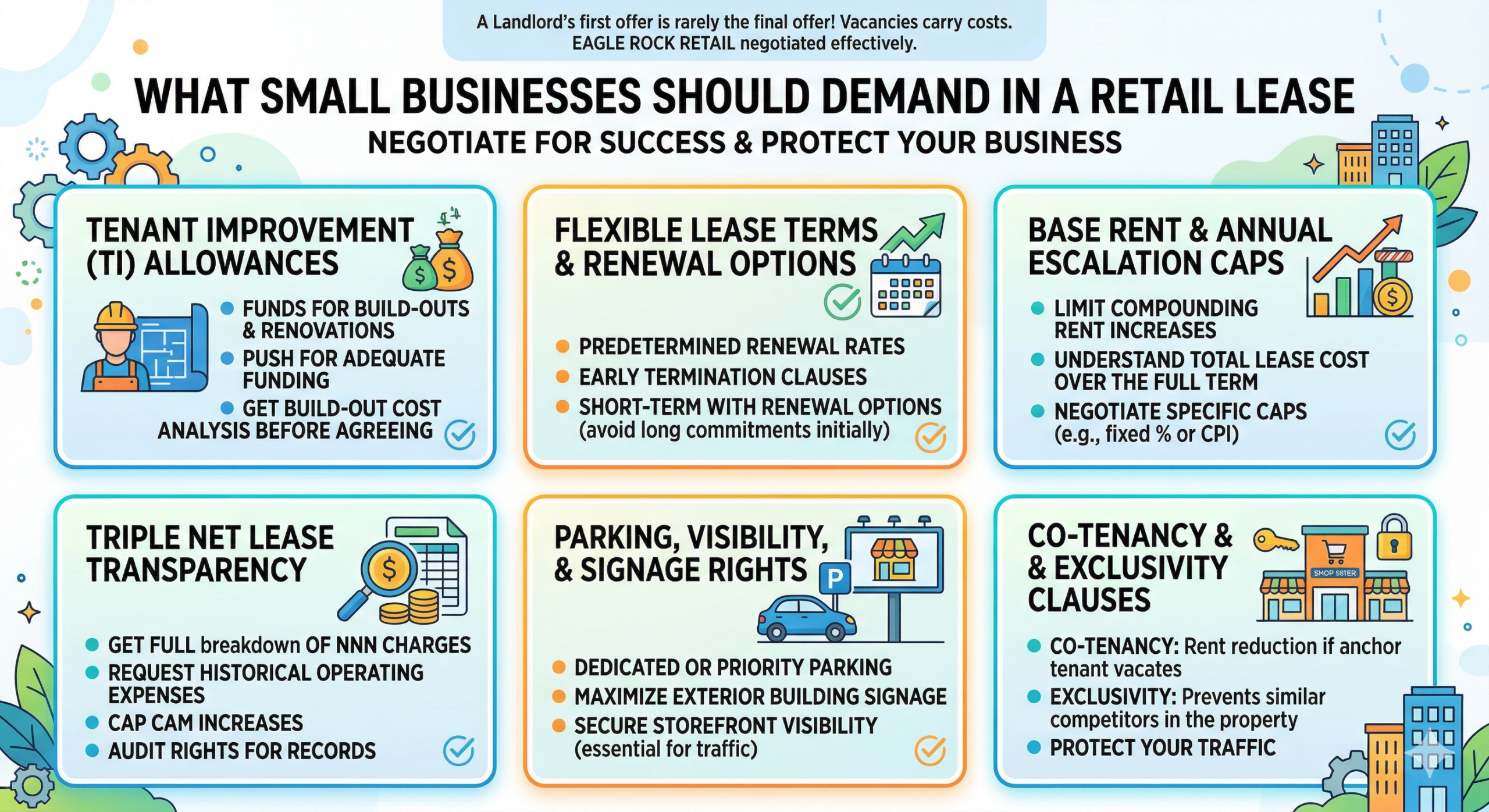
This is where most tenants leave money on the table. A landlord’s first offer is rarely the final offer, especially in a market where vacancy carries real costs for the property owner. Here’s what you should be pushing for in every retail lease negotiation in Eagle Rock.

Tenant Improvement Allowances
Tenant improvement (TI) allowances are funds the landlord provides to help you build out or renovate the space. The amount varies, but it is absolutely negotiable; and for small businesses, it can make or break whether a space is operationally ready within budget.
Whether you’re opening a restaurant that needs a full kitchen build-out or a boutique retailer that needs new flooring and lighting, always push for a TI allowance in writing before signing. Be specific about the scope of construction required and get an analysis of what the build-out will cost before agreeing to any landlord-provided figure. Don’t assume the landlord’s offering is adequate it rarely is for a first draft.
Flexible Lease Terms and Renewal Options
A new lease in Eagle Rock might feel exciting in year one, but what happens in year four when your business has outgrown the space, or, alternatively, when you need to exit? Negotiating a renewal option at a predetermined rate gives you the ability to stay without being subject to whatever the market looks like five years from now.
On the flip side, if you’re a newer business, consider negotiating an early termination clause with defined conditions. This isn’t about planning to fail; it’s about managing risk responsibly. Short-term leases with renewal options, rather than long-term commitments with no exit, give small business tenants the operational flexibility they need to scale.
Base Rent and Annual Escalation Caps
One of the most overlooked elements in retail lease negotiation is what happens to your rent over time. Many landlords build in annual escalations, sometimes pegged to CPI, sometimes a flat percentage, that compound significantly over a five- or ten-year lease term.
Always negotiate an escalation cap. A 3% annual increase may sound small, but over a ten-year lease, that’s a dramatically different rent in year ten than year one. Get a realistic picture of what your total lease obligation looks like over the full term, not just the first year. That analysis often changes the conversation significantly.
Triple Net Lease Transparency
If you’re signing a triple net lease, you have the right to see a full breakdown of what the NNN charges have actually been over recent years, not just what the landlord estimates. Ask for audited records or at least a historical range of operating expenses for the property.
You should also negotiate a cap on common area maintenance (CAM) charge increases, and insist on audit rights, the ability to review the landlord’s records if charges seem unreasonable. These protections are standard in sophisticated retail lease agreements, and a landlord unwilling to provide them is a red flag worth taking seriously.
Parking, Visibility, and Signage Rights
For most retail tenants, foot traffic and visibility are the lifeblood of the business. Ample parking is a significant amenity in Eagle Rock, where street parking is often competitive along major commercial corridors. Negotiate dedicated or priority parking access if possible, and get it written into the lease agreement, not just discussed verbally.
Signage rights matter just as much. Your ability to place exterior signage on the building, secure storefront visibility, and identify your business from the street can directly affect your sales. Confirm exactly what the landlord will permit, what costs are involved, and whether signage rights are transferable if you sublease or assign the space.
Co-Tenancy and Exclusivity Clauses
If you’re leasing in a strip center or a development with multiple tenants,co-tenancy clauses are worth fighting for. These provisions allow you to reduce rent, or in some cases exit the lease, if a key anchor tenant vacates and traffic drops as a result.
Similarly, an exclusivity clause prevents the landlord from leasing adjacent or nearby space in the same property to a direct competitor. For a restaurant, a retailer, or any business that depends on a specific customer base, this protection is not optional, it’s essential.
Why Professional Representation Changes Everything
Many small business owners go into retail lease negotiation thinking they can handle it themselves. And sometimes, for a short-term license or a simple month-to-month arrangement, that might be fine. But for any substantial retail lease, especially in a market like Eagle Rock where landlords are increasingly sophisticated, tenant representation isn’t a luxury. It’s a strategic advantage.
An experienced commercial real estate broker who specializes in retail leases brings three things to the table that most tenants simply don’t have on their own: market knowledge, negotiating experience, and relationships. They know what comparable tenants are paying, what concessions landlords in the area have recently offered, and where a landlord’s real bottom line likely sits. That intelligence is worth far more than the cost of representation, which, for tenant-side brokers, is typically paid by the landlord anyway.
It’s also worth having a commercial real estate attorney review the lease before you sign. Lease documents are long, often dense with landlord-friendly language, and the clauses that can hurt you most are often buried in sections most tenants skip. An attorney can identify risks in the existing lease language, propose modifications to related documents, and ensure that verbal agreements during negotiation are properly captured in writing.
Mistakes That Cost Eagle Rock Retailers the Most
Even well-intentioned tenants make costly errors in retail lease negotiation. Here are the ones I see most often:
- Focusing only on base rent. Monthly rent is important, but total occupancy cost, including NNN charges, insurance contributions, and maintenance fees, is what actually hits your bottom line.
- Skipping the build-out analysis. Tenants accept spaces “as-is” without fully evaluating construction costs, HVAC conditions, storage capacity, and code compliance requirements.
- Ignoring the personal guarantee. Many landlords require a personal guarantee on commercial leases, meaning your personal assets are on the line if the business fails. Negotiate the scope and duration of this obligation carefully.
- Not evaluating the renewal terms. A renewal option without a capped rate or defined terms isn’t really an option; it’s just a first right to re-negotiate at market rates under pressure.
- Moving too fast. Eagle Rock retail spaces can go quickly, and landlords know it. Don’t let urgency pressure you into signing a lease before you’ve done a proper evaluation.
FAQs
What is typically negotiable in a retail lease in Eagle Rock?
Almost everything, including base rent, lease term, tenant improvement allowances, CAM charges, annual escalation rates, signage rights, and renewal options. The key is knowing what to ask for before entering negotiations and having market data to support your position.
How do I know if I’m being quoted a fair rent for retail space in Eagle Rock?
Current retail space listings in Eagle Rock show a wide range of asking rents depending on location, square footage, and building quality. Working with a commercial real estate broker who actively tracks this market will give you a reliable benchmark for what comparable spaces are actually leasing for, not just what’s listed.
Should I hire a commercial real estate attorney to review my retail lease?
Yes. A commercial real estate attorney can identify hidden risks, problematic clauses, and landlord-friendly language that could significantly affect your business over the life of the lease. The cost of a legal review is almost always far less than the cost of a bad clause you didn’t catch before signing.
What is a triple net lease and should I avoid it?
A triple net (NNN) lease means you pay base rent plus your share of property taxes, insurance, and maintenance costs. It’s not necessarily bad, many Eagle Rock retail spaces are leased on NNN terms, but you need to understand the full cost before agreeing, negotiate caps on escalating charges, and always request historical expense records from the landlord.
When is the best time to start negotiating a lease renewal?
Ideally, 12 to 18 months before your existing lease expires. Starting early gives you time to evaluate alternatives, strengthens your negotiating position, and prevents the landlord from having leverage over you simply because you’re running out of time to find another space.
Conclusion
Eagle Rock Retail lease negotiation doesn’t have to feel overwhelming; it just takes preparation, the right team, and knowing what to ask for. Whether you’re signing your first retail lease or renegotiating an existing one, the terms you secure today will shape your business’s financial reality for years to come. Small details in a lease agreement, escalation caps, HVAC responsibilities, signage rights, renewal terms add up quickly, and they’re all negotiable when you go in ready.
If you’re a small business owner ready to secure a space that actually works for your operation, reach out to Tolj Commercial and let’s schedule a consultation. With over 18 years of commercial real estate experience representing business owners just like you, we’ll make sure you walk into that negotiation and out of it in the best possible position.