Empty retail spaces don’t have to stay empty. I’ve watched the Inland Empire transform over the past few years, and I can tell you that the smartest landlords aren’t waiting for traditional retailers to come knocking. They’re thinking differently about their square footage, and that shift is creating some exciting opportunities. Let me walk you through what’s working right now and how you can position your property for success in this evolving market.
Key Takeaways
- Development activity accelerated in Q3 2025 with 208,000 square feet of new retail space delivered, while vacancy rates reached 7.0% in the Inland Empire, creating opportunities for adaptive reuse strategies
- Fitness studios, bootcamps, and wellness centers are leading the charge in backfilling empty retail space, with flex retail spaces becoming increasingly popular across Riverside and San Bernardino counties
- Population growth continues to fuel retail demand, with the Inland Empire surpassing 4.7 million residents by 2025, making strategic space conversion essential for maximizing value in today’s market
Inland Empire Retail Market Landscape in 2025 and Beyond

The retail environment in Riverside and San Bernardino counties has changed dramatically. As of Q3 2025, the Inland Empire retail market closed with an availability rate of 7.0%, a slight increase from the previous quarter, partially driven by a surge in new supply delivered during the quarter. Net absorption totaled 16,000 square feet in Q3 2025, with the East End submarket leading the region with 311,000 square feet of positive net absorption, driven by big-box leasing activity.
What’s particularly interesting is that development activity nearly tripled between Q2 and Q3 2025, with 208,000 square feet of new retail space delivered compared to just 77,000 square feet the quarter before. Developers remained optimistic about long-term demand, supported by steady population growth and rising consumer spending.
The overall average net asking rent held steady at $1.72 per square foot in Q3 2025, reflecting balanced market conditions. By Q4 2025, vacancy reached 6.4%, while average asking rent fell to $1.69 per square foot per month. This data tells us that while there’s movement in the market, landlords need to be strategic about positioning their properties.
Shopping Center Transformation: From Big Box to Fitness Facilities
The conversion of big-box stores into fitness facilities has become a powerful trend across Southern California. Vacant retail locations are being transformed into rock climbing gyms, boutique fitness studios, and large-format health clubs. These conversions make economic sense because big-box retail locations feature wide-open layouts, tall ceilings, and existing utility infrastructure that support flexible gym zoning and cost-effective upgrades.
Adaptive reuse typically saves about 16% in project costs and 18% in construction time compared to ground-up construction. For landlords in the Inland Empire, this approach minimizes demolition waste and material consumption while providing a sustainable path forward for vacant properties.
| Conversion Factor | Big-Box to Fitness Advantage |
|---|---|
| Project Cost Savings | 16% less than new construction |
| Construction Time | 18% faster completion |
| Layout Features | Wide-open floors, high ceilings |
| Infrastructure | Existing utilities and HVAC systems |
| Environmental Impact | Reduced demolition waste |
Fitness studios and wellness centers are particularly well-suited for flex retail spaces because they need adaptable layouts that can be reconfigured based on tenant needs. These properties give tenants room to grow without the constraints of traditional retail leases, making them attractive to bootcamp operators, yoga studios, and specialized fitness concepts.
Population Growth Driving New Retail Demand
The Inland Empire’s demographic story remains strong. According to the California Department of Finance, Riverside and San Bernardino counties grew by 0.2% and 0.3% between 2024 and 2025, bringing the region’s population to more than 4.7 million. This population in-migration, combined with the region’s relative housing affordability, continues to fuel retail demand.
Inland Empire’s Fastest-Growing Cities (2024-2025):
Riverside County:
- Coachella
- Menifee (2.0% growth)
- Beaumont (2.0% growth)
San Bernardino County:
- Victorville
- Ontario (0.9% growth)
- Fontana
Cities across the Inland Empire experiencing the largest population growth include Coachella, Menifee, Beaumont in Riverside County, and Victorville, Ontario, and Fontana in San Bernardino County. People drawn to the region for its relatively affordable housing are expected to continue fueling retail demand in their local communities.
Retail construction responded to this growth, with 380,464 square feet added to the market in the first half of 2024—more than double the amount added during the same period in 2023. This demonstrates that developers and landlords recognize the fundamental strength of the Inland Empire market.
Brokerage Strategies for Backfilling Empty Retail Space
Working with a specialized brokerage that understands adaptive reuse is critical for successfully converting retail space. The process involves several key steps that forward-thinking landlords should consider.
First, conducting a zoning and use analysis helps identify allowed uses and determines if rezoning is needed. Evaluating market demand by assessing local demographics, unmet service needs, and traffic patterns ensures you’re targeting the right tenant types. Investing in flexible design by upgrading infrastructure and creating shell conditions suitable for multiple tenant types positions the asset for quicker re-leasing.
Promoting the property across modern channels using high-quality listings, digital marketing, and local networks helps reach new user types beyond traditional retailers. These steps position the asset for long-term relevance in a changing market.
Logistics Facilities and Mixed-Use Projects Reshaping Retail Centers
While the Inland Empire has been known for logistics facilities, the retail sector is carving out its own identity through mixed-use development. Mixed-use projects combining residential, retail, and commercial space are creating mini-communities that feel integrated and vibrant.
Old malls, warehouses, and even parking garages are now on the table for conversions, with many projects designed with energy efficiency and green building practices in mind. The Redlands Mall, which has been vacant for almost a decade, has tentative plans to convert into a mixed-use retail and multifamily center. Renaissance Downtowns USA and ICO Real Estate Group envision 2,000 to 3,500 residential units along with market-driven retail and office components in place of failing retail centers.
This trend toward mixed-use isn’t just about filling space—it’s about creating destinations that serve multiple needs and generate consistent foot traffic. For retail landlords, partnering with developers who understand this vision can unlock value that traditional retail tenants alone cannot provide.
Tenant Demand Patterns in San Bernardino and Riverside Counties
Understanding tenant demand in 2025 and beyond requires looking at which categories are actively leasing space. Entertainment tenants accounted for roughly one-third of big-box leasing demand in the East End submarket during Q3 2025. This signals that experiential concepts—from entertainment venues to fitness facilities—are becoming core drivers of absorption.
| Tenant Category | Examples | Market Activity |
|---|---|---|
| Entertainment | Theaters, gaming centers | 33% of Q3 2025 big-box leasing |
| Fitness & Wellness | Bootcamps, gyms, yoga studios | High demand in growing cities |
| Discount Retail | Aldi, Dollar General | Targeting modest-income residents |
| Experiential Retail | Climbing gyms, escape rooms | Driving absorption growth |
Discount chains such as Aldi and Dollar General continue to target the Inland Empire, with much of new retail geared toward residents with modest incomes. Strong tenant demand for quality retail space remains evident despite broader market challenges.
As of the third quarter of 2025, 800,000 square feet of retail inventory is under construction market-wide, with construction activity remaining fairly consistent since the beginning of 2024. This demonstrates that landlords and developers still see value in new retail space under construction, particularly in growing communities like Ontario, Menifee, and Beaumont.
Lease Terms and Rent Strategies for Converted Spaces
Progressive real estate strategies for converted retail spaces require flexibility in lease structures. Traditional grocery store layouts and sears department store footprints don’t always align with modern tenant needs, so landlords must be willing to subdivide or reposition space.
Rent growth in the Inland Empire has been measured, with asking rents holding relatively steady between $1.69 and $1.72 per square foot through 2025. For converted spaces targeting fitness tenants or specialty retail shops, lease terms often include shorter initial periods with options for expansion as the business grows.
Multi-tenant retail configurations can help landlords maximize occupancy by attracting diverse tenant mixes that complement each other. Shopping centers anchored by fitness studios, for example, often attract juice bars, physical therapy offices, and retail shops that serve health-conscious consumers.
Construction Costs and Development Economics
Construction costs remain a significant consideration for landlords evaluating conversion projects. While adaptive reuse saves approximately 16% in project costs compared to new construction, landlords must still budget for mechanical system upgrades, fire suppression systems appropriate for athletic use, and structural reinforcements to support bleachers or gym equipment.
Addressing fire code, zoning, and HVAC needs early helps minimize costly redesigns. Upgrading insulation and climate control systems is essential when converting retail shells into fitness facilities where temperature regulation affects user experience.
Newly constructed retail space in the Inland Empire continues to deliver, with developers completing roughly 700,000 square feet annually—below the 10-year historical average of 850,000 square feet but still indicating measured confidence in the market. This balance between new construction and adaptive reuse creates opportunities for landlords who can move quickly and think creatively.
New Retail Space Under Construction: What It Means for Landlords
The pipeline of new space under construction reached 1,355,942 square feet by Q4 2025, up 4.8% year-over-year. This new supply means competition for tenants will remain active, making it even more important for landlords with vacant big-box spaces to differentiate their offerings.
Properties that offer flexible floor plates, proximity to residential foot traffic, and ample parking have advantages when competing for fitness and wellness tenants. Starting with raw space gives landlords design flexibility to create unique environments that appeal to emerging concepts.
As the first half of 2024 saw 380,464 square feet of new retail added to the market—more than double the same period in 2023—landlords must recognize that tenant expectations have evolved. Modern tenants want spaces that can adapt to changing business models, support sustainability goals, and provide room for future growth.
Cap Rates and Investment Fundamentals
While specific cap rate data for fitness conversions in the Inland Empire wasn’t widely published in recent reports, the fundamental investment thesis remains sound. Population growth, household income trends, and consumer behavior shifts all support demand for experiential retail and wellness services.
Properties that successfully convert to multi-tenant retail or mixed-use configurations often command better valuations than single-tenant boxes reliant on one occupant. Diversifying your tenant base reduces risk and creates more stable cash flow, which investors value when evaluating acquisition opportunities.
The Inland Empire continues to attract attention from institutional buyers and private investors who recognize the region’s long-term growth story. Landlords who proactively reposition their assets demonstrate management expertise that translates to stronger exit strategies when it’s time to sell.
Navigating E-Commerce Impact and Vacancy Challenges
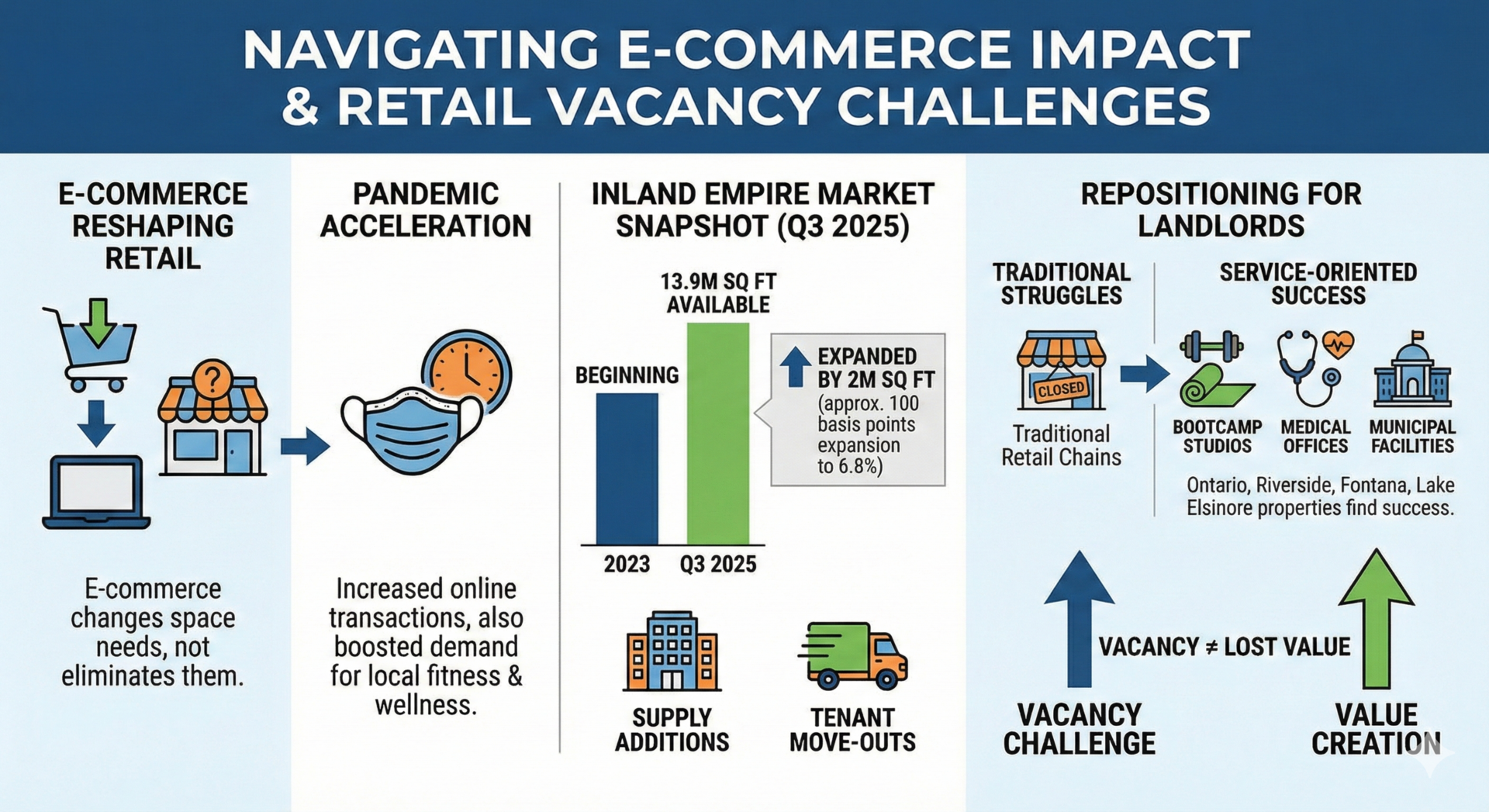
E-commerce has reshaped retail fundamentally, but it hasn’t eliminated the need for physical space—it’s changed what tenants want from that space. The pandemic accelerated shifts in consumer behavior, pushing more transactions online while simultaneously increasing demand for local fitness options and wellness services.
Retail space availability in the Inland Empire has expanded by over 2 million square feet since the beginning of 2023, reaching 13.9 million square feet as of the third quarter of 2025. This roughly 100 basis points expansion in availability to 6.8% was driven by supply additions and occasional tenant move-outs.
For landlords, vacancy doesn’t have to mean lost value. Properties in Ontario, Riverside, Fontana, and Lake Elsinore that have repositioned toward service-oriented tenants are finding success where traditional retailers struggled. The key is understanding that today’s tenant landscape includes bootcamp studios, medical offices, and municipal facilities—not just traditional retail chains.
Maximizing Value Through Strategic Conversion
Maximizing value as a retail landlord in 2026 means being proactive rather than reactive. Waiting for the perfect traditional retail tenant may cost you months or years of lost income. Instead, consider how your property could serve the growing fitness and wellness sector, which continues to expand across Southern California.
Progressive real estate partners can help you evaluate conversion options, navigate entitlement processes, and identify tenant prospects that align with your investment goals. Working with brokers who specialize in adaptive reuse and understand the Inland Empire market ensures you’re not leaving money on the table.
Remember that conversion projects often qualify for streamlined approval processes under adaptive reuse ordinances, reducing time in permitting and accelerating your path to occupancy. The faster you can bring a property to market with updated infrastructure and flexible layouts, the sooner you start generating returns.
The Ontario and Beaumont Opportunity Zones
Ontario and Beaumont represent particularly compelling markets for retail space conversion. Ontario’s population grew by 0.9% while Beaumont saw 2.0% growth, making them among the fastest-growing cities in the Inland Empire. This population influx creates demand for local services, including fitness facilities that serve residents who prefer to stay close to home.
| Factor | Ontario | Beaumont |
|---|---|---|
| Population Growth | 0.9% (2024-2025) | 2.0% (2024-2025) |
| Key Advantages | Highway access, institutional investors | Master-planned communities, family demographics |
| Target Tenants | Multi-concept fitness, entertainment | Boutique studios, family wellness |
| Market Positioning | Urban retail conversion | Suburban growth corridor |
Both cities offer strong fundamentals: good highway access, growing household income, and master-planned communities that attract young families. Landlords with properties in these markets should actively explore conversion opportunities targeting health and wellness tenants who want to capture this demographic.
The demand for quality retail space remains strong in growth corridors like Ontario and Beaumont, but “quality” now means something different than it did a decade ago. Tenants want efficient spaces with good visibility, easy parking, and room to create branded experiences—all attributes that make former big-box locations ideal candidates for conversion.
Looking Ahead: 2025 and Beyond

The Inland Empire retail market in 2025 and beyond will continue evolving as population growth, changing consumer preferences, and adaptive landlord strategies reshape the landscape. We’re likely to see more mixed-use projects, continued growth in fitness and wellness tenants, and ongoing pressure on traditional retail formats.
For landlords, the opportunity is clear: properties that adapt will thrive, while those that wait for the market to return to “normal” may struggle. The new normal includes bootcamp studios where department stores once stood, climbing gyms in former supermarkets, and multi-tenant wellness centers replacing single anchor tenants.
Progressive real estate partners who understand these trends can help you position your property for success in this evolving market. Whether you’re dealing with a vacant big-box store in San Bernardino County or a struggling shopping center in Riverside, there are strategies that can help you maximize value and secure stable, long-term tenants.
FAQs
What types of tenants are most interested in converted retail space in the Inland Empire?
Fitness studios, bootcamp facilities, entertainment venues, and medical offices are actively seeking converted retail space, valuing the open floor plans and high ceilings that former big-box stores provide.
How long does it typically take to convert a big-box retail space into a fitness facility?
Adaptive reuse projects typically save about 18% in construction time compared to ground-up builds, though timelines vary based on zoning approvals and the extent of needed improvements.
What are the main cost considerations for converting vacant retail space?
Budget for mechanical system upgrades, fire suppression systems, structural reinforcements if needed, and HVAC improvements, though adaptive reuse typically saves about 16% compared to new construction.
Which Inland Empire cities offer the best opportunities for retail space conversion?
Ontario, Beaumont, Menifee, Fontana, and Victorville are experiencing strong population growth that supports demand for local fitness and wellness services.
How do I find tenants for converted retail space?
Work with a specialized commercial real estate brokerage that understands adaptive reuse and has connections to fitness franchises, wellness brands, and entertainment concepts actively seeking Inland Empire space.
Conclusion
The Inland Empire retail space conversion opportunity is real, and it’s happening right now. I’ve seen firsthand how landlords who think creatively about their assets are finding success in this market. Whether you’re considering converting a vacant big-box into a fitness facility or exploring mixed-use options for a struggling shopping center, the key is taking action rather than waiting for perfect conditions that may never arrive.
If you’re ready to explore what’s possible with your retail property in Riverside or San Bernardino counties, I’d be glad to sit down and talk through your specific situation. At Tolj Commercial, we specialize in helping property owners navigate these transitions and find tenants who create long-term value. Let’s schedule a consultation and figure out the best path forward for your property. Reach out today—I’m here to help you maximize what you’ve built.