If you’re considering selling your office property in 2026, I need to be straight with you about what’s happening in the Los Angeles market. The numbers aren’t pretty, but understanding them is the first step toward making an informed decision about your commercial property investment.
Key Takeaways
- Office valuations in Los Angeles have dropped 27.3% compared to previous periods, creating a challenging environment for sellers who need to adjust pricing expectations and strategies
- The commercial real estate market is showing signs of stabilization entering 2026, with transaction volume projected to grow 12% to $530 billion and declining interest rates improving investor confidence
- Alternative strategies like adaptive reuse conversions and targeting distressed asset buyers present new exit opportunities for office property owners navigating the current market conditions
Understanding Today’s Market Reality

The LA office sector has experienced a significant valuation correction, with office properties declining 27.3% according to recent transaction analysis. This isn’t just a temporary blip—it reflects fundamental shifts in how tenants use space, where they want to be located, and what they’re willing to pay for it.
The Office Market’s New Normal
Current Market Conditions
Los Angeles County’s office availability rate stood at 27.6% in the final quarter of 2025, though it decreased by 60 basis points year-over-year. Leasing activity reached 14.3 million square feet in 2025, representing a post-pandemic high but still well below the 17.9 million square feet recorded in 2019. Average asking rents hit $4.03 per square foot per month in Q4 2025, up 2% year-over-year, with Class A properties in trophy markets like Century City commanding $4.30 per square foot.
The market shows selective recovery patterns. Tenants in 2026 operate with completely different priorities than even a year ago—certainty has replaced “flight to quality” as the dominant decision factor. Hybrid work models have finally stabilized, meaning companies now know exactly how much space they need rather than continuing to guess or wait.
Supply and Demand Dynamics
Limited new construction is working in favor of market stabilization. Only 2.3 million square feet of new office space is delivering in 2026, which should create spillover demand that lifts high-quality Class A assets. Net absorption remained negative in 2025 at -252,000 square feet in Q4, but this represents an improvement from -295,000 square feet in Q4 2024.
Sublease inventory remains approximately double pre-pandemic levels at 8.4 million square feet, down from 10.6 million square feet in the final quarter of 2024. This excess supply continues to pressure valuations, particularly for Class B and C properties competing with deeply discounted sublease space.
What the Valuation Drop Means for Your Property
Class-Based Performance Differences
Not all office properties are experiencing the same valuation pressure. Class A buildings in premium submarkets are approaching full occupancy, while lower-tier Class C properties have seen dramatic declines—some reporting drops of 22% from 2024 levels. Cap rates reflect this divergence, with Class A office properties at 8.4%, Class B at 8.68%, and Class C reaching 9.02%.
The gap between trophy assets and commodity office space has widened considerably. If your property features modern amenities, efficient floorplates, and locations aligned with employee-driven workplace strategies, you’re positioned better than buildings lacking these attributes.
Office Property Performance by Class
| Property Class | Cap Rate | Occupancy Trend | Valuation Change from 2024 | Buyer Interest |
|---|---|---|---|---|
| Class A | 8.4% | Approaching full | Modest decline | Strong (trophy assets) |
| Class B | 8.68% | Moderate vacancy | -10% to -15% | Selective |
| Class C | 9.02% | High vacancy | -22% or more | Limited (distressed buyers only) |
Interest Rates and Investor Confidence
The decline in interest rates going into 2026 is anticipated to significantly impact California’s commercial real estate landscape. As rates fall, lower borrowing costs can lead to compressed cap rates, potentially increasing property values. The Federal Reserve’s projected rate cuts to 5.9% by the close of 2026 represent a critical threshold expected to unlock significant pent-up demand and enable higher transaction volumes.
Alternative capital sources are stepping in aggressively where traditional banks remain cautious. Non-traditional lenders like private credit funds accounted for 24% of U.S. commercial real estate lending volume, significantly exceeding the 10-year average of 14%. This influx of capital is particularly focused on acquiring distressed assets at discounts, creating opportunities for sellers willing to engage with these buyers.
2026 Market Outlook Across Property Types
Multifamily Sector Strength
While office struggles, the multifamily sector presents a contrasting picture. Vacancy is projected to fall to 4.4% in Greater Los Angeles, with new state legislation accelerating entitlements for transit-oriented and affordable projects. Cap rates for Class A multifamily properties range from 4.90% to 5.17%, Class B from 4.95% to 5.24%, and Class C from 5.60% to 5.90%.
Supply constraints will likely persist, with new construction continuing to decline from 2024 levels. Extended rental tenure among potential homebuyers due to elevated mortgage rates supports continued demand. Projected rent growth exceeds 3% in many top-tier markets with strong employment fundamentals.
Commercial Property Type Snapshot
Strongest Performers:
- Multifamily: 4.4% vacancy, 3%+ rent growth, cap rates 4.90%-5.90%
- Industrial: Positive absorption returning, $384.55/sq ft average price, 5.3% cap rate
- Retail: Strong occupancy, experiential concepts driving demand, second-generation space preferred
Weakest Performer:
- Office: 27.6% availability, 59.3% drop in sales volume, significant valuation pressure except Class A trophy assets
Industrial Sector Resilience
The industrial sector experienced its own correction, with Los Angeles industrial vacancy hitting 4.9% in mid-2025—the highest in a decade—but this is expected to be temporary. Net absorption reached positive territory at 171,000 square feet in Q4 2025 after two negative quarters. Average industrial sale prices hit $384.55 per square foot with a 5.3% cap rate.
Aerospace and defense expansion continues to strengthen LA’s industrial base, while logistics and advanced manufacturing lead demand. As new supply slows and existing space is absorbed, rent declines should moderate through 2026.
Retail Market Stability
Limited new construction and resilient consumer spending are supporting strong retail occupancy. Grocers, restaurants, and experiential concepts continue to drive traffic, while second-generation space remains the preferred expansion avenue for retailers and investors. Nearly 26 million square feet of ground-floor retail was leased in nontraditional properties during the first three quarters of 2025, including multifamily, student housing, and office spaces.
Strategic Considerations for Office Sellers
Pricing for Today’s Market
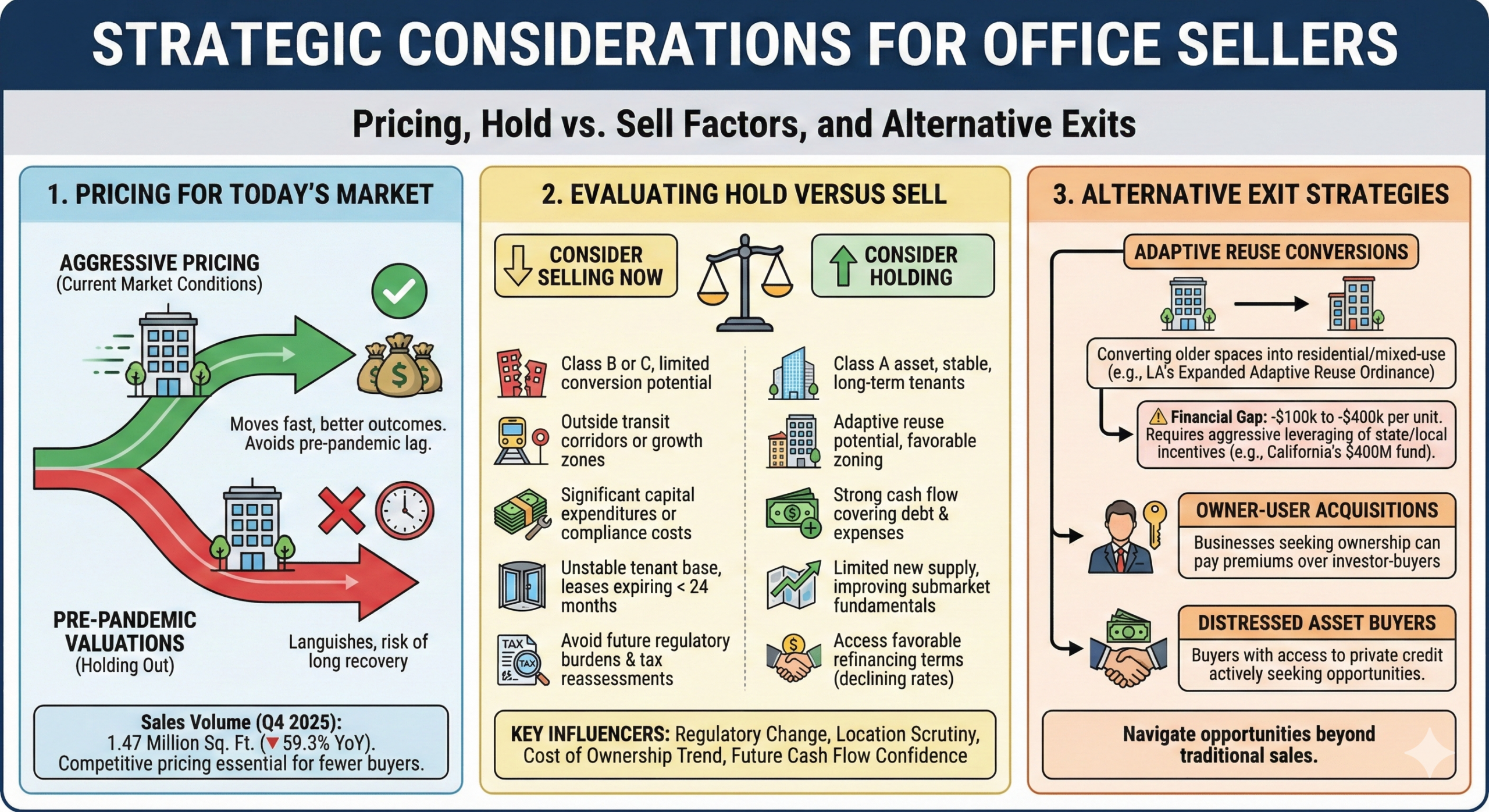
The most critical decision you’ll make is pricing strategy. Properties priced aggressively for current market conditions move, while those holding out for pre-pandemic valuations languish. I’ve seen this pattern repeatedly over 18 years—sellers who accept market reality earlier typically achieve better outcomes than those who wait hoping for a recovery that may take years.
Sales volume for office properties dropped 59.3% year-over-year in Q4 2025, totaling 1.47 million square feet. This contraction in transaction activity means fewer buyers are actively pursuing office assets, making competitive pricing essential to attract the capital that is flowing.
Evaluating Hold Versus Sell
Several factors should inform your decision to hold or sell in 2026. Commercial property ownership in California is entering a phase of meaningful regulatory change that creates additional burdens, shifting costs and risks that may alter the hold-versus-sell calculus.
Location and zoning scrutiny matters significantly. Properties located within half a mile of major transit or in zones likely to be rezoned under recent California legislation face elevated land-use risk, as commercial-only zoning advantages may fade with residential conversion pressures. Your current tenant and occupancy mix also plays a role—stable tenants with long-term leases in good condition present different dynamics than older buildings with functional obsolescence in declining submarkets.
The cost of ownership trend is another consideration. Regulatory burdens and upcoming compliance costs related to long-term maintenance, tenant protection rules, and compliance risk affect the attractiveness of holding. If you sell now, you may avoid future value erosion from macro trends, but you need confidence in future cash flow and exit value if you decide to hold.
Hold vs. Sell Decision Factors
Reasons to Consider Selling Now:
- Property is Class B or C with limited conversion potential
- Located outside transit corridors or growth zones
- Facing significant upcoming capital expenditures or compliance costs
- Tenant base is unstable or leases expiring within 24 months
- You want to avoid future regulatory burdens and property tax reassessments
Reasons to Consider Holding:
- Class A asset with stable, long-term tenants
- Building has adaptive reuse potential with favorable zoning
- Strong cash flow covering debt service and operating expenses
- Location benefits from limited new supply and improving submarket fundamentals
- You can access refinancing at favorable terms as rates decline
Alternative Exit Strategies
Adaptive reuse conversions represent a viable strategy for underutilized office assets. Converting older office or retail spaces into residential or mixed-use communities has become increasingly profitable under California’s evolving zoning programs. Los Angeles’ expanded Adaptive Reuse Ordinance now extends beyond Downtown, allowing office-to-housing conversions in many commercial corridors.
However, converting office properties often results in a negative financial gap of $100,000 to $400,000 per unit, as conversion costs far exceed the market value of resulting units due to structural issues and expensive retrofitting. California approved $400 million for commercial-to-residential conversions to help bridge this gap, making it essential to aggressively leverage state and local incentives.
Owner-user acquisitions continue to create opportunities, as businesses seeking to own rather than lease their space can sometimes pay premiums that investor-buyers won’t. Distressed asset buyers with access to private credit are also actively seeking opportunities.
Investment Sales and Transaction Volume
Commercial real estate transaction volume is projected to grow 12% to $530 billion in 2026, following a strong 16% finish in 2025. Retail and office properties will dominate deal flow, while distressed assets add volatility. Third-quarter 2025 sales volume rose over 40% year-over-year, with banks gradually returning to commercial real estate lending.
Institutional sales activity rose by 17% through October 2025, with pricing largely resetting and presenting the market with attractive opportunities for yield and income generation. Lending was reported up 35% year-over-year. This increasing capital flow suggests that properly priced assets aligned with current market fundamentals will find buyers in 2026.
Navigating Headwinds and Uncertainty
Several headwinds could impact market conditions in 2026 and beyond. Uncertainty around tariffs and supply chain issues may create considerable volatility in commercial real estate. Tariffs could significantly increase total project costs, and higher material costs could lengthen project timelines.
High interest rates earlier in the cycle created challenges that are only now beginning to ease as rates fall. While lower borrowing costs should restore investor confidence and result in more acquisition and investment activity, investors must maintain flexibility in financing strategies to adapt to changing market conditions and address potential gaps when refinancing.
Consumer spending patterns also warrant monitoring, as record credit card debt could trigger spending declines leading to mid-market retail closures and lease renegotiations. For office landlords, this economic pressure on tenants adds another layer of risk to holding strategies.
Key Trends Shaping Success in 2026
Data-driven real estate decisions are becoming increasingly important. Investors and property owners who move early to capitalize on tightening supply, sector-specific demand drivers, and improving capital markets will benefit most from the market’s next phase.
Market fundamentals show mixed signals across property types. While office faces continued challenges, the commercial real estate landscape overall is well positioned for success in 2026 with increased capital and strong fundamentals in multifamily and industrial properties. This divergence means office sellers need to be particularly strategic about timing and positioning.
The outlook for Southern California’s commercial real estate sector suggests selective opportunities. Greater Los Angeles is showing meaningful momentum across several sectors driven by tightening supply, improving demand, and renewed investor interest. Orange County and the Inland Empire also present distinct dynamics worth considering for regional investment strategies.
Preparing Your Property for Sale

Presentation matters more than ever in today’s competitive environment. With fewer buyers actively pursuing office assets, those that do engage expect properties to be well-maintained, properly documented, and ready for due diligence. Gathering updated financial statements, lease abstracts, and property condition assessments before going to market streamlines the transaction process and builds buyer confidence.
Understanding your property’s redevelopment potential versus hold value is essential. Does your building have upside through conversion to residential that the market hasn’t fully priced in? Or is your value primarily as an operating commercial asset facing headwinds from remote work reducing office demand? Being clear about your property’s highest and best use informs both pricing and marketing strategy.
FAQs
Why have LA office valuations dropped 27.3% in 2026?
The 27.3% decline in Los Angeles office valuations reflects fundamental shifts in tenant demand patterns, elevated vacancy rates at 27.6%, and excess sublease inventory approximately double pre-pandemic levels. Hybrid work models have permanently reduced space requirements, while tenants now prioritize certainty and functionality over premium locations, creating sustained downward pressure on pricing across most office segments.
What are the best strategies for selling office property in the current LA market?
The most effective strategies include pricing competitively for today’s market rather than holding out for pre-pandemic valuations, targeting alternative buyers like owner-users or distressed asset investors with private credit access, and exploring adaptive reuse conversion potential where applicable. Properties with modern amenities, efficient floorplates, and employee-friendly locations positioned as Class A assets command better pricing than commodity office space.
How are declining interest rates affecting commercial property values in 2026?
Declining interest rates projected to reach 5.9% by late 2026 are creating lower borrowing costs that should compress cap rates and potentially increase property values. This rate normalization is expected to unlock pent-up demand and increase transaction volumes, with institutional buyers becoming more active as financing costs decrease and investor confidence improves across sectors.
Should I convert my office building to residential use instead of selling?
Office-to-residential conversion can be viable but typically results in a negative financial gap of $100,000 to $400,000 per unit due to structural challenges and retrofitting costs. Success depends on leveraging California’s $400 million in approved conversion incentives, having buildings with smaller floorplates that allow natural light, and targeting locations within transit-oriented development zones where zoning changes favor residential use.
What property types are performing better than office in the 2026 LA market?
Multifamily properties are outperforming with vacancy projected to fall to 4.4%, cap rates ranging from 4.90% to 5.90% depending on class, and rent growth exceeding 3% in markets with strong employment fundamentals. Industrial assets are also showing resilience with positive net absorption returning, average sale prices of $384.55 per square foot, and 5.3% cap rates driven by aerospace, defense, and advanced manufacturing demand.
Conclusion
The 27.3% drop in LA office valuations represents a significant market correction that sellers cannot ignore. However, 2026 also brings opportunities for those willing to adapt their strategies to current conditions. With transaction volume growing, interest rates falling, and capital beginning to flow more freely, properly positioned properties can find buyers at realistic valuations.
My 18 years of experience navigating commercial real estate cycles has taught me that successful sellers are those who act decisively based on market fundamentals rather than hope. If you’re considering selling your office property in Greater Los Angeles, now is the time to develop a clear strategy that accounts for today’s realities while positioning you for the best possible outcome. Schedule a consultation with Tolj Commercial to discuss your property, review current market conditions, and determine the optimal path forward.
Sometimes the best decision is holding for better conditions; other times, it’s capturing available liquidity before headwinds intensify. Either way, you deserve an honest assessment from someone who understands this market deeply.