


Pasadena is genuinely one of the best cities in LA County to build a medical practice. You’ve got an affluent, established patient base, walkable streets, proximity to Huntington Hospital, and a business environment that supports professional services. But here’s what nobody tells you upfront: leasing medical office space in Pasadena is a completely different game than leasing general commercial space — and the traps are expensive.
I’ve been working in commercial real estate across the LA market for over 18 years, with deep experience guiding medical tenants — dentists, physicians, therapists, chiropractors — through Pasadena’s specific leasing landscape. In this guide, I’m going to walk you through the three biggest pitfalls: zoning, ADA compliance, and parking. Get these wrong, and you’re looking at wasted time, wasted money, and potentially your dream location slipping away.
Key Takeaways
- Pasadena’s zoning landscape is far from uniform — medical office use may require a Conditional Use Permit (CUP) in certain districts, and skipping that step can delay your move-in by months.
- ADA compliance in a commercial lease often defaults to the tenant, especially in NNN structures — and for medical offices serving patients, the standard is even higher than for general commercial space.
- Parking ratios for medical office use in the LA area can be significantly stricter than for general office, and converting a previously non-medical space without secured parking can kill a deal entirely.
Pasadena Zoning for Medical Offices

One of the most common assumptions I see from medical professionals entering the Pasadena market is that if a building looks like office space and is listed as office space for rent, it’s fair game for a medical practice. That’s not always true here — and it can cost you dearly.
Pasadena operates under a layered zoning system that includes both citywide zoning districts and multiple Specific Plans — the Central District Specific Plan, the East Colorado Specific Plan, the South Fair Oaks Specific Plan, and more. Each of these plans has its own land use tables that govern whether medical office use is permitted by right, requires a Minor Conditional Use Permit (MCUP), or requires a full Conditional Use Permit (CUP). As of early 2026, the city has been actively updating its Zoning Code, including amendments to how medical offices are treated in specific plan areas — which means the rules have been in flux and need to be confirmed on a property-by-property basis.
| Zoning / Specific Plan Area | Medical Office Permitted? | Notes |
|---|---|---|
| General Commercial (CG) | Typically by right | Most straightforward for medical tenants |
| Central District Specific Plan | Conditional (MCUP or CUP) | Covers downtown core; scrutiny is higher |
| East Colorado Specific Plan | Varies by sub-district | Includes Colorado Blvd corridor |
| Historic Overlay Districts | May require additional review | Exterior modifications need historic sign-off |
| Play District (near El Molino) | Additional scrutiny applies | Medical use faces extra permitting steps |
The CUP Timeline Problem
Here’s a scenario I’ve seen play out more than once: a dentist finds a beautiful suite on Colorado Blvd, goes through the trouble of negotiating a Letter of Intent, and then discovers during due diligence that the zone requires a CUP before medical use is permitted. A full Conditional Use Permit in Pasadena goes through the Zoning Administrator, requires a public hearing, and the review authority renders a decision within 10 days of the final hearing — but the application, staff analysis, and public noticing process before that hearing can stretch your timeline significantly. A Minor CUP can move faster if no objections are raised, but a standard CUP on a contested application can realistically take several months. That’s time when you’re potentially paying holding costs, delaying patient care, and watching your opening date drift.
My advice: before you fall in love with a space, verify the zoning. Check the specific plan that governs that parcel, confirm whether medical use is by-right or conditional, and if a CUP is required, factor both the timeline and cost into your business plan.
Historic Overlay Districts — The Hidden Layer
Pasadena is proud of its architectural heritage, and rightfully so. But for medical tenants, this pride adds a real compliance layer. Several properties in the city fall under historic overlay designations, and any modifications to a building’s exterior — including ADA-related accessibility upgrades like ramps, door widening, or signage — may require historic review before permits are issued. That’s not a reason to avoid a historically designated building, but it is a reason to plan for a longer and more complex permitting process when you’re budgeting your tenant improvement timeline.
ADA Compliance in Your Lease
This section is where I’ve watched tenants get genuinely blindsided, and the financial consequences can be severe. Let me be direct: ADA compliance in a commercial lease is almost never straightforward, and for medical offices serving patients — including patients with mobility impairments, visual impairments, or other disabilities — the obligations are higher than for general office use.
Under Title III of the Americans with Disabilities Act, any private entity that owns, leases, or operates a place of public accommodation must comply — and that includes both the landlord and the tenant. What complicates things is that in a typical NNN (triple net) lease, which is standard in Pasadena’s commercial office market, landlords frequently push ADA compliance responsibility onto the tenant through lease language. The lease may include a waiver of the landlord’s ADA obligations, effectively making you — the tenant — responsible for bringing the space up to code.
What That Looks Like in Practice
I’ve worked through situations where a medical tenant moved into a suite only to discover that the building’s entrance had steps with no compliant ramp — and when a patient filed an ADA complaint, the question became whether the tenant or the landlord was on the hook. Under California law, the Unruh Civil Rights Act and the California Disabled Persons Act both provide for statutory damages, which can reach $4,000 per violation. When you multiply that across multiple incidents or a lawsuit, you’re quickly in six-figure territory.
Before you sign any lease for medical office space in Pasadena or anywhere in California, you need to evaluate:
- Accessible entrance: Is there a compliant ramp or step-free path from parking to the door?
- Door width and hardware: ADA requires a minimum 32-inch clear opening width and lever-style or accessible hardware.
- Restroom compliance: Does the restroom meet ADA dimensions for turning radius, grab bars, and fixture height?
- Path of travel: The entire route from the accessible parking space to your suite must be compliant.
- Signage: Braille and tactile signage requirements apply to medical offices.
California also has the CASp (Certified Access Specialist) program — under existing legislation, landlords are increasingly required to disclose whether a property has been inspected by a CASp. If your prospective landlord can’t provide a CASp inspection report, that’s a flag worth raising during negotiations.
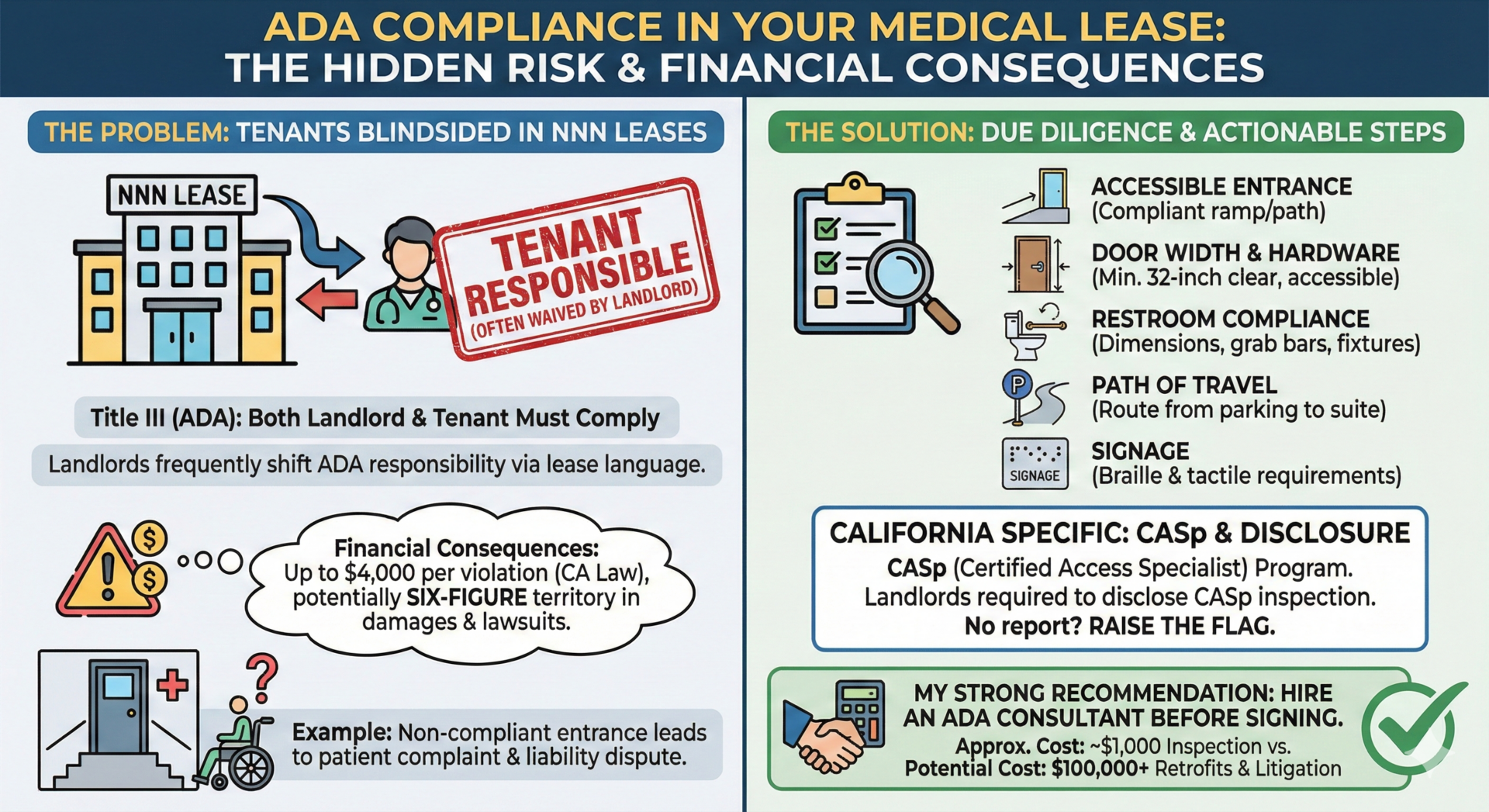
My strong recommendation: hire an ADA consultant before you sign. A professional access inspection typically runs around $1,000. That investment can identify issues that, if left unaddressed and built into a lease where you bear the compliance cost, could cost you $100,000 or more in retrofits, litigation, or both.
Parking Requirements for Medical Use
Of all the pitfalls I encounter when helping clients lease medical office space in Pasadena, parking surprises the most people — and it’s the one most likely to kill an otherwise perfect deal.
Here’s the core issue: medical office use carries a much higher parking demand than general office use, and cities reflect that in their parking codes. In the Los Angeles area, general commercial or business office typically requires around 1 space per 500 square feet of floor area, while medical office, clinic, or medical service facilities are required to provide 1 space per 200 square feet of total floor area. That’s a dramatic difference. A 2,500 square foot medical suite would require roughly 12 to 13 parking spaces under that standard — compared to just 5 spaces if it were a general office tenant.
Pasadena’s Zoning Code, being updated through 2025 and into 2026, has been working toward updated parking standards for commercial uses — but medical office use in specific plan areas may have different requirements, and any conversion from general office to medical use in an existing building could trigger additional review. When a building was previously occupied by a general office tenant and a medical practice wants to move in, the change of use can require the property to meet current medical parking standards — which the existing lot may simply not accommodate.
When Shared Parking Agreements Work — and When They Don’t
In downtown Pasadena, where surface lots are scarce and structured parking is common, shared parking agreements can be a workable solution. The city has public parking structures near key commercial corridors, and under certain conditions, shared parking arrangements with nearby lots can satisfy parking requirements. But “under certain conditions” is doing a lot of work in that sentence. Shared parking agreements need to be formally documented, approved through the city’s process, and — critically — secured in your lease language. A verbal assurance from a landlord that “there’s a lot around the corner” is not adequate protection. I’ve seen deals where a tenant relied on informal shared parking, only to find the neighboring lot’s owner unwilling to formalize the arrangement.
What you should get in writing before signing any medical office lease in Pasadena:
- Confirmed number of dedicated spaces included with the lease
- Any shared parking agreement, with the third-party lot owner as a party to the agreement
- Provisions for what happens if shared parking becomes unavailable
- Whether the landlord has confirmed with the city that the parking arrangement satisfies medical use requirements
Mike’s Pre-Signing Checklist for Medical Tenants
Before you commit to any medical office space in Pasadena, work through this checklist. It’s a synthesis of the most common deal-saving steps I run through with every medical tenant client:
- Confirm zoning permits medical use — verify by-right status or identify the CUP requirement and timeline for that specific parcel
- Check for historic overlay restrictions — if the building is historically designated, exterior modification approvals will take longer
- Get an ADA access inspection — retain a CASp-certified inspector before signing, and review the results against your lease language
- Negotiate ADA responsibility in the lease — don’t accept blanket waivers of landlord obligation; allocate known compliance costs explicitly
- Confirm parking ratio meets medical use standards — for the specific parcel and specific plan, not just a general rule of thumb
- Secure any shared parking arrangements in writing — with city confirmation that the arrangement satisfies code requirements
- Understand the TI (Tenant Improvement) allocation — who pays for required upgrades to meet building, ADA, and medical-specific code? This is negotiable, and a good broker will push for landlord contribution on pre-existing deficiencies
- Work with a broker who knows Pasadena specifically — general commercial real estate experience is not a substitute for block-by-block knowledge of the city’s zoning districts, historic overlays, and parking landscape

FAQs
Does Pasadena require a special permit for medical office use?
It depends on the zoning district — some areas allow medical office use by right, while others require a Minor CUP or full CUP. Always verify at the parcel level before signing anything.
Who is responsible for ADA compliance in a California commercial lease?
Both the landlord and tenant are legally responsible under Title III of the ADA, but NNN lease language often shifts compliance costs to the tenant — always review this before signing.
What are the parking requirements for a medical office in the LA area?
Medical offices in the LA area typically require significantly more parking per square foot than general office use — often 1 space per 200 SF versus 1 per 500 SF for standard office.
Can I convert a general office space to a medical office in Pasadena?
Yes, but a change of use usually triggers a review of parking, ADA compliance, and potentially zoning, which can add time and cost to your move-in timeline.
What’s the best way to find medical office space for lease in Pasadena?
Work with a broker who specializes in medical tenant representation and knows Pasadena’s specific plan areas — it saves time and helps you avoid the pitfalls covered in this guide.
Conclusion
Pasadena is a fantastic market for a medical practice — the patient base, the location, and the commercial environment are all genuinely compelling. But the leasing process here has real traps, and they don’t announce themselves. If you’re ready to start your search, let’s talk. Schedule a free consultation with Tolj Commercial and we’ll help you find the right space, avoid the costly surprises, and get your practice open faster.
📞 Reach out to Mike Tolj at ToljCommercial.com to book your free consultation today.


