Most people don’t connect a disruption near the Strait of Hormuz to the lease renewal sitting on their desk in Culver City. But that connection is very real — and it’s showing up in operating costs, investor behavior, and lease negotiations across LA right now. As someone who has spent over 18 years in commercial real estate, I can tell you the market never operates in isolation. What happens in the Middle East doesn’t stay there. It moves through energy markets, supply chains, and global capital flows — and eventually lands on your lease statement.
Key Takeaways:
- Oil price volatility tied to the conflict in the Middle East is driving up operating costs for LA commercial tenants — especially those on triple-net lease structures where energy expenses pass through directly.
- Gulf state investors from the UAE, Saudi Arabia, and Qatar are slowing their capital deployment, which is creating noticeable hesitation in LA’s office, hospitality, and retail investment activity.
- In 2026, the most prepared tenants and landlords are actively revisiting lease clauses — from CPI escalators and force majeure provisions to operating expense caps — to build in resilience against prolonged disruption.
It’s Closer Than You Think

You might assume geopolitical turmoil plays out thousands of miles away with no local consequences. In LA, that assumption is expensive. The situation in the Middle East in 2026 is not a background news event — it’s an active driver of macroeconomic pressure that’s influencing commercial real estate in ways both tenants and landlords are starting to feel on the ground.
The recent escalation involving U.S. and Israeli strikes on Iran has rattled financial markets globally. Representatives from high-profile sovereign wealth funds — including Qatar Investment Authority and Mubadala Investment Co. — pulled out of major international real estate conferences as recently as early March 2026, citing airspace disruptions tied to the conflict. When institutions at that scale pull back and exercise caution, the effects move outward through capital markets and eventually reach deal flow and investor sentiment in markets like Los Angeles.
We’re also seeing this in the credit environment. Mortgage rates jumped back above 6% as escalating conflict in the Middle East sent oil prices surging and reignited inflation concerns. That’s a direct constraint on deal-making, refinancing, and the investment calculus that drives commercial real estate activity here.
The Energy Cost Shock Is Real
Energy is at the center of this story, and it’s the most immediate transmission channel between geopolitical tensions and real estate operating costs. According to Allianz Economic Research, a prolonged conflict with significant disruption to shipping through the Strait of Hormuz — the waterway that global oil supply depends on — could push Brent crude toward $100 per barrel in 2026. That kind of oil price shock doesn’t stay contained to the energy sector.
California already has some of the highest commercial energy costs in the country. Southern California Edison and SDG&E have had approved rate increases going into 2026, with large industrial businesses facing proposed hikes from utilities, and similar increases approved for commercial customers. When volatile energy prices combine with regulatory rate increases, the inflationary pressure on operating budgets is compounded. Grocery prices, logistics costs, and consumer goods all reflect higher energy costs upstream — it’s visible in everyday spending across LA’s Westside and beyond.
For tenants on triple-net (NNN) leases, this lands immediately and personally. NNN structures require tenants to cover their proportionate share of property taxes, insurance, and operating expenses including utilities. There’s no buffer. When energy costs surge, the tenant absorbs it directly, and it hits working capital in real time. For industrial users, logistics operators, and manufacturers with high power consumption, higher energy prices on the monthly operating statement can and do affect space decisions — and the questions those tenants are asking before signing have shifted accordingly.
Supply Chain Disruption Is Reshaping Industrial Leasing
Los Angeles is one of the most trade-dependent metros in the country. The Ports of LA and Long Beach together handle a significant share of U.S. container imports, making this market uniquely exposed to disruption in global shipping routes. When the Middle East crisis introduces instability near key maritime corridors — through sanctions, conflict-related restrictions, or geopolitical risk that forces rerouting — the effects reach import/export businesses, logistics operators, and manufacturers who lease industrial space throughout the LA basin and Inland Empire.
Supply chain disruption is already producing a more cautious leasing environment. Businesses that depend on predictable shipment timelines and supply chain continuity are reassessing space commitments. Some are delaying expansion decisions because demand forecasting has become harder. Others are pushing for flexibility in lease structures they would have signed without negotiation two years ago. The trend is clear: tenants with regional supply chain exposure are moving more carefully, and landlords are feeling it in longer deal timelines.
The broader industrial market in Southern California reflects this shift. Los Angeles industrial vacancy reached 4.9% — the highest level in over a decade — as tenants right-size and slow down rather than commit to long-term expansions in uncertain conditions. That’s not purely a supply-side correction. It’s also a demand-side response to macroeconomic uncertainty that geopolitical tensions are amplifying.
For industrial landlords, the practical effect is more tenant leverage and slower lease-up timelines. For tenants with import/export or regional manufacturing exposure, the current environment actually provides negotiating room that wasn’t available during the tight market years — but only if you approach the process with the right due diligence and lease structure in mind.

Foreign Investment Is Reassessing
Los Angeles has long been a destination for capital from the Middle East. Investors from Saudi Arabia, Qatar, the UAE, and Bahrain have historically been active in LA’s hospitality, office, retail, and mixed-use sectors — drawn to the market’s liquidity, global profile, and long-term stability. That capital is now moving with much more caution.
Following the escalation between the United States and Israel against Iran, sovereign wealth funds and private investors connected to the Gulf states are pausing. The UAE’s property sector is facing its own reckoning — Iranian missile strikes on Dubai and Abu Dhabi disrupted the Gulf’s long-held reputation as a safe investment haven, forcing real estate investors to reassess where to deploy capital next. According to Reuters, Dubai’s property boom faces its first real test after these strikes shattered the safe-haven aura that attracted global offshore money for years.
This dynamic creates two possible outcomes for LA commercial real estate. In the near term, fewer active Gulf state investors means softer demand for premium office, hospitality, and retail assets — with potential downward pressure on valuations and deal volume in those sectors. Over a longer horizon, if the conflict in the Middle East creates prolonged instability in Gulf markets, some of that redirected capital may eventually seek stable, liquid U.S. destinations — and LA is well-positioned to capture a portion of it. How much of that upside materializes depends entirely on how prolonged the disruption turns out to be and how quickly those investors normalize activity.
Lease Terms Are Under the Microscope
This is where the rubber meets the road for most of our clients. The conversations happening in 2026 are fundamentally different from what we were navigating two years ago. Tenants aren’t just asking about base rent. They’re asking about escalation clauses, expense structures, flexibility provisions, and what their contractual position looks like if conditions shift dramatically mid-lease.
Here’s what’s under active review:
- CPI Escalation Clauses: Most commercial leases tie rent adjustments to the Consumer Price Index. When inflation expectations rise — as they are now, driven by higher energy costs and supply chain pressure — annual CPI-linked bumps can increase faster than tenants anticipate. Savvy tenants are negotiating caps on CPI escalations or pushing for fixed annual increases that provide predictability regardless of what the macro environment does.
- Operating Expense Structures: With energy and utility costs fluctuating, how operating expenses are itemized, allocated, and reconciled in your lease is now a much more consequential negotiation point. Tenants should be pushing for fully itemized, auditable operating expense disclosures — not aggregate figures that obscure where costs are actually coming from.
- Fair Market Value (FMV) Renewal Options: If your lease includes a renewal option priced at FMV, the current environment makes that option harder to underwrite with confidence. Market rents are uncertain, cap rates are under pressure from elevated interest rates, and valuation methodologies are shifting. FMV renewals coming up in the next 12–18 months should be approached early and with professional support.
- Force Majeure Provisions: This is the key legal clause most tenants skip until they actually need it. A prolonged disruption to global shipping, a significant shock to energy production, or a macroeconomic contraction triggered by geopolitical escalation could all qualify under a broadly written force majeure clause. Understanding your legal position — and your counterparties’ positions — before an event occurs is essential. The contractual language here is everything.
- Tenant Improvement Allowances: Construction costs in LA remain elevated, and supply chain disruption adds unpredictability to project timelines. TI packages being negotiated right now should account for the possibility that materials costs surge and timelines extend — especially for specialized industrial or manufacturing fit-outs with specific equipment or infrastructure requirements.
What the Smartest Parties Are Doing Right Now
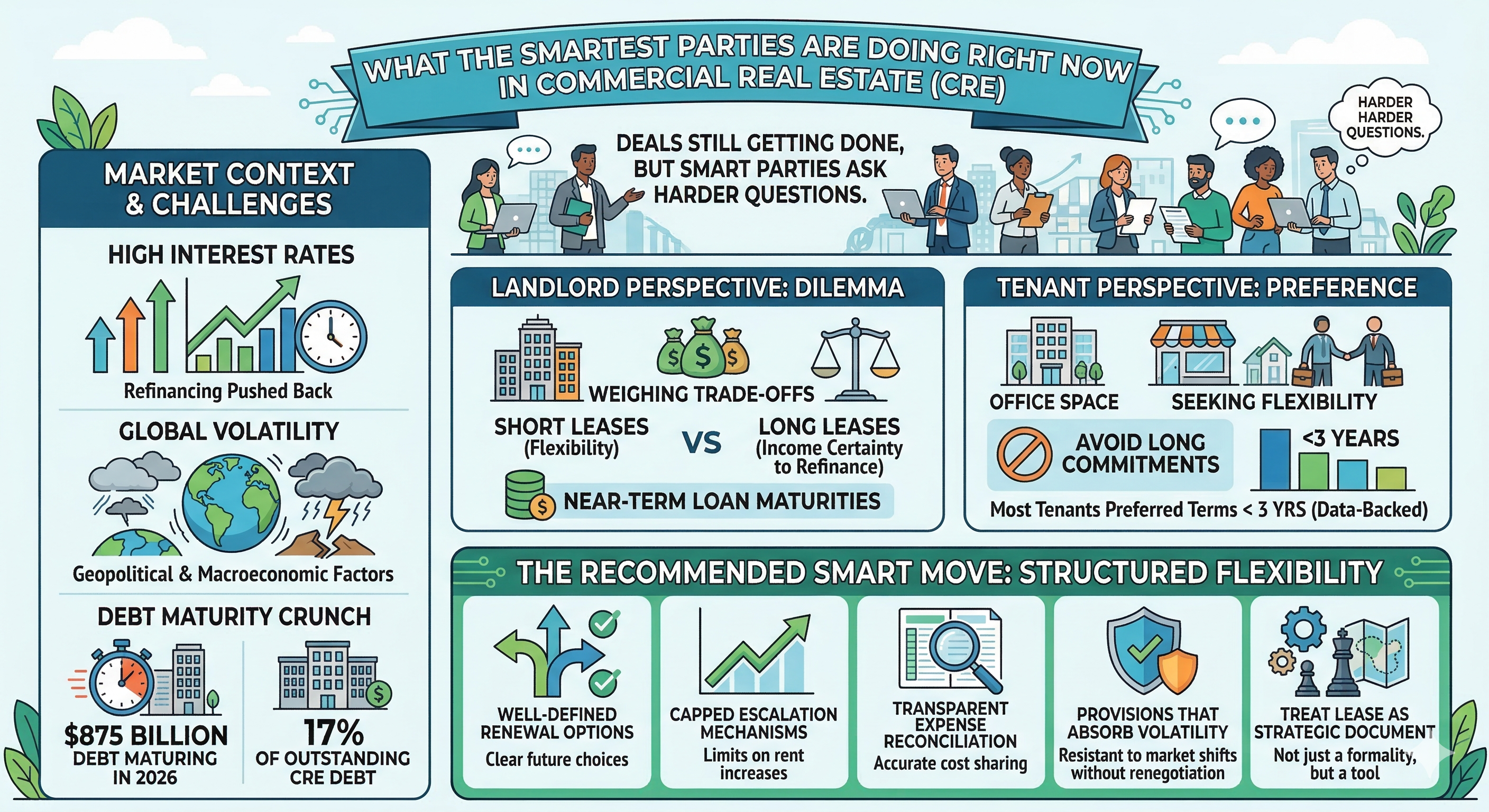
Deals are still getting done. The market hasn’t seized up — but the most informed parties are asking harder questions before they commit.
On the landlord side, there’s real hesitation about locking in long-term rates in an environment where interest rate relief keeps getting pushed back. An estimated $875 billion in commercial and multifamily mortgage debt is set to mature in 2026 — representing 17% of roughly $5 trillion in outstanding debt. Landlords with near-term loan maturities are genuinely weighing the trade-off between shorter leases that preserve flexibility and longer terms that lock in income certainty they need to refinance.
On the tenant side, the preference for flexibility is clear and data-backed. According to TenantBase lease data, 67% of LA commercial tenants preferred lease terms of three years or less. That preference has only been reinforced by the geopolitical and macroeconomic volatility defining 2026. Most retail tenants are similarly pushing for flexible, shorter-term leases with renewal options rather than long commitments.
The approach I’m recommending to clients right now isn’t to freeze and wait for clarity — because that clarity may not arrive on anyone’s preferred timeline. The smarter move is structured flexibility: well-defined renewal options, capped escalation mechanisms, transparent expense reconciliation, and lease provisions that can absorb volatility without requiring renegotiation at the worst possible moment. It’s about going into a deal knowing exactly what you’re agreeing to, what the risk exposures are, and where your leverage sits in the current market.
The clients navigating this environment best are the ones treating their lease as a strategic document — not just a formality to get through before they move in.
Frequently Asked Questions
How does Middle East instability directly affect commercial real estate in Los Angeles?
The conflict in the Middle East puts upward pressure on oil prices, which feeds into inflation, higher operating costs, and elevated borrowing costs. For LA commercial properties, this shows up in utility costs for industrial tenants, tighter credit conditions for real estate investors, and softening demand from Gulf state capital sources that have historically been active buyers in the market. The macroeconomic chain from geopolitical risk to lease economics is shorter than most people expect.
Are triple-net leases more vulnerable to energy cost volatility?
Yes. In a triple-net lease, tenants are directly responsible for operating expenses — including utilities — without any landlord buffer. When energy costs surge due to volatile oil markets or a disruption to energy production, those higher costs pass through to the tenant on the monthly operating statement. NNN tenants should carefully review how utility and energy expenses are structured and allocated in their leases, and negotiate caps or expense stop provisions wherever possible.
Is foreign investment from the Middle East still active in Los Angeles?
It has slowed considerably. Investors from the Gulf states — including Saudi Arabia, the UAE, and Qatar — have historically been significant buyers in LA’s hospitality, office, and retail sectors. The current Middle East crisis and the direct impact on Dubai and Abu Dhabi’s investment environment has prompted many of these investors to pause, reassess risk, and delay major capital decisions for now.
What lease clauses should tenants be focused on right now?
The key legal provisions to review carefully include CPI escalation clauses, operating expense allocation and itemization language, force majeure definitions, Fair Market Value renewal option mechanics, and tenant improvement allowance terms. Each of these can be materially affected by the inflationary and macroeconomic environment that geopolitical tensions are creating in 2026. The contractual details matter more in a volatile market than they do when conditions are stable.
Is now a good time to sign a commercial lease in LA, or should tenants wait?
Waiting is rarely a neutral strategy — it’s just deferred risk with an uncertain payoff. The most effective approach is to negotiate with full awareness of current market conditions: understand your leverage, secure clarity on escalation and expense structures, and ensure flexibility provisions are built into the deal. Deals can be structured well even in volatile environments — the key is knowing what to ask for, and having someone in your corner who knows what the market is actually doing right now.
Conclusion
What’s happening in the Middle East isn’t just geopolitics — in LA, it shows up in your operating costs, lease terms, and deal timelines. The clients who come out ahead are the ones who understand what’s actually driving the market.
If you’re a tenant, landlord, or investor trying to make sense of where things stand right now, let’s talk. Schedule a consultation with Tolj Commercial — no pressure, just a real conversation about your options and what the current environment means for your next move.