If you’ve been watching the Port of Los Angeles warehouse market, you’ve witnessed quite the ride. After the explosive rent growth through 2022, many predicted a hard landing was inevitable. Yet here we are in early 2026, and something unexpected happened—the market didn’t crash. Instead, we’re seeing something more nuanced: stabilization. I’ve spent nearly two decades in commercial real estate, and what’s unfolding around the port right now tells a compelling story about resilience, adaptation, and opportunity.
Key Takeaways
- Port of Los Angeles warehouse rents have declined nearly 29% from their 2022 peak, with Q4 2025 averaging $1.22-$1.43 per square foot per month, creating more affordable entry points for tenants
- Vacancy rates stabilized around 4.6-5.8% in Greater Los Angeles through Q4 2025, signaling market equilibrium after years of unprecedented tightness
- The San Pedro Bay ports processed over 10 million TEUs in 2025, maintaining their position as the busiest gateway for U.S. imports despite trade uncertainty and tariff pressures
Understanding the Port of LA Industrial Space Landscape

The Port of Los Angeles serves as the busiest container port in the Western Hemisphere, operating across 7,500 acres of land and water along 43 miles of waterfront. This massive hub processes containerized cargo that flows through Greater Los Angeles, Orange County, and the Inland Empire, creating an ecosystem where warehouse space, distribution centers, and logistics operations thrive on proximity to global trade.
The geography matters enormously here. The San Pedro Bay port complex—comprising both Los Angeles and Long Beach—handled over 10 million twenty-foot equivalent units (TEUs) in 2025, finishing the year as one of the top three busiest years in history despite a modest decline from 2024. That throughput drives demand for industrial space across multiple submarkets, from Vernon and Commerce to Compton and the South Bay.
What makes this market unique is its land constraint. Los Angeles County remains the tightest and most land-constrained industrial market in the United States, with functional vacancy rates near the ports hovering between 0-1% for prime warehouse and yard space. This scarcity has historically kept pricing power in landlords’ hands, but recent shifts are rewriting that dynamic.
The “Hard Landing” That Never Quite Landed
Throughout 2023 and 2024, industry analysts warned of an impending correction. Warehouse rents had soared during the pandemic boom, with average asking rates peaking around $1.60-$1.80 per square foot monthly across Greater LA. New construction flooded the market—26 million square feet of deliveries in 2024 alone—while import volumes normalized after the pandemic surge.
The ingredients seemed perfect for a crash: oversupply meeting softening demand. And yes, rents did decline. Average asking rates fell for nine consecutive quarters through Q4 2025, dropping roughly 29% from their peak. By the end of 2025, direct asking rates settled around $1.22-$1.43 per square foot per month depending on the submarket.
But here’s what didn’t happen: the floor didn’t fall out. Instead of a hard landing, we experienced what I’d call a controlled descent. Vacancy rates increased from historic lows of 2-3% to a more balanced 4.6-5.8% across Greater Los Angeles. That’s still remarkably tight compared to national industrial averages hovering around 7.6%.
Greater LA Warehouse Market: Then vs. Now
| Metric | Peak (2022) | Q4 2025 | Change |
|---|---|---|---|
| Average Asking Rent (per SF/month) | $1.60-$1.80 | $1.22-$1.43 | -29% |
| Vacancy Rate | 2-3% | 4.6-5.8% | +2.6-2.8% |
| Market Condition | Extreme shortage | Balanced | Stabilizing |
| Landlord Leverage | Very High | Moderate | Decreasing |
| Tenant Concessions | Rare | Common | Increasing |
Why Port of LA Logistics Rents Are Stabilizing
Several factors explain why Port of Los Angeles warehouse rents found their footing rather than collapsing entirely.
Cargo Volume Resilience
Despite concerns about tariffs and shifting trade policies, the San Pedro Bay ports maintained strong throughput. The Port of LA processed approximately 10.2 million TEUs in 2025, down less than 1% from 2024. The Port of Long Beach set an all-time record. Executive Director Gene Seroka emphasized that cargo moved without congestion and not a single ship backed up—a testament to operational efficiency that keeps shippers committed to the West Coast route.
This steady flow of import cargo sustains baseline demand for warehouse space, distribution centers, and last-mile delivery facilities. When goods keep arriving, they need somewhere to go.
Labor Stability Removes Uncertainty
West Coast dockworkers signed a contract in 2023 that runs through mid-2028, eliminating the threat of strikes at the Ports of LA and Long Beach. East and Gulf Coast ports also secured long-term agreements in early 2025 after a brief shutdown. With both coasts under stable labor contracts, the risk of cargo rerouting due to disruptions has largely evaporated.
For landlords and tenants alike, this certainty matters. Companies can commit to long-term lease agreements near the port without fear that labor unrest will suddenly shift their supply chain strategy elsewhere.
Construction Pipeline Tapering
The construction boom that added millions of square feet is finally winding down. The pipeline is tapering significantly, setting the stage for supply-demand rebalancing by mid-to-late 2026. With fewer new deliveries coming online and positive net absorption returning in Q4 2025 (171,000 square feet in Los Angeles County), fundamentals are improving.
Institutional investors recognize this inflection point. Many view the next 6-12 months as a compelling acquisition opportunity, buying warehouse properties at reset pricing before fundamentals tighten again.
Strategic Location Premium
Proximity to the Port of Los Angeles carries inherent value that doesn’t disappear during market corrections. The port serves as America’s gateway for Pacific Rim trade, connecting to major freeways, rail infrastructure, and Los Angeles International Airport (LAX). Distribution centers and logistics operations prioritize being close to where cargo enters the country, minimizing drayage costs and transit times.
Submarkets like the South Bay, San Pedro, Wilmington, and Carson command premium pricing precisely because of this proximity advantage. Even as rents softened elsewhere, port-adjacent industrial properties maintained relatively stronger pricing due to location scarcity.
Current Market Dynamics Across Key Submarkets
Port-Adjacent Submarket Snapshot
| Submarket | Avg. Rent (NNN/SF/mo) | Vacancy Rate | Primary Tenants | Key Advantage |
|---|---|---|---|---|
| South Bay/Harbor | $2.75-$3.25 | 0-1% | Drayage, 3PLs, Freight Forwarders | Closest to port terminals |
| Vernon/Commerce | $1.30-$1.60 | 3-5% | Distribution, E-commerce | Central LA location + highway access |
| San Gabriel Valley | $1.15-$1.35 | 6-8% | Regional distribution, Light manufacturing | Value pricing with port access |
| Inland Empire | $0.95-$1.15 | 7-9% | Large-scale distribution, Mega warehouses | Lower costs, massive footprints |
South Bay and Harbor Area
The South Bay remains the tightest submarket, with vacancy effectively at 0-1% for functional warehouse and yard space. Warehousing averages $2.75-$3.25 NNN per square foot monthly here—significantly above the broader Greater LA average. Tenant base skews heavily toward drayage operations, third-party logistics providers (3PLs), freight forwarders, customs brokers, and e-commerce fulfillment.
Industrial Outdoor Storage (IOS) has emerged as a critical asset class in this land-constrained environment, with container yards leasing for $100-$200 per slot per month. This reflects the premium tenants will pay for proximity to port terminals.
Vernon and Commerce
Central Los Angeles distribution hubs like Vernon and Commerce saw some rent softening but remain active markets. Older facilities are being upgraded with higher clear heights and improved dock configurations to meet modern logistics requirements. These submarkets benefit from central location and highway access via the I-5, I-10, and I-710 corridors.
San Gabriel Valley and Mid-Counties
These areas experienced more noticeable vacancy increases as new construction delivered. Asking rents moderated in response, creating opportunities for tenants seeking value while maintaining reasonable access to port operations. Landlords here are offering concessions—including free rent periods, delayed start dates, and enhanced tenant improvement allowances—to attract creditworthy tenants.
What This Means for Port Area Landlords
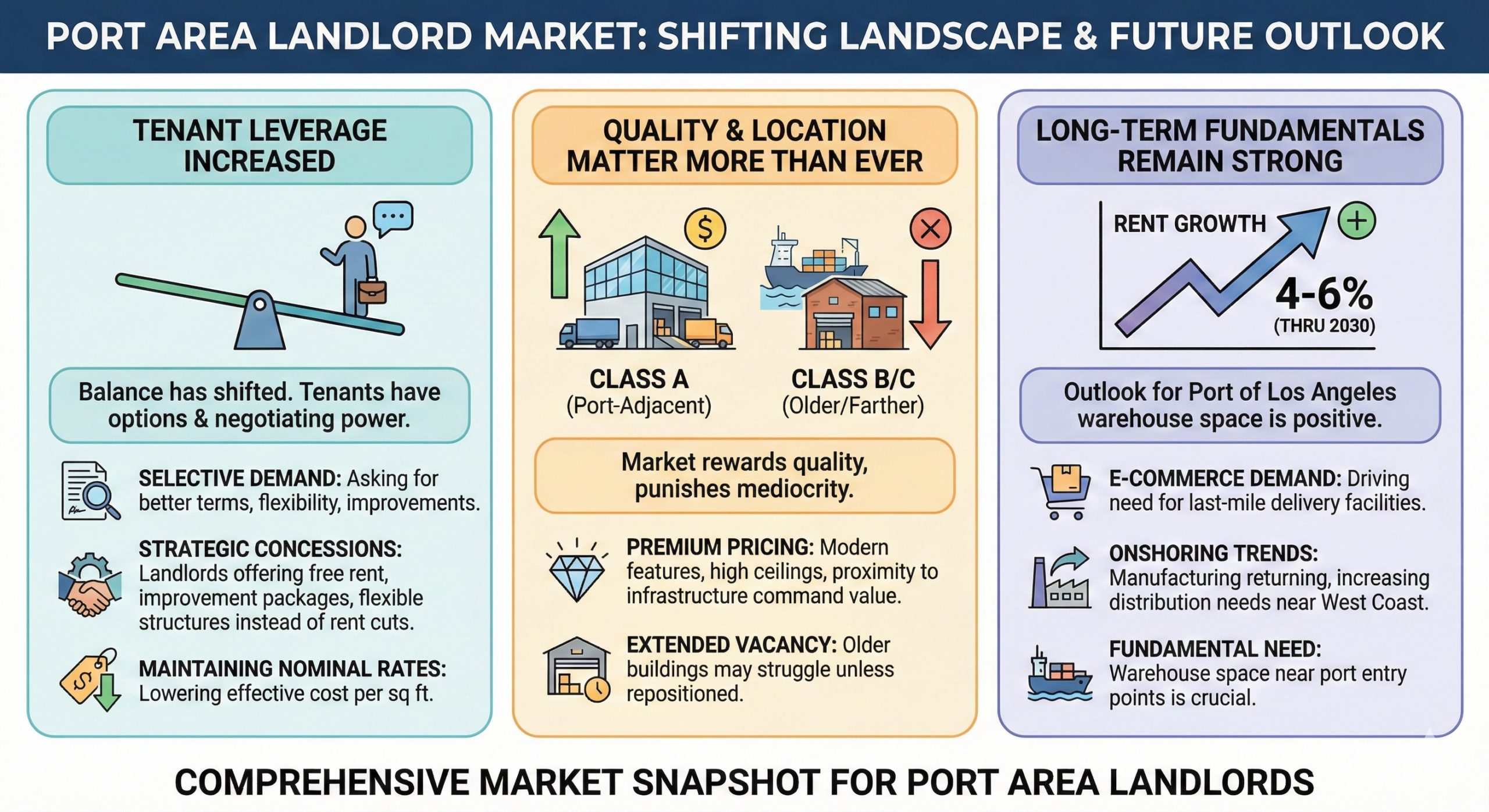
Tenant Leverage Has Increased
After years of landlords dictating terms in a supply-constrained market, the balance has shifted. Tenants now have options and negotiating power. Vacancy stabilizing around 5% means tenants can be more selective, demanding better lease terms, flexibility, and improvements.
Landlords responding strategically are offering concessions rather than publicly slashing asking rents. Free rent periods, tenant improvement packages, and flexible lease structures help maintain nominal rates while effectively lowering cost per square foot for tenants.
Quality and Location Matter More Than Ever
Not all industrial space is equal in this environment. Class A properties with modern features—high ceilings, ample truck courts, efficient layouts, and proximity to transportation infrastructure—continue commanding premium pricing. Port-adjacent locations maintain their value proposition.
Conversely, older Class B and C buildings farther from the port may struggle with extended vacancy periods unless repositioned or priced competitively. The market is rewarding quality and punishing mediocrity.
Long-Term Fundamentals Remain Strong
Despite near-term rent softening, the long-term outlook for Port of Los Angeles warehouse space remains positive. Forecasts suggest annual rent growth of 4-6% through 2030, especially in port-adjacent locations and submarkets with limited new supply.
E-commerce continues driving demand for last-mile delivery facilities. Onshoring and nearshoring trends are bringing manufacturing back to North America, increasing need for distribution infrastructure near West Coast ports. The fundamental need for warehouse space near where goods enter the country isn’t going away.
Strategic Considerations for 2026
Focus on Stabilized Assets
Institutional capital is targeting stabilized or near-stabilized industrial properties at current pricing. For landlords considering disposition, market conditions favor selling quality assets with in-place cash flow. For buyers, there’s opportunity to acquire at more favorable pricing than the 2021-2022 peak.
Smaller Footprints in Demand
Demand for smaller units—particularly 50,000 square feet and under—remains strong across Greater LA. These spaces suit last-mile delivery operations, e-commerce fulfillment, and businesses requiring flexibility. Landlords with larger buildings might consider demising strategies to capture this demand segment.
Operational Excellence Differentiates
With tenants having more choices, property management quality and landlord responsiveness become differentiators. Facilities that operate efficiently, maintain high standards, and accommodate tenant operational requirements will achieve higher occupancy and better rent retention.
Monitor Construction Pipeline
The tapering construction pipeline should lead to tightening conditions by mid-to-late 2026. Landlords who maintain occupancy through the current adjustment period will benefit as supply-demand dynamics shift back in their favor.
The Broader Greater LA and Orange County Context
While focusing on Port of LA specifically, it’s worth noting trends across Greater Los Angeles and Orange County. The broader region encompasses diverse submarkets—from the Inland Empire’s massive distribution centers to Orange County’s more affluent consumer markets.
Average rents across Greater LA declined to around $1.22-$1.43 per square foot monthly in Q4 2025, depending on submarket and property quality. Orange County industrial space typically commands premium pricing due to limited supply and high-income demographics driving consumer demand.
Transportation infrastructure connects these markets through major freeways including I-5, I-10, I-15, I-405, I-605, and I-710. Cargo flowing through the San Pedro Bay ports distributes across this network to reach consumers throughout Southern California and beyond.
Los Angeles International Airport (LAX) adds another dimension, particularly for air cargo and expedited logistics. Downtown Los Angeles serves as a central hub where multiple transportation modes converge.
E-Commerce and Last-Mile Delivery Impact
The e-commerce boom fundamentally reshaped industrial real estate demand. Consumers expect fast delivery, pushing companies to locate distribution facilities closer to population centers. This “last-mile delivery” trend favors infill locations and smaller warehouse formats over massive regional distribution centers in remote areas.
Port-adjacent Los Angeles offers proximity to both import cargo and dense consumer populations—a powerful combination. Companies operating here can receive goods from Asia, clear customs, and position inventory for rapid delivery to millions of consumers across the LA metro area.
This dynamic supports rent stability even as broader market conditions soften. The operational value of location near both port and consumers creates inherent demand that cushions against downward pressure.
Looking Ahead: Mid-2026 and Beyond
As we move through early 2026, several indicators suggest the market is approaching an inflection point. Positive net absorption returned in Q4 2025 after two negative quarters. Leasing activity, while down from peak levels, continues as companies lock in plateauing rents.
Port cargo volumes may experience modest growth in 2026, though trade policy uncertainty creates some headwinds. Long Beach officials expressed cautious optimism for continued steady throughput despite potential tariff impacts.
The key question for landlords is timing. Markets rarely move in straight lines. We’ve experienced the downward adjustment phase; now we’re in a stabilization period. The next phase—recovery and rent growth—depends on how quickly remaining vacant space gets absorbed and whether construction remains disciplined.
Investment capital positioning for the next 6-12 months suggests smart money believes fundamentals will improve. Cap rates have compressed to around 5.3% for quality assets, indicating strong investor demand at current pricing.
Practical Implications for Landlord Strategy
Quarterly Landlord Checklist
Market Intelligence
- Review monthly Port of LA cargo volume reports
- Track quarterly vacancy and rent data from CBRE, Cushman & Wakefield, or Newmark
- Monitor new construction deliveries in your submarket
Property Operations
- Conduct competitive rent surveys within 3-mile radius
- Assess property condition vs. competing buildings
- Review tenant lease expiration schedule for next 24 months
Tenant Relations
- Schedule check-ins with existing tenants quarterly
- Understand their business growth or contraction plans
- Address maintenance requests within 48 hours
Financial Planning
- Model scenarios for rent concessions vs. extended vacancy
- Calculate break-even occupancy for your asset
- Review cap rate trends for potential sale or refinance timing
Maintain Competitive Positioning
Understand your property’s competitive set. What are comparable buildings offering in terms of rent, concessions, and lease flexibility? Price your space appropriately based on realistic market conditions, not what you wish the market would support.
Consider Strategic Concessions
Rather than lowering asking rents, offer value through concessions that don’t permanently reset your rental basis. Free rent periods, tenant improvement allowances, and flexible lease terms can attract tenants while preserving nominal rent levels for future escalations.
Invest in Property Improvements
In a tenant-favored market, property condition and functionality matter more. Consider strategic capital improvements—upgraded loading docks, improved lighting, better truck circulation, enhanced power infrastructure—that make your space more competitive.
Build Tenant Relationships
Retention is cheaper than backfill. Proactive communication with existing tenants about their evolving space needs can prevent unexpected vacancies. Understanding their business challenges and demonstrating flexibility builds loyalty that pays dividends.
Monitor Market Intelligence
Stay informed about cargo volumes, new construction deliveries, leasing velocity, and rent trends across submarkets. The Port of Los Angeles releases monthly cargo reports; commercial real estate firms publish quarterly market updates. This intelligence helps you anticipate market shifts and adjust strategy accordingly.

FAQs
What are current warehouse rental rates near the Port of Los Angeles?
As of Q4 2025, warehouse rents near the Port of Los Angeles average between $1.22 and $1.43 per square foot per month for Class A and B space across Greater LA, with port-adjacent South Bay submarkets commanding premium rates of $2.75-$3.25 per square foot monthly due to extreme scarcity and proximity advantages.
Why didn’t Port of LA warehouse rents crash despite increased vacancy?
Port of LA warehouse rents stabilized rather than crashed due to several factors: consistent cargo throughput of over 10 million TEUs maintaining baseline demand, labor stability through 2028 eliminating disruption risks, tapering construction pipeline reducing future supply, and the inherent location premium of proximity to America’s busiest port complex.
What is the vacancy rate for industrial space in Greater Los Angeles?
The vacancy rate for industrial space in Greater Los Angeles reached 4.6-5.8% in Q4 2025, depending on the specific submarket and reporting methodology, representing the highest level in a decade but still significantly tighter than the national average of 7.6%.
Are Port of Los Angeles warehouse rents expected to increase in 2026?
Port of Los Angeles warehouse rents are expected to stabilize in early 2026 before potentially resuming modest growth by mid-to-late 2026 as the construction pipeline tapers, existing space gets absorbed, and cargo volumes remain steady, with long-term forecasts projecting annual rent growth of 4-6% through 2030.
What factors drive warehouse demand near the Port of Los Angeles?
Warehouse demand near the Port of Los Angeles is driven by its position as the busiest West Coast gateway for Pacific Rim imports, proximity to dense consumer populations enabling last-mile delivery, access to major transportation infrastructure including freeways and rail, labor stability through 2028, and the operational efficiency of avoiding cargo congestion that keeps supply chains reliable.
Conclusion
The Port of Los Angeles warehouse market has navigated challenging waters remarkably well. What could have been a hard landing turned into a soft correction—rents adjusted from unsustainable peaks, vacancy normalized to healthier levels, and fundamentals stabilized. For landlords who weathered the adjustment, the outlook ahead looks increasingly positive as supply discipline and steady demand create conditions for renewed rent growth.
If you’re a landlord in the Port of LA area looking to optimize your warehouse investment strategy—whether leasing, repositioning, or considering a sale—I’d welcome the chance to discuss your specific situation. With 18 years of experience in commercial real estate transactions around the port, I understand these market dynamics and how to help you achieve your goals. Schedule a consultation with Tolj Commercial, and let’s talk about what makes sense for your property in this evolving market.