I’ve spent nearly two decades working with business owners and landlords across the San Fernando Valley, and I can tell you that 2026 presents both challenges and opportunities for office investors. The Sherman Oaks commercial real estate market sits at a crossroads where media industry consolidation is reshaping tenant stability, and understanding how to protect your investment has never been more critical.
Key Takeaways
- Sherman Oaks maintains a relatively stable 13.6% vacancy rate compared to the wider San Fernando Valley office market, making it an attractive balance for investors seeking predictable returns
- Media consolidation trends in 2025-2026 are creating significant sublease inventory pressure as companies merge, downsize, and offload excess office space across major markets
- Strategic lease protections, sublease rights negotiation, and proactive tenant management are essential for SFV office investors to preserve asset value during industry consolidation cycles
Understanding the Sherman Oaks Commercial Property Landscape

Sherman Oaks commercial real estate currently offers one of the more balanced office environments in the San Fernando Valley. With approximately 3.7 million square feet of inventory and average lease rates around $3.00 per square foot, the submarket remains significantly more affordable than the wider Los Angeles market average of $3.50 per square foot. This pricing advantage, combined with the area’s central location and strong business infrastructure, continues to attract tenants seeking quality space at competitive rates.
The Sherman Oaks office market recorded a 13.6% vacancy rate as of Q2 2025, demonstrating relative stability compared to neighboring submarkets like Woodland Hills/Warner Center, which struggles with a 22.8% vacancy rate. Net absorption of 55,500 square feet over the past 12 months indicates modest but consistent tenant demand, though year-over-year rent growth remains flat at -0.7%, reflecting broader market softness.
The Media Consolidation Wave: What SFV Office Investors Need to Know
Rising M&A Activity Creates Sublease Pressure
The media and entertainment industry is experiencing a significant consolidation wave that directly impacts commercial real estate markets across Southern California. According to industry analysts, media M&A activity surged by 50% in the first half of 2025 compared to the same period in 2024, driven by streaming market maturation and the need for content companies to achieve operational scale. This consolidation creates immediate consequences for office landlords as merged entities eliminate duplicate facilities, downsize operations, and flood the market with sublease space.
When major media companies merge or restructure, they typically consolidate their real estate footprint within 12-24 months of closing the transaction. This pattern has become increasingly common as legacy Hollywood studios merge with digitally-native competitors and private equity investors target media assets for their content libraries. For investors holding Sherman Oaks commercial property with media or entertainment tenants, this consolidation trend represents a tangible risk that requires proactive management.
How Consolidation Impacts Local Markets
The San Fernando Valley has historically served as home to numerous media production companies, post-production facilities, and entertainment industry support businesses. As these companies face acquisition or merger, the resulting real estate decisions ripple through the local market. A company occupying 10,000 square feet in Sherman Oaks may suddenly find itself redundant after a merger, leading to sublease listings that compete directly with landlords seeking new tenants.
The broader Los Angeles market has seen sublease space decline in some Class A segments as tenants either lease top-tier spaces or withdraw sublease offerings from the market. However, this stabilization hasn’t fully reached the San Fernando Valley, where availability rates remain elevated at 17.8% in Sherman Oaks. The combination of media consolidation and flexible work arrangements continues to create uncertainty around long-term office demand.
Media Consolidation Impact Timeline on Commercial Real Estate:
- Months 0-3: Merger announcement and due diligence period
- Months 3-6: Real estate audit and consolidation planning begins
- Months 6-12: Duplicate facilities identified; sublease space hits market
- Months 12-24: Office footprint consolidation complete; lease terminations/non-renewals
- Post-24 Months: Stabilization or continued downsizing based on business performance
The Tri-Cities Sublease Crisis: A Warning for Valley Investors
Understanding Sublease Inventory Dynamics
While the “Tri-Cities” reference in commercial real estate discussions often relates to various regional markets, the underlying sublease crisis phenomenon affects office markets nationwide, including the San Fernando Valley. Sublease inventory represents space that existing tenants are marketing because they no longer need it, whether due to downsizing, relocation, or business closure. This inventory directly competes with landlord-controlled space and typically leases at significant discounts.
For Sherman Oaks commercial real estate investors, monitoring sublease inventory is crucial because it signals both tenant health and future vacancy risk. When sublease space increases rapidly, it often precedes direct vacancy as leases expire and tenants don’t renew. The current environment requires landlords to understand which of their tenants might be vulnerable to consolidation or downsizing pressures.
Media Industry Restructuring and Office Space Implications
The telecommunications and media alignment trend has accelerated as cable providers bundle streaming apps and content companies seek distribution partnerships. These strategic shifts often result in workforce reductions and office space consolidation. The challenge for San Fernando Valley office investors is that media industry tenants who seemed stable 18 months ago may now be actively planning exits or significant downsizing.
Markets like New Jersey have seen sublease space reach five-year lows in Class A segments after a year of absorption, signaling stabilization. However, this recovery pattern hasn’t uniformly appeared across all markets, and the San Fernando Valley’s elevated availability rates suggest continued pressure through 2026.
Protecting Your Sherman Oaks Commercial Real Estate Investment
Strategic Lease Structuring for Investor Protection
As someone who has negotiated countless lease agreements, I can tell you that the protections you build into your lease documents today will determine how well you weather industry disruptions tomorrow. Several critical provisions should be standard in any commercial property lease when media or consolidation-vulnerable tenants are involved.
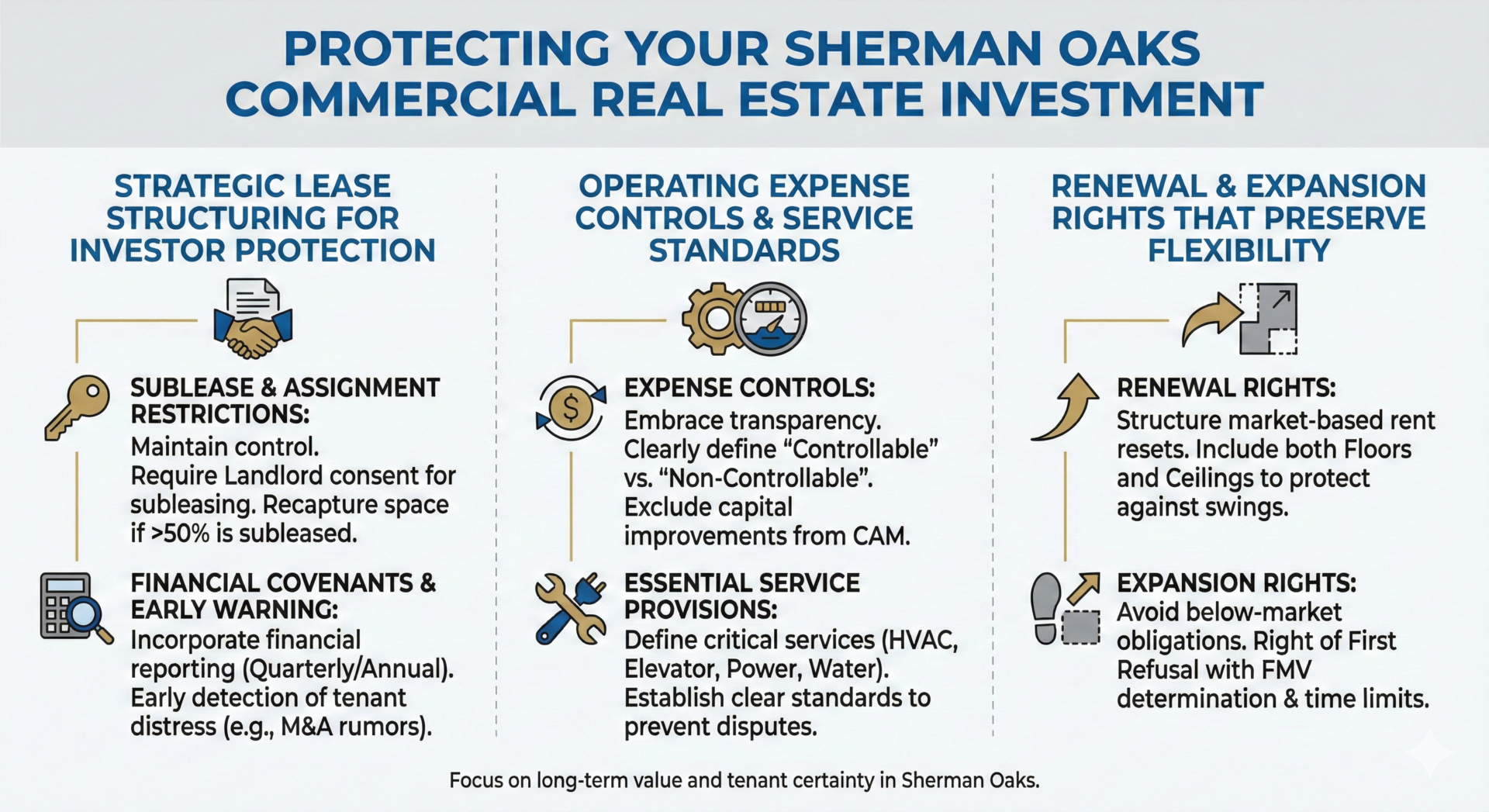
Sublease and Assignment Restrictions: While tenant-friendly markets have pushed for more liberal sublease rights, landlords must maintain meaningful control over who occupies their buildings. Negotiate sublease provisions that require landlord consent (not to be unreasonably withheld) but also give you the right to recapture space if a tenant subleases more than 50% of their premises. This provision protects you from becoming a passive participant in your tenant’s real estate strategy while still providing them reasonable flexibility.
Financial Covenants and Early Warning Systems: Consider incorporating financial reporting requirements for tenants above certain square footage thresholds. Quarterly financial statements or annual audited financials can provide early warning signals of tenant distress. For media industry tenants, this becomes particularly valuable as M&A rumors often circulate months before public announcements.
Operating Expense Controls and Service Standards
Office tenants have become increasingly sophisticated about negotiating caps on controllable operating expenses, and savvy landlords should embrace transparent expense structures that build tenant confidence. Negotiate detailed definitions of “controllable” versus “non-controllable” expenses and ensure capital improvements aren’t inappropriately included in Common Area Maintenance (CAM) charges.
Essential service provisions should clearly define HVAC, elevator access, water, and power as critical services where extended interruptions trigger rent abatement or offset rights. While these provisions may seem tenant-favorable, they actually protect landlords by creating clear standards that prevent disputes and tenant defaults during service disruptions.
Renewal and Expansion Rights That Preserve Flexibility
Market conditions in 2026 favor tenants across most San Fernando Valley submarkets, making it essential to structure renewal options that preserve long-term value while providing tenant certainty. Consider renewal clauses with market-based rent resets that include both floors and ceilings, protecting against dramatic market swings in either direction.
For multi-tenant buildings in Sherman Oaks, carefully structure expansion rights to avoid creating situations where you’re contractually obligated to provide space to an expanding tenant at below-market rates. Right of first refusal provisions should include fair market value determinations and time-limited response periods to maintain your leasing flexibility.
Current Market Opportunities in Sherman Oaks Commercial Space
Tenant-Favorable Conditions Create Strategic Acquisition Potential
The current tenant-favorable market environment across the San Fernando Valley, while challenging for existing landlords, creates compelling opportunities for strategic acquisitions. Properties with near-term lease rollover and creditworthy tenants may be available at attractive pricing as some investors exit the market. Sherman Oaks commercial real estate for sale may offer better relative value than neighboring submarkets given the area’s stability metrics.
With average rents around $3.00 per square foot and healthy absorption trends, Sherman Oaks represents a middle path between the higher-priced Encino market and the deeply discounted Woodland Hills/Warner Center submarket. For investors with patience and proper lease structuring expertise, acquiring well-located Sherman Oaks commercial property during market softness can generate strong long-term returns.
The Search for Quality Tenants in a Consolidating Market
Finding commercial real estate tenants who aren’t vulnerable to media consolidation pressures requires diversification beyond entertainment industry companies. The San Fernando Valley’s strong population base and consistent consumer spending support professional services, medical offices, and technology companies that offer more stable long-term occupancy. When evaluating Sherman Oaks commercial real estate for lease opportunities, prioritize tenant diversity to insulate your property from sector-specific disruptions.
Quality tenants in 2026 look for transparent lease terms, reasonable landlord flexibility, and well-maintained properties with modern amenities. Investing in property improvements, implementing efficient tenant communication systems, and demonstrating responsive management can help you attract and retain the best available tenants even in competitive leasing environments.
San Fernando Valley Office Market Positioning for 2026
Comparative Submarket Analysis
Understanding how Sherman Oaks commercial real estate positions relative to other Valley submarkets helps investors make informed decisions. Encino maintains a 14.8% availability rate with strong net absorption of 99,900 square feet over the past year, suggesting healthy tenant demand and market confidence. The submarket appeals to professional services firms seeking prestigious addresses without downtown Los Angeles pricing.
Woodland Hills/Warner Center presents maximum tenant leverage with 22.8% vacancy and 26.6% availability, including substantial sublease inventory at properties like Farmers Plaza. While this creates challenges for existing landlords, it also offers cost-conscious tenants exceptional value. Sherman Oaks occupies the middle ground, offering balanced conditions without the extreme pressure seen in Warner Center or the premium pricing of Encino.
Long-Term Value Preservation Strategies
Protecting your asset against media consolidation and sublease pressure requires both defensive and offensive strategies. Defensively, ensure your lease agreements include the protections discussed earlier and maintain strong relationships with tenants to receive early warning of potential issues. Offensively, invest in property improvements that differentiate your space from competing inventory and make it more difficult for tenants to relocate.
Consider implementing smart building technologies that enhance tenant experience while reducing operating costs. These improvements demonstrate commitment to property quality and can justify premium pricing even in soft markets. Automated communication systems, proactive maintenance scheduling, and transparent service request tracking all contribute to tenant satisfaction and retention.
Market Data and Investment Considerations
Current Leasing Activity and Absorption Trends
The San Fernando Valley commercial real estate market has demonstrated resilience despite broader economic uncertainties. Quarterly leasing activity in the retail sector has frequently exceeded 90,000 square feet, with peaks over 200,000 square feet during high-activity periods. While these figures primarily reflect retail activity, they indicate sustained business confidence in the Valley’s commercial property market.
Office absorption in Sherman Oaks reached 55,500 square feet over the past 12 months, suggesting modest but positive tenant demand. This absorption partially offset new supply and space returned to the market, contributing to relatively stable vacancy rates. For investors evaluating Sherman Oaks commercial real estate for sale, positive absorption trends indicate underlying market strength despite surface-level vacancy concerns.
Pricing and Valuation Metrics
Average asking rents in Sherman Oaks of $3.00 per square foot represent a meaningful discount to the Los Angeles metro average of $3.50 per square foot. This 14% pricing advantage makes the submarket attractive to cost-conscious tenants while still supporting reasonable landlord returns. However, negative rent growth of -0.7% year-over-year reflects ongoing market softness and tenant leverage in lease negotiations.
Investment valuations for Sherman Oaks commercial property should account for the current tenant-favorable environment and potential for continued rent pressure through 2026. Cap rate expectations have expanded across most commercial real estate sectors as investors prioritize yield over growth, a trend evident in both office and multifamily assets.
Professional Services and Property Management Excellence
The Role of Specialized Commercial Real Estate Expertise
Successfully navigating the current market environment requires specialized knowledge of both commercial real estate fundamentals and industry-specific trends affecting tenant stability. Working with experienced professionals who understand media consolidation dynamics, lease negotiation strategies, and local market conditions significantly improves investment outcomes.
For landlords with existing Sherman Oaks commercial property portfolios, proactive asset management means regularly reviewing tenant financial health, maintaining competitive property conditions, and staying informed about industry trends that might impact occupancy. This hands-on approach helps identify potential problems early when solutions are still available.
Tenant Communication and Relationship Management
Strong landlord-tenant relationships create value by fostering open communication and collaborative problem-solving. When tenants face business challenges, landlords who have maintained positive relationships are more likely to receive early notice and opportunities to negotiate workable solutions. This might include lease restructuring, temporary rent modifications, or flexible sublease arrangements that preserve occupancy while accommodating tenant needs.
Implementing streamlined communication channels through property management software or tenant portals demonstrates professionalism and responsiveness. These systems allow tenants to submit maintenance requests, track service status, and communicate with property management teams efficiently, reducing friction and improving satisfaction.
Looking Ahead: 2026 Market Outlook
Expected Trends and Market Evolution
The commercial real estate market in Southern California is poised for continued evolution through 2026. Media and entertainment industry consolidation will likely persist as companies seek operational efficiencies and competitive positioning in the streaming era. This creates ongoing sublease pressure and tenant turnover risk that Sherman Oaks commercial real estate investors must actively manage.
However, stabilization signals are emerging in some markets as sublease inventory gets absorbed and companies complete post-pandemic space optimization. The San Fernando Valley may see gradual improvement in vacancy rates if economic conditions remain stable and business confidence continues building. Investors who positioned correctly during the downturn could benefit from improved fundamentals in the second half of 2026 and beyond.
Strategic Positioning for Market Recovery

Successful investing in the current environment requires balancing defensive risk management with opportunistic positioning for eventual recovery. Maintaining high property standards, competitive pricing, and flexible lease terms helps preserve occupancy during soft periods. Simultaneously, selectively pursuing acquisitions or tenant improvements during market weakness positions investors to capture upside when conditions improve.
The key is understanding that Sherman Oaks commercial real estate offers better relative stability than many Valley submarkets while remaining affordable compared to premium locations like Encino. This balanced positioning makes it attractive for both defensive and growth-oriented investment strategies.
FAQs
How does media consolidation specifically impact Sherman Oaks commercial real estate?
Media consolidation creates sublease inventory pressure as merged companies eliminate duplicate office locations and downsize their real estate footprints. The San Fernando Valley’s proximity to entertainment industry employers makes it particularly vulnerable to these consolidation cycles, though Sherman Oaks’ diverse tenant base provides some insulation compared to submarkets more concentrated in media tenants.
What lease provisions should landlords prioritize to protect against tenant defaults during consolidation?
Landlords should negotiate sublease consent provisions that include recapture rights, financial reporting requirements for larger tenants, clearly defined operating expense caps, and renewal options with market-based rent resets that include both floors and ceilings. These provisions balance tenant flexibility with landlord protection.
Is Sherman Oaks commercial real estate a good investment compared to other San Fernando Valley submarkets?
Sherman Oaks offers balanced market conditions with 13.6% vacancy compared to 22.8% in Woodland Hills/Warner Center, while maintaining more affordable rents than Encino. This middle-ground positioning makes it attractive for investors seeking stability without paying premium pricing.
How can property owners differentiate their space in a tenant-favorable market?
Invest in smart building technologies, implement efficient tenant communication systems, maintain proactive maintenance schedules, and offer transparent operating expense reporting. These improvements enhance tenant satisfaction and can justify premium pricing even in competitive markets.
What are the early warning signs that a commercial tenant might be vulnerable to consolidation?
Watch for industry M&A rumors involving your tenant or their parent company, declining financial performance in quarterly reports, requests to sublease portions of their space, or reduction in actual space utilization. Early detection allows landlords to proactively address potential vacancy before it occurs.
Conclusion
The intersection of media consolidation and commercial real estate creates both challenges and opportunities for Sherman Oaks office investors. While sublease pressure and tenant instability pose real risks, strategic lease structuring, proactive asset management, and market-informed decision-making can protect and enhance asset value. The San Fernando Valley continues to offer compelling investment opportunities for those who understand the dynamics at play and position accordingly.
If you’re navigating these market complexities with Sherman Oaks commercial property or considering an investment in the San Fernando Valley, I’d welcome the opportunity to discuss your specific situation. At Tolj Commercial, we’ve helped business owners and landlords work through these exact challenges for nearly two decades. Let’s schedule a consultation to explore how we can help you protect and maximize the value of your commercial real estate assets.