Putting solar panels on commercial properties, offices, or stores cuts electricity bills a lot. This extra savings means you make more profits. Other benefits happen too – like positive attention from eco-friendly customers. As your advisor who cares about sustainability and your bottom line, I strongly recommend going solar before competitors do. Now, let’s discuss how solar power can help your commercial property.
Key Takeaways
- Solar panels can eliminate electricity costs for businesses, with federal and state tax credits reducing installation expenses.
- Appraisers confirm solar panels increase commercial building value from $20k to $100k-plus for resale.
- Excess solar energy can be sold back to the grid, and sustainability-focused buyers actively seek out green buildings aligning with ESG mandates.
Leveraging Solar Power to Enhance Commercial Buildings
The modern commercial landscape glitters with opportunities for sustainability upgrades. Solar technology has advanced further and faster than anyone imagined even a decade ago. Business owners now stand at the exciting crossroads of environmental values converging with bottom-line savings. This blog explores the practical methods, lucrative incentives, and proven business case for complementing your company’s mission and margins with commercial solar power. Let the sunshine on both ideals and revenue through creative clean energy investments.
So if you’re on the fence about installing solar photovoltaic (PV) solar arrays on your commercial building, read on for enlightenment! I’ll be covering:
- The financial upsides of switching to solar
- Impacts on your property value
- Options for solar systems
- Vetting if your building site is viable
- Plus answers some “burning questions” commercial owners have about transitioning from conventional to clean energy.
Let’s get started!
How Much Do Commercial Solar Panels Cost in 2025?
Commercial solar panel systems typically cost between $2.50 and $3.50 per watt installed. For a medium-sized 100 kW system, expect a total upfront investment of $250,000 to $350,000 before incentives. Larger 500 kW installations range from $750,000 to $1.3 million, while smaller systems under 100 kW may run $170,000 to $200,000.
However, the 30% federal Investment Tax Credit immediately reduces these costs. A $300,000 system nets down to $210,000 after claiming the ITC, and many states offer additional rebates covering another 5–10% of costs. Most businesses achieve full payback within 5 to 8 years, then enjoy decades of nearly free electricity.
Slashing Electric Bills with Commercial Solar Panels
One big reason to add solar panels to your business property is lower electricity bills. Utility costs are a large ongoing expense for companies.
By harnessing the sun’s renewable energy, solar panels shrink high electric charges. Solar panels give buildings their supply of clean energy, needing less from the electric grid.
For some companies, the sunlight hitting their rooftops or parking lots allows complete self-supply from solar. This makes their electric bills zero! The sun provides their needs.
Other businesses need more electricity than their solar system makes. But their utility bills see major savings, often 70% cheaper. They still partly use the grid, just less.
And when solar panels make surplus electricity, there’s still financial value. This extra clean energy can be sold back to utility companies to generate income.
Over the 25+ year product lifespan, the compounding savings to businesses from slashed electric bills offer great value from commercial solar panels through lower operating costs.
Lucrative Financial Incentives for Going Solar
Installing solar also unlocks lucrative financial incentives from federal, state, and utility programs:
- The federal solar investment tax credit (ITC) rebates 30% of your capital expenditure on a commercial solar energy system.
- Additional state-level solar incentives can cover 5-10% of costs through rebates and production-based payouts.
- Utilities themselves offer special commercial rates when generating surplus solar power.
Collectively, these financial catalysts tremendously boost ROI for commercial solar projects.

What Is the ROI on Commercial Solar Panels?
Commercial solar panels deliver an annual return on investment of 10 to 15 percent, making them one of the strongest long-term investments for property owners. Most businesses recoup their initial capital within 5 to 8 years through energy bill savings alone, then benefit from an additional 17 to 25 years of nearly cost-free power.
For example, a company installing a 150 kW system at $450,000 receives a $135,000 federal tax credit, reducing net cost to $315,000. If that system saves $50,000 annually on electricity, the payback period is just over 6 years. Over the system’s 25 to 30 year lifespan, total savings can exceed $1 million while significantly cutting carbon emissions.
Boosting the Value of Your Commercial Property
As a commercial real estate broker, I always have my eye on tactics and improvements that can enrich a property’s value. And solar panels check both those boxes resoundingly.
There are a few pathways by which solar energy enhances the value of your commercial asset:
- Appraisers consistently confirm higher valuations for solar-equipped buildings, to the tune of +$20k to +$100k.
- Increasingly, commercial buyers actively seek out green buildings for eco-compliance.
- Lower operating expenses increase the net operating income valuation.
- Plus, on-site power generation conveys business continuity benefits that attract buyers.
Ways Solar Power Can Enrich Commercial Property Value
Specifically, commercial solar energy boosts asset value through:
- Higher Appraisals: Licensed appraisers apply income-based and cost-based methodologies yielding higher valuations for sold buildings.
- Elevated Market Perception: Green building certifications like LEED positively sway buyer opinions and pricing.
- Risk Mitigation: On-site solar electricity lowers vulnerability to grid outages, easing investor concerns.
- Expanded Buyer Pool: Corporations and institutional buyers have ESG mandates to acquire sustainable buildings.
And buyers are willing to pay higher price premiums for sold commercial real estate.
Types of Commercial Solar Panel Systems
Commercial properties have three main solar installation options, each suited to different site conditions and business goals.
Rooftop solar arrays remain the most popular choice because they use existing building infrastructure without consuming ground space. Panels are mounted flush or tilted on flat or sloped roofs, making them ideal for urban properties where land is limited. Rooftop systems can also reduce cooling costs by shading the roof and lowering heat absorption.
Solar parking canopies create dual value by covering parking areas with elevated panel structures. Tenants and customers appreciate the shaded parking, and businesses maximize unused airspace to generate clean power without sacrificing usable land.
Ground-mounted solar works best for properties with available land adjacent to buildings or on vacant lots. These systems allow flexible panel angles and easier maintenance access, though they require more site preparation and may face zoning restrictions in some municipalities.
Is Your Commercial Property Suitable for Solar?
Not every building is an ideal candidate for solar panels. Before moving forward, conduct a detailed site assessment to evaluate your property’s solar potential and avoid costly surprises.
Start with your roof condition and capacity. Solar systems add 3 to 5 pounds per square foot of load, so older roofs may need structural reinforcement or replacement before installation. Roof age, material, and remaining lifespan all affect whether mounting panels makes financial sense.
Next, analyze shading and sunlight exposure. Nearby trees, taller buildings, or HVAC equipment can cast shadows that drastically reduce energy production. A professional solar installer will perform a shade analysis and calculate how many peak sun hours your site receives throughout the year.
Finally, review your current energy usage and utility rate structure. Properties with high daytime electricity consumption and expensive peak demand charges see the fastest payback, while buildings with minimal energy use may need a smaller system or alternative efficiency upgrades first.
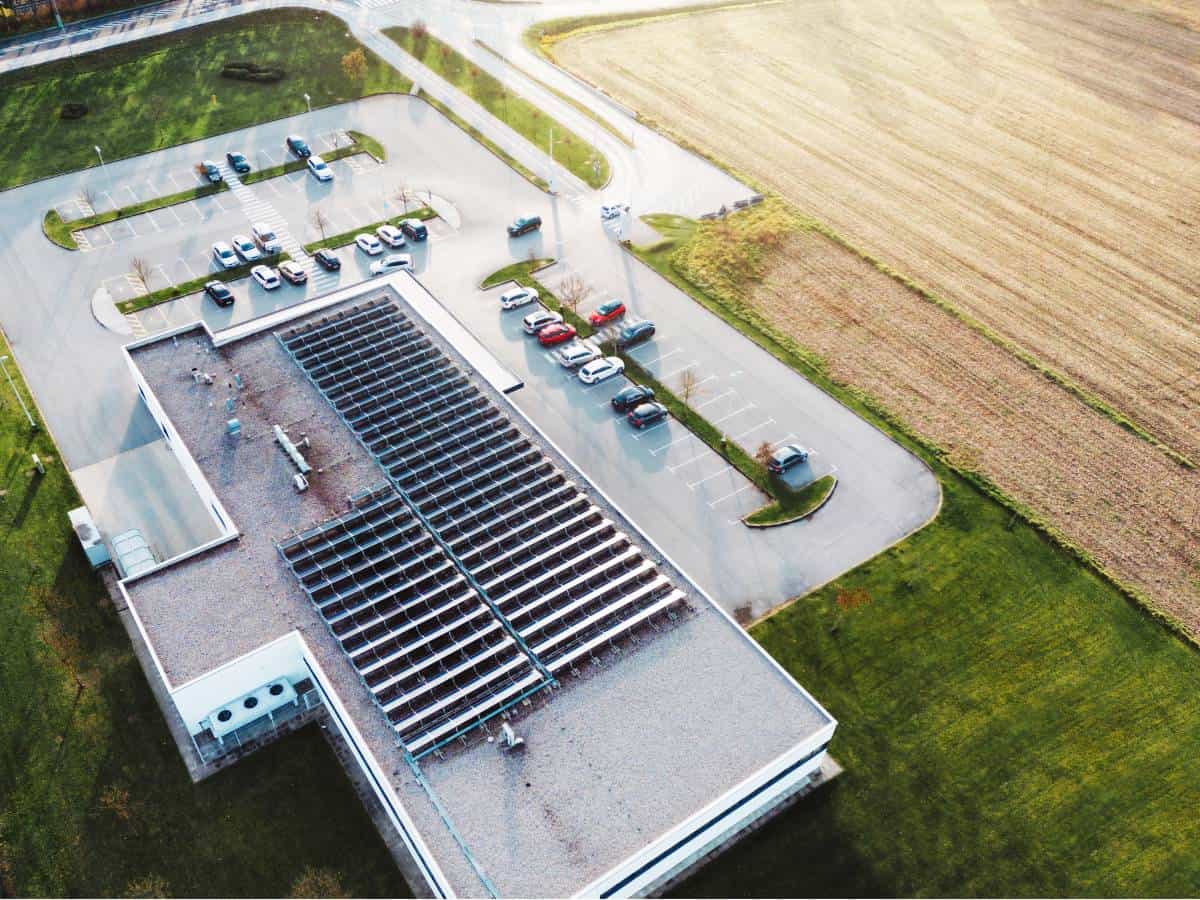
Evaluating the Viability of Your Building for Solar
Of course, not every commercial building site works seamlessly for installing solar panels. Space constraints, surrounding structures causing shading, and suboptimal rooftop angles can pose challenges.
As part of scoping your solar potential, experts analyze:
- Rooftop size, age, and load capacity
- Shadow analysis based on nearby trees and towers
- Custom panel tilt angles to maximize solar capture
- Energy efficiency tactics to right-size the system
This feasibility evaluation will determine if your property can support an economic solar energy system or not.
FAQs
How expensive is a commercial solar array installation?
The costs vary widely based on system size, panels, etc. but roughly $100k to $500k+ for medium to large installations.
What are the drawbacks of solar panels for commercial buildings I should consider?
Potential downsides include upfront capital needs, visual aesthetic impacts, and roof penetration considerations.
What solar incentives exist for commercial buildings?
The federal ITC tax credit, state/local rebates, property tax exemptions, special utility rates, and accelerated depreciation.
How much can solar panels increase my asset’s value?
Valuation lifts range from +$20k to +$100k+ for commercial buildings with solar power systems.
Who owns the solar array after installation?
You maintain full ownership as it becomes a permanent improvement to the real estate. No separate solar company owns panels on your building.
A Seasoned Commercial Real Estate Expert Advises Businesses to Go Solar
After 18 years of working in commercial real estate, I highly recommend business owners consider installing solar panels. With various financing options available, you can slash electricity expenses dramatically. This not only saves money every month, but solar energy increases property value as tenants desire sustainable buildings. Going solar delivers rapid returns through electricity bill savings and tax incentives.
As a seasoned agent representing tenants and landlords across countless deals, I assure you solar is a shrewd investment. Take advantage of the sun rather than miss out on thousands in savings and lease negotiations. With my consultation, I can connect you to reputable solar firms to capitalize on these immense commercial solar benefits.