The Tri-Cities office sublease market is sending property owners a clear message in 2026: adapt or get left behind. With sublease rents running 40% below direct space and tenant behavior shifting dramatically, I’m seeing landlords in Burbank and Glendale face challenges they’ve never encountered before. But here’s the thing—understanding what’s happening in nearby markets like Sherman Oaks and Warner Center gives you the playbook you need to stay competitive and profitable.
Key Takeaways:
- Sublease asking rents in the Tri-Cities average $2.25 per square foot—40.3% below direct space—offering substantial cost savings for Burbank and Glendale property owners looking to optimize their office investments
- Sherman Oaks maintains a stable 13.6% vacancy rate with modest tenant demand, while Warner Center struggles with a 22.8% vacancy rate and elevated availability, creating dramatically different investment opportunities
- Sublease leasing activity surged 42.1% year-to-date in early 2025 across Los Angeles County, while direct leasing activity dropped 8.5%, signaling a fundamental shift in how tenants approach office space
Understanding the Current Office Market Landscape

The office market across Los Angeles County has entered a new phase in 2026, and if you own commercial property in Burbank or Glendale, understanding these shifts is critical to your investment strategy. I’ve been tracking these trends closely, and what’s happening in the Tri-Cities office sublease market tells a compelling story about where opportunity lies right now.
During the first quarter of 2025, the Los Angeles County office market showed signs of recovery, with occupied space increasing by 348,604 square feet quarter-over-quarter. The vacancy rate fell to 16.7%, a 30-basis-point decline from the previous quarter. However, this overall trend masks significant differences between submarkets—differences that create both challenges and opportunities for property owners.
Why the Tri-Cities Office Sublease Market Stands Out
The Tri-Cities submarket—encompassing Burbank, Glendale, and Pasadena—has emerged as one of the most value-oriented office markets in the region. Sublease asking rents average $2.25 per square foot, which is 40.3% (or $1.52) below direct space. This substantial rent gap reflects a broader trend that’s stimulating demand as sublessors approach lease expirations and look to offset sunk costs.
For property owners in Burbank and Glendale, this creates a dual-edged scenario. On one hand, if you’re holding vacant space, you’re competing with deeply discounted sublease inventory. On the other hand, if you’re flexible and strategic about tenant improvements, you can attract quality tenants who might otherwise pursue sublease options. The key is understanding what drives tenant decisions in this market.
Countywide, sublease leasing activity gained significant momentum in early 2025, rising 42.1% year-to-date compared to the same period in 2024. Meanwhile, direct leasing activity continued to lag, down 8.5% year-to-date. While tenants leased close to half a million square feet of sublease space compared to 4.3 million square feet of direct space in Q1, the increased demand for subleases reflects a clear search for value.
| Metric | Sublease Space | Direct Space | Difference |
|---|---|---|---|
| Average Asking Rent (per sq ft) | $2.25 | $3.77 | -40.3% |
| Year-to-Date Leasing Activity Change | +42.1% | -8.5% | 50.6% gap |
| Q1 2025 Volume | ~500,000 sq ft | 4.3M sq ft | — |
Sherman Oaks vs. Warner Center: A Tale of Two Markets
The contrast between Sherman Oaks and Warner Center illustrates why location and market positioning matter more than ever. These two San Fernando Valley submarkets are experiencing vastly different conditions, and understanding why helps explain the broader dynamics affecting the Tri-Cities office research report trends we’re seeing in 2026.
Sherman Oaks: Stability in Uncertain Times
Sherman Oaks presents one of the more stable office markets in the Valley, with a 13.6% vacancy rate as of Q2 2025. The submarket contains 3.7 million square feet of inventory with average rents around $3.00 per square foot, significantly below the wider Los Angeles market average of $3.50 per square foot.
What makes Sherman Oaks particularly interesting is its net absorption of 55,500 square feet over the past 12 months, indicating modest but consistent tenant demand. The availability rate sits at 17.8%, providing tenants with substantial options without the oversupply challenges plaguing other submarkets. With no new construction delivery, the market benefits from inventory stability that keeps vacancy rates from spiraling.
For Burbank and Glendale owners, Sherman Oaks represents a comparable market—one where measured vacancy and stable demand create predictable conditions. The -0.7% rent growth year-over-year reflects market softness, but the overall environment remains functional for both landlords and tenants.
Warner Center: Maximum Struggle, Maximum Opportunity
Warner Center tells a starkly different story. This submarket presents the most tenant-favorable conditions in the Valley, with a 22.8% vacancy rate and nearly 10 million square feet of inventory. Average rents of $32.00 per square foot make this the most affordable major office submarket in Greater Los Angeles—but that affordability comes at a cost for property owners.
The availability rate reaches 26.6%, offering unprecedented choice for tenants. Sublease space comprises 10.3% of inventory, including over 500,000 square feet at properties like Farmers Plaza, providing unique short-term and flexible leasing opportunities. Market pricing runs approximately 25% below the Los Angeles metro average.
Warner Center’s struggles stem from oversupply combined with fundamental shifts in how companies approach office space. The high vacancy creates a challenging environment for landlords, who must compete not only with each other but also with a substantial sublease inventory. Recent case studies show tenants achieving annual savings exceeding $350,000 by right-sizing their space in Warner Center, demonstrating the intense pricing pressure landlords face.
What’s Driving These Market Differences?
Several factors explain why Sherman Oaks maintains relative stability while Warner Center struggles with elevated vacancy. First, Sherman Oaks benefits from smaller average building sizes and a more diverse tenant mix, which creates natural resilience. Warner Center, by contrast, developed around large corporate campuses that are now being vacated or dramatically downsized as companies embrace hybrid work models.
Second, Sherman Oaks occupies a more central Valley location with easier access to major employment centers across Los Angeles. Warner Center sits at the western edge of the Valley, making it less convenient for employees commuting from other parts of the region.
Third, the sublease inventory in Warner Center significantly exceeds Sherman Oaks, creating additional competitive pressure. When large anchor tenants downsize or exit, they often sublease rather than terminate leases, flooding the market with discounted space that undercuts direct landlord offerings.
Why Sherman Oaks Succeeds While Warner Center Struggles:
- Building Scale: Sherman Oaks has smaller, more adaptable buildings vs. Warner Center’s large corporate campuses
- Geographic Position: Central Valley location with easier regional access vs. western edge isolation
- Tenant Diversity: Mixed-use tenant base vs. heavy reliance on large corporate anchors
- Sublease Pressure: Minimal sublease competition vs. 500,000+ sq ft of discounted sublease space
- Downsizing Impact: Limited exposure to corporate space reduction vs. major anchor tenant exits
Implications for Burbank and Glendale Property Owners
If you own office property in Burbank or Glendale, these market dynamics present both challenges and strategic opportunities. The Tri-Cities office market shares characteristics with both Sherman Oaks and Warner Center, but with its own distinct profile.
Burbank recorded an 18.8% vacancy rate in Q1 2025, with positive net absorption of 52,401 square feet. The direct rental rate reflects competitive pressure, but the market benefits from entertainment industry tenants and media companies that maintain physical office presence. Burbank’s proximity to major studios and production facilities creates inherent demand that other submarkets lack.
The key for property owners is recognizing that the traditional leasing playbook no longer applies. Tenants prioritize flexibility, value, and move-in-ready space over long-term commitments to shell spaces requiring extensive tenant improvements. The high cost of tenant improvements continues to present challenges for owners, creating opportunities for tenants willing to adapt to existing sublease spaces.
Strategic Responses to Current Market Conditions
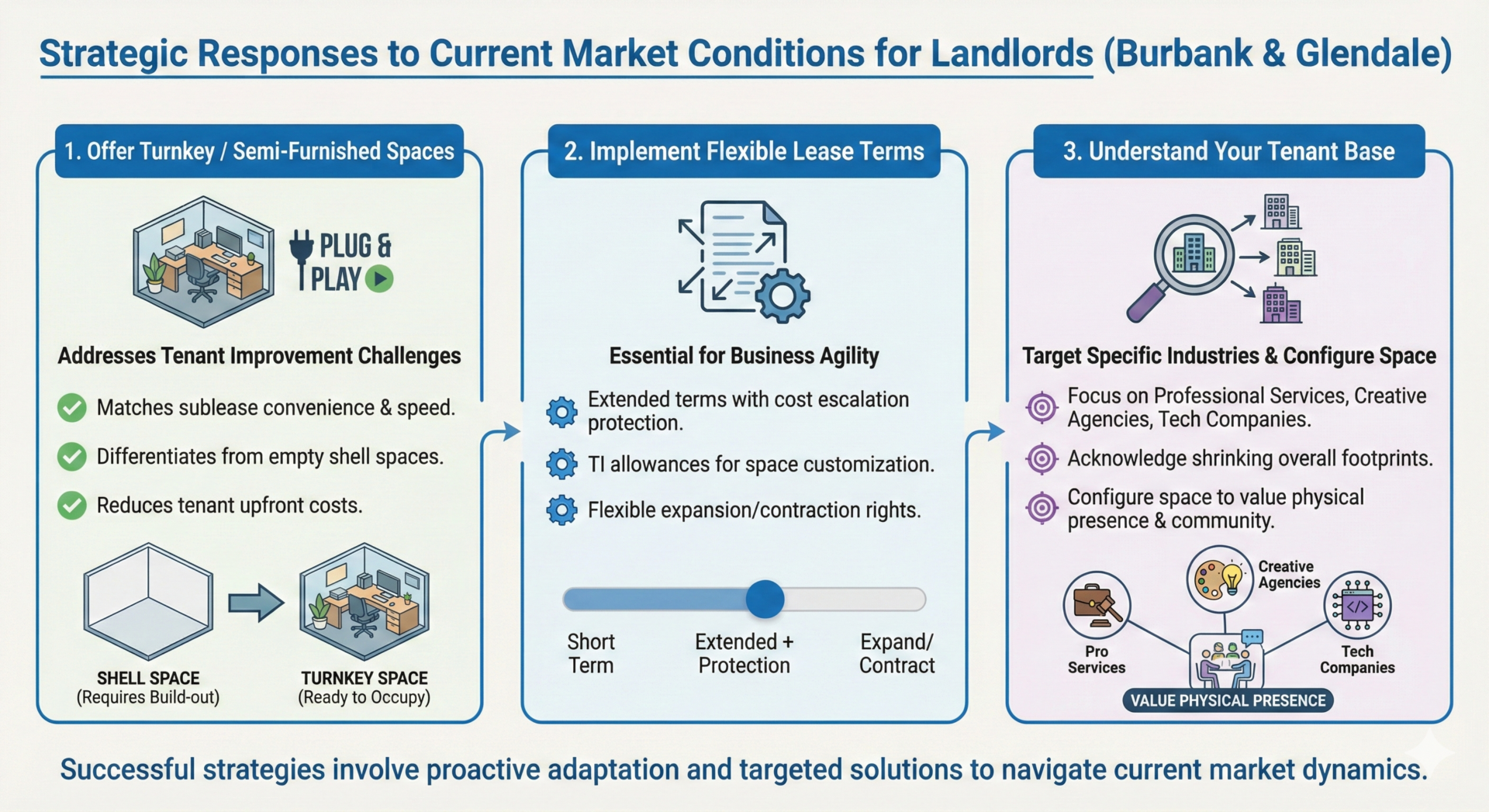
I’ve observed several successful strategies that Burbank and Glendale landlords are employing to navigate these conditions. First, offering turnkey or semi-furnished spaces addresses the tenant improvement challenge while differentiating from sublease competition. When sublease spaces come partially or fully improved, landlords of direct space must match that convenience.
Second, flexible lease terms have become essential rather than optional. Extended lease terms with built-in cost escalation protection, tenant improvement allowances for space customization, and flexible expansion or contraction rights accommodate business changes that are now expected rather than exceptional.
Third, understanding your tenant base matters more than ever. Office footprints are shrinking across the board, but certain industries—professional services, creative agencies, and technology companies—still value physical office presence and community. Targeting these sectors and configuring space to their needs creates competitive advantage.
The Flight to Quality and Sublease Dynamics
One of the most significant trends shaping the market is the flight to quality, which persists even as overall demand softens. The LA West submarket, home to the largest concentration of Class A office space, is well-positioned to capture this demand, accounting for 35.4% of the county’s available sublease space, or 3.9 million square feet.
Asking rent for sublease space in LA West averages $4.01 per square foot on a full-service gross basis—16.6%, or $0.80, lower than direct space. This creates an interesting dynamic where quality-focused tenants can access Class A space at Class B prices through subleases.
For Burbank and Glendale owners, this underscores the importance of property class and condition. If you’re holding Class B or C space, competing with discounted Class A subleases becomes extremely difficult. However, if you own well-maintained Class A or A+ properties, you can potentially attract tenants seeking quality while still benefiting from sublease pricing pressure that keeps overall market rates competitive.
Market Outlook for 2026 and Beyond
Looking ahead through 2026, several trends will continue shaping the Tri-Cities office sublease market. Available sublease space declined slightly by 2.7% quarter-over-quarter in Q1 2025 and fell 4.3% year-over-year to 10.9 million square feet, contracting at a faster rate than direct space availability. This suggests that sublease inventory may be gradually absorbing, though substantial supply remains.
Direct availability, by contrast, rose 1.0% quarter-over-quarter and 1.1% year-over-year to approximately 66 million square feet across Los Angeles County. This indicates that while sublease inventory contracts, new direct vacancy continues entering the market as leases expire and companies downsize.
Office vacancies began edging down nationally, with vacancy dipping to 18.4% in December 2025 after peaking earlier in the year. Flexible workspaces and coworking models helped fill gaps, suggesting that alternative office formats may support gradual vacancy improvement.
For property owners, this means the market remains challenging but shows signs of stabilization. Leasing momentum is expected to remain positive in 2026, with a lack of meaningful downsizing or sublease additions and record-low construction predicted to boost absorption and keep rent growth stable.
Practical Considerations for Today’s Market
If you’re navigating lease negotiations or considering property investments in the Tri-Cities area, several practical factors deserve attention. First, understand that tenants now view office space as a variable cost rather than a fixed asset. This shift fundamentally changes lease structures, with shorter terms and more flexibility becoming standard.
Second, recognize that sublease competition isn’t going away quickly. Even as sublease inventory contracts gradually, the substantial supply that remains will continue influencing market pricing. Your rental rates and lease terms must acknowledge this competitive reality.
Third, consider the role of amenities and building features beyond square footage. As companies bring employees back to the office, they’re seeking environments that justify the commute. Buildings offering conference facilities, outdoor space, food service, and modern infrastructure command premium rents even in soft markets.
Learning from Warner Center’s Challenges
Warner Center’s struggles offer important lessons for all property owners. The submarket’s 22.8% vacancy rate and 26.6% availability rate demonstrate what happens when supply significantly exceeds demand. The 10.3% sublease inventory creates a three-way competition between direct landlords, sublessors, and each other.
Property owners in Burbank and Glendale should monitor their local sublease inventory carefully. When sublease space exceeds 5-6% of total inventory in a submarket, it typically signals distress conditions that pressure all rents downward. The Tri-Cities currently shows sublease rents 40.3% below direct space, indicating substantial competitive pressure.
The key defensive strategy involves maintaining quality, offering value beyond price, and cultivating long-term tenant relationships that discourage opportunistic moves to cheaper sublease space. Tenants who feel valued and whose space meets their needs are less likely to endure relocation costs for modest rent savings.
Opportunity in Market Dislocation
Despite the challenges, market dislocation creates genuine opportunities for strategic property owners. First, acquisition opportunities have emerged as sales volume and pricing adjust to new realities. The average sale price dropped 5.3% from Q4 2024 and 36.2% year-over-year to $249 per square foot across Los Angeles County.
Second, repositioning opportunities abound. Office-to-residential conversions and alternative use strategies are being pursued in markets facing persistent vacancy challenges. While not appropriate for every property, owners of buildings with favorable characteristics—good bones, convenient location, manageable conversion costs—may find alternative uses more profitable than continuing to compete in oversupplied office markets.
Third, the market rewards landlords who innovate around tenant needs. Flexible lease structures, spec suites designed for immediate occupancy, and amenities that support hybrid work models differentiate properties in crowded markets.
Preparing for Market Evolution

The office market is evolving rather than simply recovering to pre-pandemic conditions. Remote work, hybrid models, and fundamentally changed attitudes toward office space mean that demand patterns have shifted permanently. Property owners must adapt their strategies accordingly.
This evolution creates long-term implications for property values, rental rates, and optimal use strategies. Buildings designed for traditional office use may require reimagining to meet current tenant needs. Space configurations emphasizing collaboration over individual workstations, technology infrastructure supporting hybrid meetings, and amenities that create reasons for in-person presence will increasingly differentiate successful properties.
For Tri-Cities property owners, this means thinking beyond near-term leasing challenges to longer-term positioning. The market will eventually stabilize at new equilibrium rent levels and occupancy patterns. Properties positioned to thrive in that new equilibrium—rather than simply surviving current conditions—will ultimately deliver superior returns.
FAQs
How does the Tri-Cities office sublease market compare to direct leasing options?
Sublease asking rents in the Tri-Cities average $2.25 per square foot, which is 40.3% (or $1.52) below direct space. Sublease leasing activity surged 42.1% year-to-date in early 2025, while direct leasing activity dropped 8.5%. This significant rent gap creates strong competitive pressure for direct landlords but offers tenants substantial cost-saving opportunities.
Why is Warner Center struggling while Sherman Oaks remains stable?
Warner Center faces a 22.8% vacancy rate with 26.6% availability and sublease space comprising 10.3% of inventory, creating intense competition among landlords. Sherman Oaks maintains a more manageable 13.6% vacancy rate with positive net absorption of 55,500 square feet and no new construction adding to supply. Sherman Oaks benefits from smaller building sizes, diverse tenant mix, and more central Valley location.
What is the current vacancy rate for office space in Burbank?
Burbank recorded an 18.8% vacancy rate in Q1 2025, with positive net absorption of 52,401 square feet. The market benefits from entertainment industry tenants and media companies that maintain physical office presence, creating inherent demand compared to other submarkets.
How are tenant improvement costs affecting the office market in 2026?
The high cost of tenant improvements continues to present challenges for property owners, creating opportunities for tenants willing to adapt to existing sublease spaces that come partially or fully improved. This dynamic particularly benefits the sublease market, as tenants can avoid the time and expense of building out raw space.
What market conditions should Burbank and Glendale property owners watch in 2026?
Property owners should monitor sublease inventory levels (currently contracting at 4.3% year-over-year), direct availability trends (rising 1.1% year-over-year), and net absorption patterns in their specific submarkets. Additionally, tracking tenant improvement cost trends, lease term flexibility demands, and flight-to-quality dynamics will help inform leasing strategies.
Conclusion
The Tri-Cities office sublease market presents a complex but navigable landscape for Burbank and Glendale property owners in 2026. While sublease competition creates pricing pressure, understanding market dynamics and responding strategically positions you to protect asset value and maintain steady occupancy. The contrast between Sherman Oaks’ stability and Warner Center’s struggles illustrates how location, tenant mix, and supply dynamics determine market outcomes.
If you’re looking to optimize your commercial property strategy in this evolving market, I’d welcome the opportunity to discuss your specific situation. Schedule a consultation with Tolj Commercial, and let’s explore how to position your assets for success in today’s market conditions.