The Westside office market is experiencing what I call the “Westside Reset”—a recalibration period where Class A rents are softening and landlords face a critical decision: chase new tenants at discounted rates or invest in keeping the quality tenants already in place. After nearly two decades working with West LA property owners, I’ve learned that tenant retention isn’t just about avoiding vacancy—it’s about preserving value, maintaining cash flow, and positioning your asset for the next market cycle.
Key Takeaways
- West Los Angeles office vacancy hovers around 19-20%, creating competitive pressure where tenant retention becomes more cost-effective than backfilling space at lower rates
- Strategic concessions, modern amenities, and proactive communication reduce turnover costs while maintaining long-term property value during market corrections
- Flexible lease terms, tenant improvement allowances, and relationship-building initiatives can improve renewal probability from 25% to 75%, lifting NOI by 10-15% over a decade
Understanding the Current West LA Office Landscape

Market Realities Shaping Tenant Decisions
Westside vacancy rates stabilized around 19.9% through mid-2025, with sublease space reaching 2.3 million square feet. Greater Los Angeles office vacancy hit roughly 24% by Q3 2025, though year-to-date leasing activity still totaled approximately 7.0 to 7.3 million square feet. This tells us the market is moving, but tenant leverage has shifted dramatically.
The LA West submarket accounts for 35.4% of the county’s available sublease space—roughly 3.9 million square feet. Sublease asking rents average $4.01 per square foot on a full-service gross basis, running 16.6% lower than direct space. For landlords, this creates downward pricing pressure that makes tenant retention more valuable than ever.
The Split-Market Story
Buildings with real identity, strong amenities, and clear positioning still maintain leverage. Commodity office space without differentiation struggles unless owners reposition, reprice, or offer meaningful concessions. This bifurcation means your tenant retention strategy must be tailored to where your property sits in this spectrum.
Why Tenant Retention Outperforms Backfilling
The True Cost of Tenant Turnover
Losing a tenant in this environment means more than just temporary vacancy. Commercial lease turnover can cost up to 40% of your annual lease value when you factor in lost rent, tenant improvement allowances, leasing commissions, and the time required to secure a replacement tenant.
| Tenant Turnover Costs | Tenant Retention Benefits |
|---|---|
| Up to 40% of annual lease value lost | 30% lower turnover rates |
| Leasing commissions (3-6% typically) | 10-15% higher NOI over 10 years |
| Tenant improvement allowances | 50-100 basis points IRR increase |
| 3-12 months vacancy period | Stable cash flow maintained |
| Marketing and showing costs | Stronger property reputation |
Properties that implement comprehensive retention strategies show up to 30% lower turnover rates and achieve premium rents compared to buildings constantly cycling tenants. The math is straightforward: moving renewal probability from 25% to 75% can halve tenant incentive expenses and lift net operating income over a 10-year period by 10-15%, raising unlevered IRRs by 50-100 basis points.
Keeping Quality Tenants vs. Attracting New Ones
In a softening market, the quality tenants already occupying your space are statistically more creditworthy than the average tenant you’ll attract at discounted rates. Good tenants who renew maintain your property’s income stability, reduce associated costs with turnover, and help preserve your building’s reputation in the market.
The Westside Reset Playbook: Strategic Retention Tactics
Offer Strategic Concessions Without Devaluing Your Asset
Tenants are seeking shorter lease terms, early termination rights, rent reductions, and flexible space options. However, landlords can offer flexibility without compromising long-term value by structuring concessions thoughtfully.
Consider deferring rent for an initial period in exchange for higher-than-market rent later in the term. For businesses with seasonal cash flow variations, you might charge lower rents during off-season periods with compensating increases during peak seasons. These approaches make leases more attractive while allowing you to share in potential upside gains.
Current market conditions also favor offering lease renewal incentives such as rent discounts, improvement allowances, flexible terms, or rights of first refusal. The key is structuring these incentives to encourage long-term occupancy rather than creating precedents that permanently reduce your property’s value.
Enhance Your Tenant Improvement Approach
The high cost of tenant improvements presents challenges for property owners, but it also creates opportunities. Tenants willing to adapt to existing spaces—particularly sublease spaces—can find significant value, but direct landlords who strategically invest in improvements demonstrate commitment to tenant needs.
Rather than viewing tenant improvement allowances purely as costs, consider them investments in tenant satisfaction and lease renewal probability. Enhanced TIAs with appropriate safeguards protect your investment while making your spaces more competitive. Buildings offering flexible workspace configurations show 22% lower turnover rates.
Modernize Amenities to Match 2025 Tenant Expectations
Tenant expectations have evolved rapidly. In 2025, workplace amenities are no longer optional—they’re essential drivers of tenant retention. Properties with modern amenities command 5.6% higher rents than comparable non-upgraded buildings.
Top-performing West LA properties now feature fitness centers, wellness spaces, conference and collaboration areas, high-speed connectivity infrastructure, grab-and-go cafés, and outdoor workspaces. Buildings that add value-add spaces see 12% higher tenant demand compared to properties without such features.
High-Impact Amenities by Priority:
- Wellness & Fitness: On-site gyms, yoga studios, meditation spaces
- Collaboration Zones: Conference rooms, brainstorming areas, informal meeting spaces
- Food & Beverage: Grab-and-go cafés, barista stations, tenant lounges
- Outdoor Access: Terraces, rooftop decks, landscaped common areas
- Technology Infrastructure: High-speed fiber, 5G connectivity, smart building systems
- Convenience Services: Bike storage, EV charging, package handling
Culture-building is cited as a primary advantage of returning to office work, and tenants actively seek buildings with amenity spaces that encourage engagement and shared experiences. Convenient amenities foster the sense of community that makes tenants feel connected to your property and more likely to renew their leases.
Prioritize Sustainability and Wellness Initiatives
Environmental, Social, and Governance (ESG) initiatives significantly impact tenant retention. Buildings with sustainable features experience 30% lower tenant turnover rates. Energy-efficient systems can cut operational costs by 35%, while green-certified buildings attract premium rents and face lower default risks.
Wellness amenities have shifted from luxury to necessity. Tenants prioritize features improving mental and physical well-being, such as fitness centers with modern equipment, green spaces or indoor plants for biophilic design, and healthy on-site food options. Air filtration, ventilation, and purification rank among the top drivers of tenant satisfaction.
Building Tenant Relationships That Drive Renewals
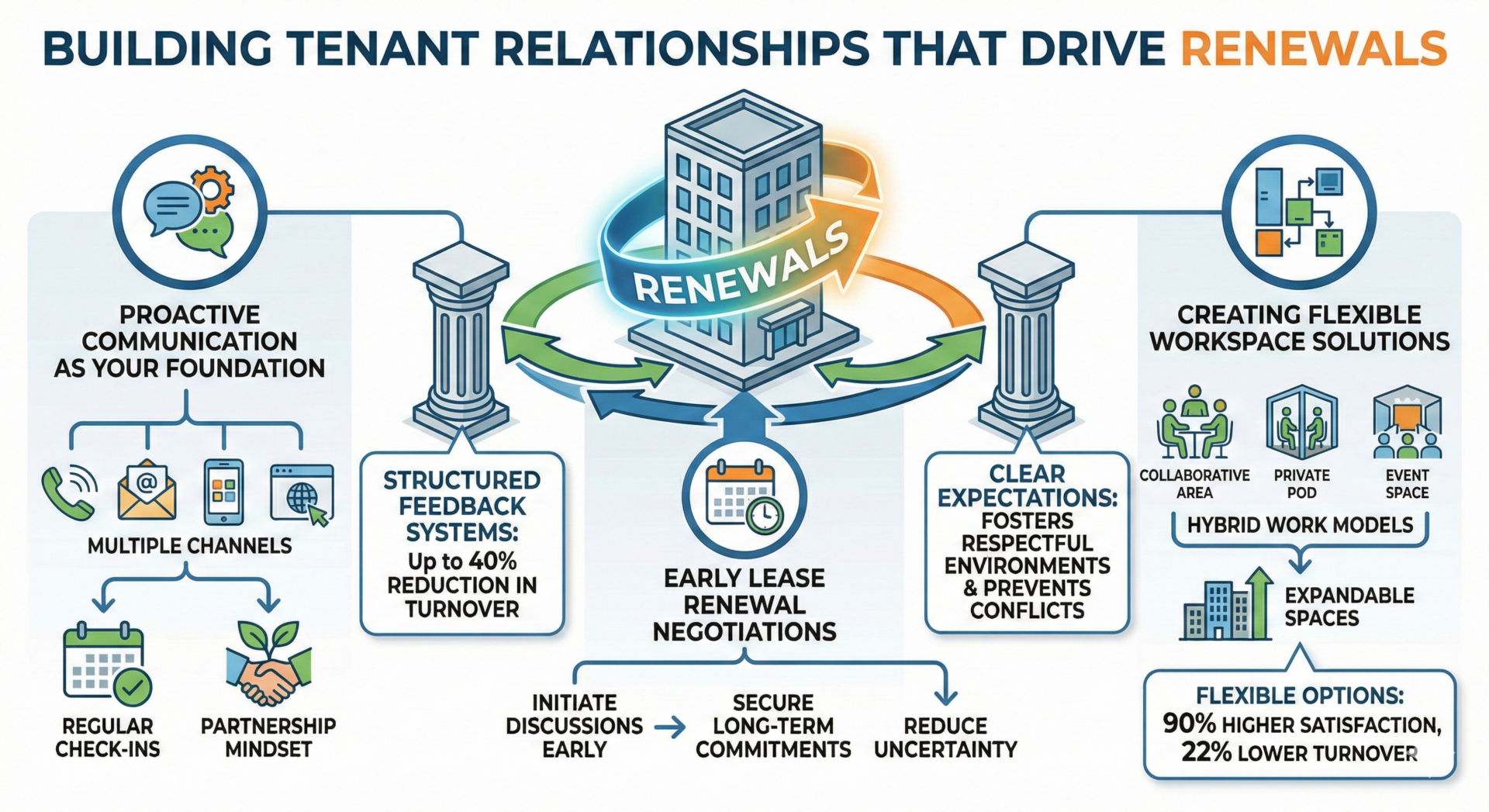
Proactive Communication as Your Foundation
Building management responsiveness consistently emerges as the most critical factor in tenant satisfaction across all property types. This encompasses far more than addressing maintenance requests—it represents the overall quality of communication, problem-solving, and relationship management between property management teams and tenants.
Properties using structured tenant feedback systems experience up to 40% reduction in turnover rates. Successful properties provide multiple communication channels including mobile apps, phone lines, email systems, and online portals, ensuring tenants can reach management through their preferred method.
Regular tenant check-ins beyond issue resolution demonstrate proactive care and often identify potential problems before they become complaints. Property managers who view themselves as partners in their tenants’ success consistently achieve higher satisfaction scores.
Early Lease Renewal Negotiations
Initiating discussions well before lease expiration secures long-term commitments and reduces uncertainty for both parties. Tenants who feel valued through ongoing dialogue are more likely to renew, lowering vacancy costs and reducing the risk of losing income during market downturns.
Setting clear expectations early through well-crafted lease agreements and transparent property rules fosters respectful environments and prevents conflicts. The more clearly expectations are established, the fewer disputes arise later in the tenancy.
Creating Flexible Workspace Solutions
Tenants value spaces that evolve with their business needs. Properties offering flexible workspace options show 90% higher tenant satisfaction rates. The rise of hybrid work models means tenants prioritize spaces supporting collaborative areas for brainstorming, private pods for focused work or virtual meetings, and event spaces for networking or company gatherings.
Expandable spaces allow tenants to grow within your property instead of moving elsewhere when their needs change. Properties providing flexible lease terms and workspace configurations demonstrate 22% lower turnover rates.
Data-Driven Retention Strategies
Tracking the Right Metrics
Modern property management requires systematic approaches to track and analyze tenant data. Your tenant satisfaction monitoring should target specific, measurable key performance indicators including response time to maintenance requests, tenant survey completion rates, Net Promoter Score (NPS), lease renewal probability scores, and payment history patterns.
Properties with detailed risk assessment systems can identify 60% of potential turnover cases through early warning signs. This predictive capability allows you to address tenant concerns before they escalate to lease non-renewals.
Smart Building Integration for Tenant Comfort
Smart building technology enhances operational efficiency and tenant experience. IoT sensors and automated systems optimize energy usage while improving tenant comfort. Research shows smart building systems can save 20-25% on HVAC energy costs alone. These technologies create environments that keep tenants satisfied while reducing your operating costs—a win-win scenario for tenant retention and property value.
Navigating Lease Expirations in 2025-2026
The Opportunity in Market Timing
With approximately 150 million square feet of office space facing lease expirations through 2025, tenant leverage remains elevated. This creates competitive pressure but also opportunities for landlords willing to act decisively on retention.
Tenants exploring their options find landlords more amenable to reduced rates or lower effective rental rates when calculating the economic benefits of concessions such as free rent. However, landlords with solid financing are increasingly willing to invest in tenant improvements to make spaces more appealing, either as turnkey build-outs or through higher tenant improvement allowances.
Positioning Your Property Competitively
The flight to quality continues as companies choose offices supporting culture, productivity, and credibility. Buildings without clear value propositions struggle while properties offering genuine advantages in location, amenities, technology, or tenant services maintain occupancy and rental rates.
Your retention strategy should emphasize what makes your property irreplaceable. Is it proximity to talent pools? Superior building systems? A collaborative tenant mix? Outstanding management responsiveness? Identify your competitive advantages and communicate them consistently to existing tenants.
Long-Term Value Creation Through Retention
Protecting Property Value During Market Cycles
Thoughtful and strategic lease negotiations not only attract tenants but also help stabilize rental income and preserve property values during downturns. Properties maintaining high occupancy through retention strategies position themselves advantageously for the next appreciation cycle.
Operational expense savings from reduced turnover can equate to around 10% of a building’s original purchase price for core investors. This represents significant value creation that compounds over time, particularly in longer hold periods.
Building Competitive Moats

Tenant relationships, property reputation, and demonstrated management excellence create competitive advantages that transcend individual market cycles. Properties known for tenant satisfaction and fair dealing attract quality tenants more easily and maintain pricing power even during softer markets.
The companies that excel at listening to their tenants and being proactive in communication will be the long-term winners in competitive West LA submarkets. Regular visits, follow-ups, and genuine willingness to listen build trust and strengthen relationships while reducing the likelihood of tenants exploring other options when leases expire.
FAQs
What are the most effective tenant retention strategies for West LA office landlords in 2025?
The most effective strategies combine proactive communication, strategic concessions, modern amenities, and flexible lease terms. Properties implementing comprehensive approaches—including regular tenant check-ins, wellness and sustainability initiatives, and technology-enabled experiences—see up to 30% lower turnover rates. Building management responsiveness consistently ranks as the most critical factor driving tenant satisfaction.
How much does tenant turnover actually cost compared to retention initiatives?
Commercial lease turnover can cost up to 40% of annual lease value when factoring in lost rent, tenant improvements, leasing commissions, and time to secure replacements. In contrast, increasing renewal probability from 25% to 75% can lift NOI by 10-15% over a 10-year period and raise unlevered IRRs by 50-100 basis points. The operational expense savings from reduced turnover can equal approximately 10% of a building’s purchase price.
What amenities do office tenants prioritize most in the current market?
Tenants in 2025 prioritize amenities supporting culture-building and wellness, including fitness centers, collaboration spaces, outdoor workspaces, on-site cafés, and flexible multi-use areas. Air quality systems, sustainable features, and technology infrastructure also rank highly. Buildings adding these amenities see 12% higher tenant demand compared to properties without such features.
Should I offer rent concessions or invest in property improvements?
The optimal approach often combines both strategically. Temporary concessions can provide immediate relief to quality tenants facing economic pressures, while property improvements create lasting value that benefits all tenants and supports future rental rates. Consider deferring rent in exchange for higher future rates or offering improvement allowances that encourage long-term lease commitments rather than permanent rent reductions that erode property value.
How early should I start lease renewal discussions with tenants?
Initiate renewal discussions well before lease expiration—ideally 12-18 months out for larger tenants and 6-12 months for smaller tenants. Early engagement demonstrates commitment to tenant relationships, provides time to address concerns, and secures long-term commitments before tenants seriously explore alternatives. Properties with detailed tenant monitoring can identify renewal risks even earlier through early warning indicators.
Conclusion
The Westside Reset presents West LA landlords with a clear choice: invest in the quality tenants you already have or face the higher costs and risks of constant turnover in a competitive market. The data consistently shows that strategic tenant retention—through proactive communication, modern amenities, flexible terms, and genuine relationship-building—delivers superior returns compared to cycling through tenants at discounted rates.
If you’re navigating tenant retention challenges or positioning your West LA property for the next market cycle, I’d welcome the opportunity to discuss strategies specific to your asset. With 18 years of experience representing landlords across West Los Angeles, I’ve helped property owners preserve value and maintain cash flow through multiple market cycles. Schedule a consultation with Tolj Commercial today to explore how we can strengthen your tenant retention and maximize your property’s performance.