What to Negotiate When Securing Gym Space for Lease in LA
Mike Tolj
Mike Tolj
Mike Tolj specializes in representing business owners and landlords in the leasing and sale of commercial properties. He has over 18 years of experience in the industry and knows how to get deals done quickly and efficiently. Mike is passionate about helping business owners and landlords alike achieve their real estate goals. He has a track record of achievement, having completed numerous transactions for his clients.
Finding gym space for lease in LA is already competitive enough without leaving money on the table before you’ve even opened. After 18 years in commercial real estate, I can tell you most gym and fitness studio tenants sign leases that work out great — for the landlord. The good news? With the right approach, you can negotiate terms that genuinely protect your investment and your long-term operations. Here’s exactly what to ask for, and why most tenants never do.
Key Takeaways
Most gym tenants focus entirely on base rent — the real leverage is in clauses like TI allowances, exclusive use provisions, and HVAC responsibility, which can save tens of thousands of dollars before you open your doors.
A gym buildout in LA typically takes 3–6 months, which means rent abatement during construction isn’t just a nice perk — it’s a financial necessity you should be pushing for from the very start of negotiations.
Early termination protection tied to zoning changes is a clause most fitness tenants skip entirely, but in a city like Los Angeles — actively overhauling its land use code right now — it could be the clause that saves your whole business.
Why Gym Leases Are Different From Standard Commercial Space
A gym isn’t a boutique retailer or a standard office tenant, and your lease shouldn’t be treated like one either. When you secure training space for a fitness center or private gym, you’re committing to a buildout that can run from $50,000 to well over $200,000 depending on the size and scope of the project. You need reinforced flooring to handle heavy equipment, plumbing for showers and restrooms, upgraded AC systems to manage large groups of people working out for hours, high ceilings to accommodate functional movements and equipment, and often a fully open floor plan that most vanilla commercial spaces just don’t have out of the box.
That buildout complexity changes your negotiating position entirely. You’re not just a renter — you’re a tenant who’s going to dramatically improve a landlord’s property with your own capital. That’s real leverage, and most gym owners don’t use it. They walk in, ask about square feet and monthly rent, and sign before they’ve pushed for a single protective clause.
In active submarkets like West Hollywood, Glendale, Santa Monica, and across the broader West Los Angeles corridor, quality gym space for lease moves quickly. But speed isn’t a virtue here — strategy is.
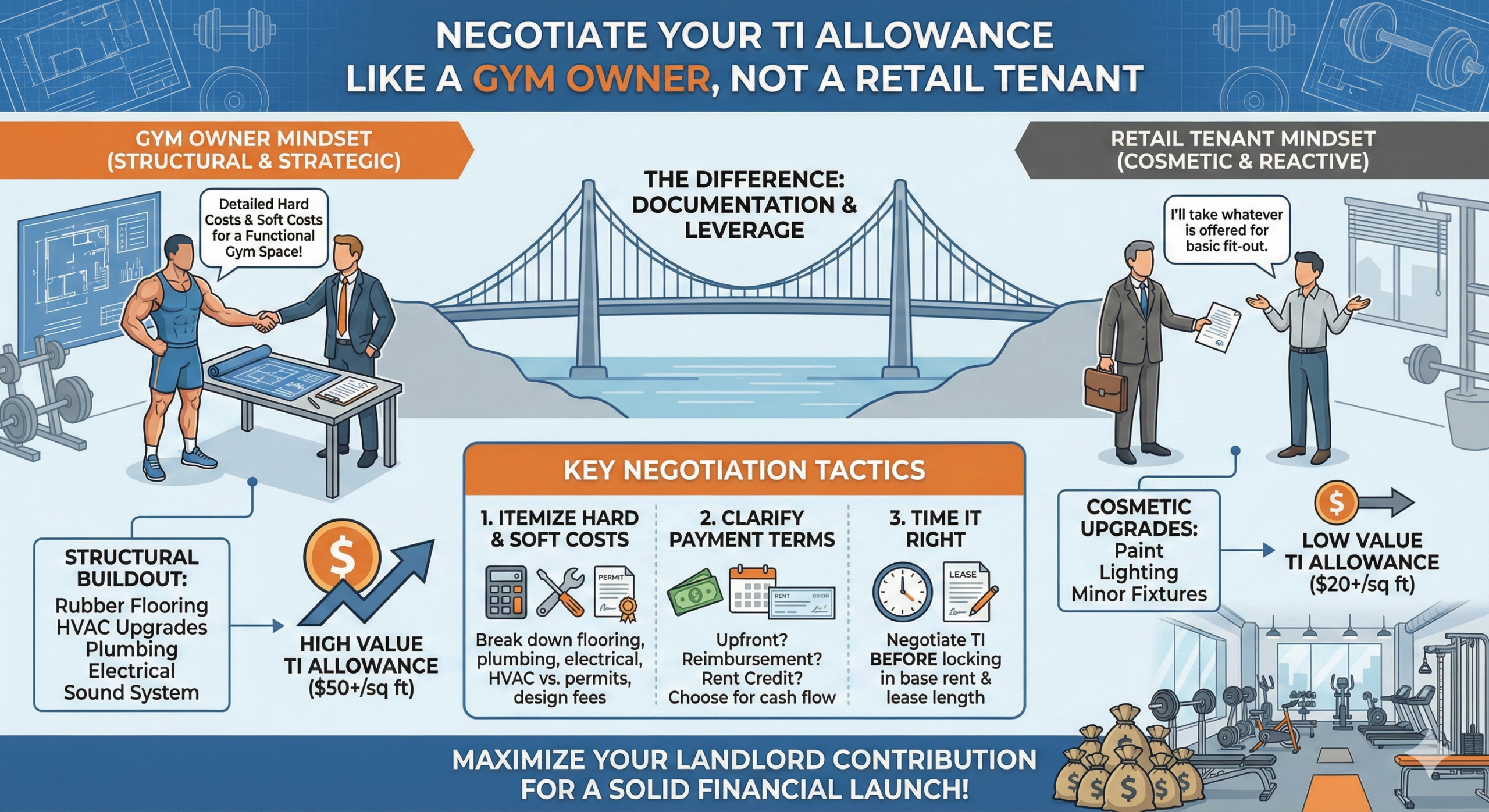
Negotiate Your TI Allowance Like a Gym Owner, Not a Retail Tenant
A TI allowance is money the landlord contributes toward customizing the space for your specific use. For a fitness studio or commercial gym in LA, a meaningful buildout covers rubber flooring across several thousand sq ft, locker room plumbing, electrical panel upgrades, AC and HVAC improvements, a lounge area, and potentially a full sound system. These aren’t cosmetic upgrades — they’re structural, and they’re expensive.
In the Los Angeles market, commercial tenant improvement allowances for retail and fitness-adjacent spaces typically range from $20 to $50 per square foot, depending on lease length, the property’s condition, and how motivated the landlord is to fill the space. On a 5,000 sq ft training space, that’s anywhere from $100,000 to $250,000 in potential landlord contribution toward your buildout. That money can determine whether your gym launches on solid financial footing or starts in a hole.
Here’s what most gym tenants get wrong: they accept whatever the landlord first offers without backing their ask with documentation. Bring detailed contractor estimates. Break down hard costs — flooring, plumbing, electrical work, HVAC upgrades — separately from soft costs like permits, architectural plans, and inspection fees. The more specific and itemized your request, the harder it is for a landlord to justify a lowball response.
Also, clarify how the TI is paid. Is it disbursed upfront, reimbursed after invoices are submitted, or credited against rent? Cash flow timing matters enormously when you’re several months into a buildout with no members paying dues yet.
One more thing: negotiate TI before you lock in base rent. Landlords are often more flexible on improvement contributions than they are on the face rental rate — and some will actually concede more on TI if you’re willing to commit to a longer lease term.
Lock Down an Exclusive Use Clause Before Anyone Else Does
This is the clause most gym and fitness studio tenants either don’t know to ask for or don’t ask for with enough precision. An exclusive use clause prohibits the landlord from leasing any other space in the same shopping center or building to a direct competitor — another gym, fitness center, yoga studio, dance studio, or training space.
Why does this matter so much? Picture this: you’ve invested heavily in a 4,500 sq ft fitness studio with high ceilings, a spacious open layout, and large windows bringing in natural light. Six months after you open, a boutique cycling studio opens two doors down in the same center because your lease had no exclusivity language. The landlord did nothing wrong — because you didn’t ask for that protection.
Getting this clause right requires precision. A loosely written exclusive use provision might only cover a “primary use” that mirrors yours exactly, leaving plenty of room for a competitor to operate as a secondary activity under a different lease classification. Your clause needs to:
Cover the full range of competing fitness, wellness, and training uses — not just a narrow description
Prohibit the landlord from amending existing tenant leases to allow competing activity
Include meaningful remedies — rent abatement, injunctive relief, or termination rights — if violated
Apply to new leases, renewals, and any approved assignments or subleases in the same center
This single clause protects everything you’re investing in your gym space for lease, your buildout, your branding, and your membership base at that location.
Make HVAC Upgrades the Landlord’s Problem, Not Yours
Here’s something most fitness tenants don’t think about until it’s already a problem: the HVAC systems in standard commercial spaces are designed for typical office density. A fitness center running boot camps, group training sessions, or packed spin classes with 20 to 40 people generates significantly more heat and requires dramatically more airflow than any office or typical retail space.
That means HVAC upgrades aren’t optional — they’re a code-required, operationally critical necessity. And they can carry a significant price tag. The key negotiation move here is framing: you’re not asking the landlord to customize the building for your personal preferences. You’re asking them to deliver a space that can legally and practically support the use they’re agreeing to permit under your lease. That’s a different ask, and it lands differently in negotiations.
If the landlord won’t take full responsibility for the HVAC upgrade, negotiate a defined line item within the TI allowance with a written cap on your financial exposure. Don’t let an HVAC surprise drain the capital you need for equipment, staffing, and your pre-opening marketing push.
Rent Abatement During Your Buildout: You’ve Earned It Before You Open
A gym buildout in Los Angeles realistically takes 3 to 6 months when you account for permitting timelines, contractor scheduling, and city inspections. During that entire stretch, you’re paying vendors, waiting on permits, and building out a space that hasn’t generated a single dollar in revenue. Paying full rent on top of all that is like paying for a restaurant seat before the kitchen has even been built.
Rent abatement during the buildout period — sometimes called a free rent period — suspends your rent obligation until construction reaches substantial completion or until you open for business. It’s one of the most powerful tools in any gym lease negotiation, and landlords are frequently more willing to grant it than most tenants expect.
Why? Because free rent during a buildout doesn’t change the “face rent” the landlord can report to other tenants or to lenders. It’s a one-time, time-limited concession — which makes it psychologically easier for a landlord to agree to than a permanent reduction in the monthly rate.
Early Termination Protection in a City That’s Rewriting Its Zoning Code
This is the clause almost no gym tenant asks for — and in Los Angeles in 2026, it may be the most strategically important protection you can put in your lease.
Los Angeles is in the middle of a comprehensive zoning overhaul, replacing its outdated 1946-era land use framework with a new form-based code that introduces new Use Districts, Overlay Zones, and frontage standards across neighborhoods from Downtown LA to West LA, Sherman Oaks, and beyond. For a fitness studio tenant, that means the zoning classification that makes your use perfectly legal today could theoretically be complicated, reclassified, or burdened with new compliance requirements as the new code rolls out neighborhood by neighborhood.
An early termination clause tied to zoning changes gives you a defined exit if local land use regulations materially impact your ability to operate — or force expensive compliance retrofits you never budgeted for. This isn’t paranoia. It’s practical risk management in a city actively rewriting the rules for how commercial spaces are used.
Ask your real estate attorney to draft language that permits termination with reasonable notice if:
Your permitted fitness use is restricted or reclassified under new zoning rules
City-mandated compliance retrofits to maintain your operating permit exceed a defined threshold
New overlay restrictions materially affect your core gym operations or hours
Not every landlord will agree to this on first pass, but many will — especially if you frame it as a mutual protection clause rather than a one-sided exit option.
Other Lease Protections Worth Fighting For
Beyond those five major provisions, here are a few more clauses I consistently help fitness clients push for in their gym lease negotiations:
Assignment and subletting rights. If you ever want to sell your gym or bring in an equity partner, a restrictive assignment clause can trap you. Negotiate reasonable assignment rights so your business retains flexibility.
Dedicated parking. Fitness centers live and die by convenient, available parking. Whether your gym space is located in Glendale, Gardena, Santa Monica, or anywhere in between, dedicated parking — with a specific number of spaces in writing — should be in your lease. Street parking alone won’t carry a high-volume training facility.
Co-tenancy clauses. If you’re choosing a space in a shopping center because of an anchor tenant driving foot traffic, a co-tenancy clause protects your rent rate if that anchor vacates.
Personal guarantee burn-off provisions. Landlords typically ask for personal guarantees from gym operators. Negotiate a burn-off schedule so your personal exposure decreases over time as you demonstrate consistent rent payment history.
Capped rent escalations. Lock in future rent increases at a capped annual percentage or tie them to CPI. On tight fitness business margins, uncapped rent escalations can quietly kill a gym four or five years into an otherwise successful lease.
What Smart Gym Tenants Know Before They Sign
The difference between a gym that thrives and one that struggles often has nothing to do with the equipment, the programming, or even the members — it comes down to the lease that was signed before the doors ever opened. Every clause discussed here represents a real financial exposure you can either protect yourself from or absorb unknowingly. TI allowances fund your buildout. Exclusive use clauses protect your market position. HVAC provisions prevent surprise capital drains. Rent abatement keeps your cash flow intact during construction. And early termination rights give you an exit if the regulatory landscape shifts under your feet.
None of these protections are handed to you automatically — they’re negotiated. And in a market as active and competitive as Los Angeles, where gym space for lease can move fast and landlords know it, preparation is everything. Whether you’re targeting a spacious open floor plan in West Hollywood, a high-ceiling training space in Glendale, or a full-service fitness studio with natural light and large windows in Santa Monica, the terms you fight for before you sign are the foundation your entire business will be built on. Get them right, and you’ll be operating from a position of strength from day one.
FAQs
What is a TI allowance and how much should I ask for as a gym tenant in LA?
A TI allowance is the landlord’s financial contribution toward customizing the space for your use. In LA, that typically runs $20 to $50 per square foot — meaning $100,000 to $250,000 on a 5,000 sq ft gym. Always back your ask with detailed contractor estimates; documented costs are much harder to push back on than a ballpark number.
What is an exclusive use clause and why does it matter for a gym?
It’s a lease provision that stops your landlord from renting nearby space to a competing gym, fitness studio, or training facility. Without it, a competitor can legally open next door. It’s one of the most valuable protections a fitness tenant can have — and it costs nothing to ask for.
How long does a typical gym buildout take in Los Angeles?
Expect 3 to 6 months when you factor in permitting, contractor scheduling, and city inspections. That’s the exact reason rent abatement during construction matters so much — you shouldn’t be on the hook for full rent while your space is still a construction zone.
Can I negotiate HVAC upgrades into my gym lease in California?
Yes, and you should. Standard commercial HVAC systems aren’t built for fitness center occupancy loads. Under California commercial lease standards, major HVAC capacity upgrades are generally a landlord responsibility — push to have that spelled out in writing before you sign, or cap your exposure within the TI allowance.
Why do I need early termination protection in a gym lease in LA right now?
Los Angeles is actively rolling out a sweeping zoning code overhaul in 2026, replacing its 1946 land use framework with new Use Districts and Overlay Zones. If new regulations restrict your fitness use or trigger costly compliance retrofits, an early termination clause gives you a negotiated exit — instead of leaving you locked into a space you can no longer operate.
Conclusion
Securing gym space for lease in LA is a big move — and the lease you sign will shape your business for years to come. Getting the right protections in place from the start isn’t just smart; it’s the difference between a gym that grows and one that gets squeezed by terms it never should have accepted.
The information presented in articles on our website or affiliated platforms is exclusively intended for informational purposes. It’s crucial to grasp that this content does not constitute professional advice or services. We strongly recommend our readers to seek guidance from appropriately qualified experts, including, but not limited to, real estate and other attorneys, accountants, financial planners, bankers, mortgage professionals, architects, government officials, engineers, and related professionals. These experts can offer personalized counsel tailored to the specific nuances of your individual circumstances. Relying on the content without consulting the relevant experts may hinder informed decision-making. Consequently, neither Tolj Commercial Real Estate nor its agents assume any responsibility for potential consequences that may arise from such action.