


So you’ve got the concept locked in, you’ve been dreaming about that perfect corner spot on Colorado Boulevard, and you’re ready to make your Eagle Rock coffee shop a reality. That’s exciting — and honestly, this neighborhood deserves more great independent cafés. But before you fall in love with a space, there’s a lot more to navigate than just the rent number. Permits, parking compliance, and lease terms can quietly derail even the best-planned concepts. Here’s what you need to know before you sign anything.
Key Takeaways
- Eagle Rock’s Colorado Boulevard corridor is one of Northeast LA’s most active retail strips, but competition for quality café space is real — and lease terms can make or break your concept before you pour a single espresso.
- Opening a coffee shop in Eagle Rock, CA requires multiple permits from different city and county agencies; skipping even one can delay your opening by weeks or months.
- Hidden lease costs like NNN charges, CAM fees, and percentage rent clauses can quietly erode your margins — always review the full lease with a commercial real estate professional before signing.
Table of Contents
- Why Eagle Rock Is a Prime Spot for a Coffee Shop
- Understanding the Eagle Rock Retail Lease Market
- Permits You’ll Need to Open a Coffee Shop in Eagle Rock
- The Parking Problem in Eagle Rock
- Common Lease Pitfalls for Coffee Shop Tenants
- What to Look for in an Eagle Rock Coffee Shop Space
- FAQs
- Conclusion
Why Eagle Rock Is a Prime Spot for a Coffee Shop

Eagle Rock is one of those neighborhoods that just feels right for an independent café. Tucked in Northeast Los Angeles, it’s a vibrant, diverse community with a tight-knit local identity — the kind of place where people actually linger over their espresso instead of rushing out the door. Colorado Boulevard runs through the heart of it, lined with an eclectic mix of restaurants, art galleries, and independent retail that draws steady foot traffic from both locals and visitors throughout the week.
It’s worth noting that Colorado Boulevard and Eagle Rock Boulevard — the neighborhood’s two main commercial corridors — each operate under different zoning rules, permitted uses, and design standards. Where exactly you land on the map matters more than most people realize.
The neighborhood has a well-documented coffee culture, supported by a mix of young professionals, creatives, and long-time families — a demographic that actively champions local food and beverage concepts over national chains. That community loyalty is one of Eagle Rock’s biggest commercial assets. If your café concept is authentic, neighborhood-first, and built around quality, this market has the audience for it.
But “great neighborhood” doesn’t automatically translate to “easy lease.” Before you start designing your menu boards and sourcing your single-origin beans, there’s a lot of ground to cover — permits, parking compliance, and lease terms that can trip up even experienced operators.
Understanding the Eagle Rock Retail Lease Market
Finding the right space on or near Colorado Blvd takes patience. There are currently dozens of commercial real estate listings available in and around Eagle Rock, spanning retail, restaurant, and mixed-use properties — but not all of them will be suited for a food and beverage concept. Coffee shops have specific infrastructure needs: proper ventilation, plumbing for espresso equipment, adequate electrical capacity, and enough square footage to accommodate comfortable seating without feeling cramped. Not every available space will come equipped with those systems already in place, which means your build-out costs can vary dramatically from one property to the next.
When you find a space that checks those boxes, the next thing to scrutinize is the lease structure. Most retail spaces in Eagle Rock and greater Los Angeles are offered on a triple net (NNN) basis, which means you pay base rent plus your pro-rata share of property taxes, insurance, and common area maintenance (CAM). In 2026, NNN add-ons across Greater LA typically run $0.75–$1.50+ per square foot on top of base rent. That number adds up fast, especially for a first-time tenant who budgeted only around the listed asking rate.
It’s also worth knowing that California’s SB 1103, effective January 2025, gives qualified small business tenants new rights around lease transparency and notice periods. This legislation was specifically designed to level the playing field between large institutional landlords and small business operators — another strong reason to have an experienced commercial real estate broker in your corner before you put pen to paper.
Permits You’ll Need to Open a Coffee Shop in Eagle Rock
This is where a lot of aspiring café owners get caught off guard. Opening a coffee shop in Eagle Rock, CA isn’t just about signing a lease — it involves navigating multiple layers of city and county requirements. The process is manageable, but it requires careful sequencing. Here’s what you’re typically looking at:
- Business License — Filed with the City of Los Angeles before you can legally operate any commercial enterprise in the area.
- Health Department Permit — The LA County Department of Public Health will inspect your premises for food safety compliance. Your kitchen layout, equipment specs, and sanitation setup all factor into the review.
- Zoning Approval — You need to confirm your chosen location is zoned for food service retail use. Not every commercial space on a boulevard is automatically approved for a café, especially if the prior tenant operated a non-food business.
- Building Permits — Any interior renovation, plumbing work, or equipment installation requires permits from the LA Department of Building and Safety. This includes installing espresso plumbing lines, upgrading electrical panels, and building out any interior walls or counters.
- Signage Approval — Signage in Eagle Rock is regulated by both zoning codes and any applicable overlay districts. Design approvals can limit your options for exterior branding, size, and placement — all of which directly affect how visible your café is to passersby. Confirm signage rights and restrictions before signing your lease.
- Outdoor Seating Permit — If you want a patio or sidewalk seating — a major draw in Eagle Rock’s walkable streetscape — additional approvals are needed from multiple agencies, including the city, the fire department, and potentially the local business district.
- Seller’s Permit — Required by the California Department of Tax and Fee Administration if you’re selling taxable goods, which includes most café items from drinks to packaged merchandise.
- Title 22 Compliance — California’s environmental health standards that apply to food facilities; your space must meet these requirements before the health department signs off.
- ADA Accessibility — Goes beyond restrooms. The path of travel — including entrances, sidewalks, and interior layout — must meet current ADA standards. Older Eagle Rock buildings frequently require upgrades here, and the cost responsibility should be spelled out clearly in your lease.
- Energy Conservation Standards — Required under California code for new construction and significant renovations.
- Ventilation, Grease Interceptors & Fire/Life Safety — Older buildings in Eagle Rock commonly need upgrades to ventilation systems, grease interceptors, and fire and life-safety systems. Make sure your lease clearly defines which party — landlord or tenant — is responsible for these upgrades.
- Utility Capacity — Confirm the property’s power, gas, and water capacity can support your equipment load before committing to a space.
Build extra time into your pre-opening timeline. And don’t assume a space that previously housed a café is automatically cleared for yours. Code requirements change regularly, and ADA compliance in particular can require unexpected and costly updates, especially around restroom configurations and accessible entry points.
The Parking Problem in Eagle Rock
Parking is one of the most underestimated headaches for new coffee shop operators in LA, and Eagle Rock is no exception. The neighborhood has a walkable stretch along Colorado Boulevard, but the surrounding blocks are a mix of street parking and small surface lots — and the City of Los Angeles enforces specific parking requirements for food service uses that don’t always align with what’s available at a given property.
If you’re planning to take over a space that was previously used for something other than a café or restaurant, a change of use can trigger a full parking re-evaluation from the city.
One important nuance specific to Colorado Boulevard: in certain sections of the corridor, new businesses may be eligible for a parking credit program that allows on-street parking to count toward the business’s minimum required parking. This program is administered through the Los Angeles Planning Department and the Department of Transportation, and typically involves a monthly fee calculated based on your leased or building square footage. However, this only applies in specific sections of Colorado Boulevard, eligibility criteria may have changed, and the program details are subject to revision. Before relying on this as part of your parking strategy, consult directly with the local City Planning District and your Neighborhood Council to confirm current eligibility, fees, and availability.
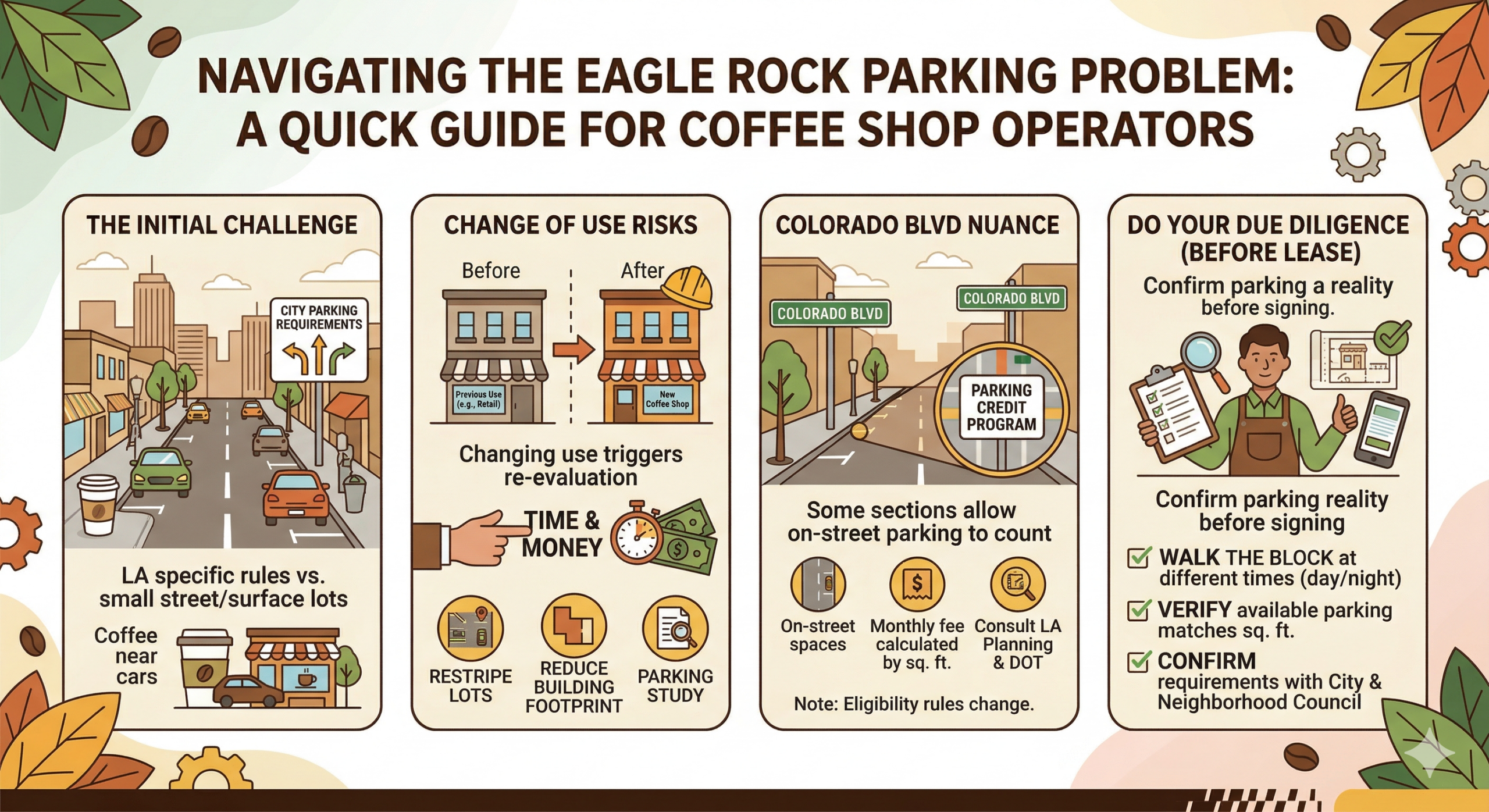
Even if the space already has a food use history, confirm that the available parking actually matches the square footage you’re leasing. Before you sign anything, walk the block at different times of day, note what’s realistically available for your customers, and verify with the city that your proposed use and square footage align with current parking requirements.
Common Lease Pitfalls for Coffee Shop Tenants
Beyond the base rent number, there are several lease clauses that can quietly damage your business if you’re not paying close attention during negotiations. These are provisions that come up in standard commercial leases all the time, and they can have a real impact on your long-term profitability.
Percentage Rent Clauses Some retail leases include a provision where you pay additional rent once your gross sales exceed a certain threshold. The concept is that the landlord shares in your upside when business is good. For a successful café, this can feel like a financial penalty for doing well. Before signing, make sure you understand exactly how percentage rent is calculated, what the breakpoint threshold is, and whether it applies to your specific deal.
CAM Fee Caps In Southern California, common area maintenance fees for retail space can amount to 20–30% of your base rent when uncapped. Without a negotiated limit on annual CAM increases, your occupancy costs can creep up significantly year over year — sometimes faster than your revenue grows. Always push to negotiate an expense stop or a cap on controllable operating cost increases so you can forecast your costs with confidence.
Use Clauses That Are Too Narrow Your lease should clearly define what you’re permitted to sell and how you’re permitted to operate. If you eventually want to add beer and wine service, host evening events, or meaningfully expand your food menu, a restrictive use clause can block you from evolving your concept without renegotiating with the landlord from scratch — often at a significant cost.
Exclusivity Provisions Make sure your lease includes a clause preventing the landlord from leasing another unit in the same property or center to a competing coffee concept. This is especially relevant in multi-tenant retail centers, but it’s worth raising in any negotiation where other café-type uses could theoretically be accommodated in nearby units.
Tenant Improvement Allowance Café build-outs are expensive, and the costs are almost always higher than first-time operators expect. Negotiate for a tenant improvement (TI) allowance upfront — landlords in the current market are often willing to contribute meaningfully to build-out costs in exchange for a longer lease commitment. Don’t leave this on the table; even a modest TI allowance can offset tens of thousands of dollars in upfront costs.
Assignment and Subletting Rights Life happens. If your circumstances change and you need to exit the lease early, or if you eventually want to sell your business, you want the contractual right to assign the lease to a qualified buyer without the landlord having unreasonable veto power over the transaction. Without this protection, selling your café business can become surprisingly complicated.
Alcohol Sales: What a Liquor License Really Involves
If your coffee shop concept includes beer, wine, or full liquor service — an increasingly common model for cafés that transition into evening bar programming — plan for a longer and more expensive regulatory process than most operators anticipate.
In California, selling alcohol requires a liquor license from the Department of Alcoholic Beverage Control. Depending on your location and the type of license you’re applying for, you may also need a Conditional Use Permit (CUP) from the City of Los Angeles. The CUP process involves public hearings, neighbor notifications, and city planning review — and costs can exceed $10,000 when you factor in application fees, legal costs, and consultant fees.
Beyond the expense, CUPs often come with strings attached. The city may impose conditions on your hours of operation, noise levels, or outdoor service to maintain compatibility with the surrounding neighborhood. If alcohol is part of your business model — even just beer and wine — factor this process into your pre-opening timeline and budget from day one, and discuss it openly with your commercial real estate broker before selecting a location, since certain properties and corridors may have restrictions that make CUP approval more difficult.
What to Look for in an Eagle Rock Coffee Shop Space

When you’re touring available retail and restaurant spaces in Eagle Rock, it pays to go beyond the square footage and the rent number. The right space on paper can still be a poor fit operationally, and discovering that after you’ve signed a coffee shop lease in Eagle Rock is an expensive lesson.
Ask about the following before you commit to any property:
- Grease trap and ventilation infrastructure — Is it already in place, or will you need to install it from scratch? Commercial ventilation systems and grease traps are significant capital expenses, and not every retail space is configured to accommodate them without major structural work.
- Electrical capacity — Commercial espresso machines, refrigeration units, HVAC, and lighting draw significant power. Confirm the existing electrical panel can support your full equipment load, or get a realistic estimate of what an upgrade will cost.
- Visibility and signage rights — A café tucked off the main corridor with limited or restricted signage will face an uphill marketing battle from day one. Make sure the lease grants you clear, visible signage rights on the building’s exterior.
- Lease term and renewal options — A five-to-seven year initial term with clearly defined renewal options gives you the stability to build a loyal local following, recoup your build-out investment, and grow your brand within the community.
- Landlord’s track record — Before signing, talk to other tenants in the building or center. A landlord who is slow to address maintenance issues or difficult to communicate with will become a recurring operational headache once you’re open and running.
Eagle Rock’s retail market has genuine demand, and the neighborhood’s vibrant, community-oriented culture is a real asset for an independent café concept. But the deals that work long-term are the ones where the lease terms are as solid as the location itself.
FAQs
How much does it typically cost to lease a retail space for a coffee shop in Eagle Rock?
Retail lease rates vary based on location, size, and condition, but always factor in NNN add-ons on top of base rent — in Greater LA, those currently run $0.75–$1.50+ per square foot. Work with a commercial real estate broker to get a realistic picture of your total occupancy cost before committing.
How long does the permit process take for a new coffee shop in Los Angeles?
Plan for several months at minimum from permit application to final sign-off, and longer if a change of use or significant renovations are involved. Starting the process as early as possible — ideally in parallel with lease negotiations — is always the smarter move.
What is a triple net (NNN) lease and how does it affect a coffee shop in Eagle Rock?
A triple net lease means you pay base rent plus a proportionate share of property taxes, insurance, and CAM fees on top of that. Understanding your full NNN burden before signing is critical to knowing whether a space is genuinely affordable for your business.
Do I need a special permit for outdoor seating at my Eagle Rock coffee shop?
Yes — outdoor seating in Los Angeles requires approvals from multiple agencies and can also affect your insurance obligations and maintenance responsibilities. Factor this approval timeline into your pre-opening schedule if a patio is part of your concept.
Can I negotiate a lease for a coffee shop space in Eagle Rock on my own?
Most commercial lease terms are negotiable, and having an experienced broker representing you ensures you’re not leaving TI allowances, CAM caps, or key protections on the table. In most cases, tenant representation fees are covered by the landlord — so there’s little reason not to have professional support.
Conclusion
Eagle Rock is a genuinely exciting market for a well-conceived coffee shop. The neighborhood’s loyal community, active street life along Colorado Boulevard, and strong appetite for authentic local concepts create real opportunity for the right operator. But the lease is where deals either set you up for long-term success or quietly undermine you before you even open your doors.
If you’re serious about finding the right space and negotiating a deal that actually works for your business, I’d love to help. At Tolj Commercial, we specialize in representing business owners through exactly this kind of process — cutting through the noise, identifying the right properties, and negotiating lease terms that protect your investment. Schedule a consultation with us today, and let’s find the Eagle Rock location your café concept deserves.


