After navigating economic headwinds and inflation pressures throughout 2025, I’ve witnessed the San Gabriel Valley retail market emerge as a standout performer heading into 2026. While national headlines continue focusing on retail challenges, the data tells a different story in this region. The combination of limited new construction, strategic tenant mix evolution, and sustained consumer resilience has created compelling opportunities for real estate investors who understand what’s driving these San Gabriel Valley retail trends.
Key Takeaways
- San Gabriel Valley retail vacancy remains exceptionally tight at 6.0-6.4%, with shop space under 2,500 square feet experiencing significant demand and quality spaces leasing quickly
- Grocery-anchored centers continue attracting strong investor interest with cap rates ranging from 5.0-6.2% for multi-tenant properties, significantly outperforming other retail sectors
- Internet-resistant tenants including service-oriented businesses, quick-service restaurants, and experiential retail are reshaping the San Gabriel Valley retail landscape and driving occupancy rates higher
The SGV Retail Market Snapshot for 2026

The San Gabriel Valley and Inland Empire retail markets entered 2026 from a position of relative strength despite broader economic uncertainty. Retail vacancy reached a 20-year low of 5.2% in the fourth quarter of 2023 and has since increased modestly to 6.4% as of late 2025. This uptick represents approximately 3 million additional square feet hitting the market, much of which consists of junior-box to big-box space from tenant bankruptcies and store closures including 99 Cents Only Stores, Big Lots, Rite Aid, and Joann Stores.
However, when you exclude the 5.5 million square feet of space measuring 20,000 square feet and larger, the vacancy rate drops dramatically to just 4.6%. This distinction is crucial for understanding current San Gabriel Valley retail trends. Shop space under 2,500 square feet remains exceptionally tight, and quality spaces continue to lease quickly across the region.
From my day-to-day observations working these markets, the lack of available vacancy is often striking. Over three decades in commercial real estate, I’ve seen prolonged periods with far more empty shop space than exists today. Many mediocre centers are currently running at 100% occupancy, underscoring the continued strength and resilience of the San Gabriel Valley retail sector.
Why Internet-Proof Tenants Are Reshaping SGV Retail
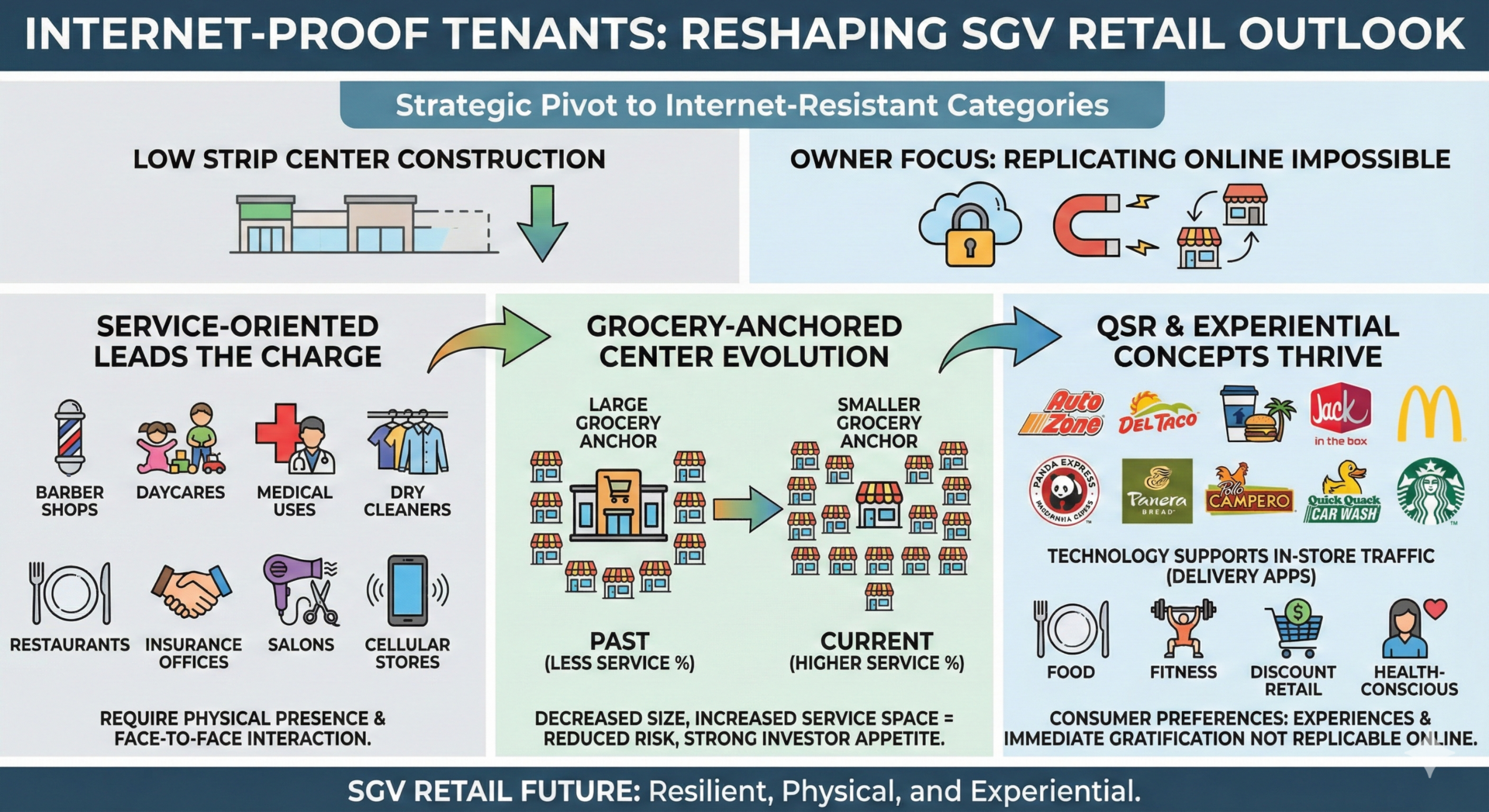
The most significant trend transforming the San Gabriel Valley retail outlook involves the strategic pivot toward internet-resistant tenant categories. While construction of new strip centers has remained well below historical averages for several years, shopping center owners are increasingly focused on attracting businesses that cannot be easily replicated online.
Service-Oriented Tenants Lead the Charge
Service-oriented tenants occupying small-shop space in grocery-anchored shopping centers rank among the most internet-resistant categories. These include barber shops, daycares, medical uses, dry cleaners, restaurants, insurance offices, salons, and cellular stores—businesses that require physical presence and face-to-face interaction.
The average size of supermarket-anchored shopping centers has decreased over the past decade, with developers building less square footage around the grocery anchor. This shift has increased the percentage of space leased by internet-resistant service uses, reducing overall risk for grocery-anchored centers and allowing investor appetite to remain strong.
Quick-Service Restaurants and Experiential Concepts
Throughout 2025, several quick-service restaurant brands opened multiple locations across the San Gabriel Valley and Inland Empire, including AutoZone, Del Taco, Dutch Bros, In-N-Out, Jack in the Box, McDonald’s, Panda Express, Panera Bread, Pollo Campero, Quick Quack Car Wash, and Starbucks. These concepts benefit from delivery app integration while maintaining strong in-store traffic—technology actually supports rather than threatens their business models.
Food, fitness, discount retail, and health-conscious concepts have been among the most active retail segments, reflecting consumer preferences for experiences and immediate gratification that e-commerce cannot fully replicate.
Grocery-Anchored Centers: The Foundation of SGV Retail Resilience
Grocery-anchored retail centers have emerged as the preferred investment vehicle for real estate investors seeking stability in uncertain markets. In late February 2025, JLL Capital Markets facilitated the sale of Grand Covina Plaza, a grocery-anchored San Gabriel Valley retail center, for $24.975 million. The transaction generated significant interest with double-digit offer counts, demonstrating strong market appetite for well-located, grocery-anchored properties in the region.
Understanding Cap Rate Dynamics in 2026
Investment sales metrics for 2025 reveal compelling data for real estate investors. Single-tenant net lease properties traded at an average cap rate of 5.6% with sales prices averaging $461 per square foot. Multi-tenant properties showed cap rates of 6.2% with average pricing of $251 per square foot. These compressed cap rates reflect sustained investor confidence in the San Gabriel Valley retail sector’s cash flow stability.
For top-tier grocery-anchored centers in Southern California, cap rates compress into the 5-6% range, as these assets are viewed as stable, recession-resistant cash flow generators. The typical returns for high-end groceries anchoring quality centers—think Trader Joe’s, Whole Foods, or similar premium operators—trade in the five to six cap range.
National grocer-anchored centers have seen cap rates move from 6.37% to 6.80% over the past six quarters, demonstrating relative stability compared to other retail property types. Regional anchors hover between 6.7% and 6.9%, reflecting moderate investor confidence even amid broader market volatility.
| Property Type | Average Cap Rate | Average Price/SF |
|---|---|---|
| Single-Tenant Net Lease | 5.6% | $461 |
| Multi-Tenant Properties | 6.2% | $251 |
| Premium Grocery-Anchored | 5.0-6.0% | Varies |
| National Grocer-Anchored | 6.37-6.80% | Varies |
Demographic and Economic Drivers Supporting SGV Retail
Retail demand is heavily influenced by employment, population growth, and income trends. Between 2020 and 2025, median household incomes in the Inland Empire and San Gabriel Valley increased substantially, from $67,903 to $87,513 for Riverside County, and from $83,456 to $94,138 for San Bernardino County. The San Gabriel Valley saw median incomes rise from $76,955 to $90,870 during the same period.
However, these income gains have not kept pace with the region’s 28% inflation rate between 2020 and 2025. This compression is squeezing certain consumer segments, and retailers are responding with greater caution, particularly in middle to lower income trade areas. This economic reality makes the San Gabriel Valley’s diverse retail mix—including independent shops, family-owned businesses, and regional centers—particularly valuable for maintaining steady activity.
With limited residential growth throughout 2025, most new leasing activity involves backfilling second-generation space. Tenant expansion often focuses more on reshuffling existing retail dollars than serving new population, making location quality and tenant mix increasingly critical for property performance.
Industrial Market Influence on Retail Performance
The San Gabriel Valley’s industrial market continues defying expectations and indirectly supports retail vitality. Despite a 29.8% quarter-over-quarter drop in new industrial leasing activity in Q3 2025, year-to-date activity of 6.6 million square feet through three quarters represented the region’s strongest industrial performance in the past decade. This makes San Gabriel Valley one of the most active industrial submarkets in Los Angeles.
Strong industrial performance translates to sustained employment in warehousing, logistics, and distribution—sectors providing steady wages that support local retail spending. The connection between industrial job growth and retail demand cannot be overstated when analyzing San Gabriel Valley retail trends and their sustainability heading into 2026.
Sales Volume Trends and Investment Activity
While comprehensive 2025 investment sales volume data for San Gabriel Valley retail specifically remains limited in public reports, transaction activity throughout the year demonstrated sustained investor interest in well-located, grocery-anchored properties with strong tenant demand. The Grand Covina Plaza transaction exemplifies how quality assets in the San Gabriel Valley continue attracting multiple qualified buyers and achieving favorable pricing.
Real estate investors evaluating portfolio allocation opportunities should note that retail properties—particularly grocery-anchored centers with internet-resistant tenant mixes—have maintained relatively strong liquidity compared to other commercial property types facing more significant headwinds. The combination of limited new supply, compressed cap rates, and durable tenant demand creates a favorable environment for portfolio optimization and strategic acquisitions.
Q2 2024 Performance Indicators
Looking back at Q2 2024 performance metrics provides context for understanding current market trajectory. The San Gabriel Valley retail sector demonstrated resilience during that period, with vacancy rates holding steady and leasing activity remaining consistent across quality properties. This momentum carried forward through the remainder of 2024 and into 2025, establishing the foundation for continued strength heading into 2026.
Leasing Activity and Tenant Demand Patterns
Recent leases signed throughout 2025 indicate that occupiers in this economy are looking to deliver value to consumers. While vacancy rates remain relatively stable, the slight uptick in Q3 2025 and the gradual uptrend show that the overall San Gabriel Valley retail economy is experiencing some moderation.
Rent growth in the retail market has slowed, reflecting regional market trends in the post-pandemic economy as retail tenants adjust to changing consumer behavior and economic conditions. Average asking rents in the broader Inland Empire declined to $1.72 per square foot in Q3 2025, representing a 3.33% decrease from Q3 2024.
However, this rent softening creates opportunity for investors and landlords willing to work strategically with internet-resistant tenant categories. Quality small-shop space remains in high demand, and properties positioned in strong residential trade areas with grocery anchors continue commanding premium rents and attracting tenant interest.
Notable Projects and New Construction
Despite limited new construction activity, several notable projects opened or are opening across the region.
Major Retail Openings Across the Region (2025-2026):
- Shops at Jurupa Valley: Target and Burlington (new development)
- Highland: Stater Bros. and Costco locations
- Apple Valley: Sprouts Farmers Market
- Eastvale: 171,000 SF Walmart (January 2026)
These major anchor openings reinforce the San Gabriel Valley retail outlook and demonstrate that well-capitalized retailers with proven business models continue investing in physical locations throughout the region. The limited new construction pipeline also supports occupancy rates by preventing oversupply conditions that plagued retail markets in previous decades.
Key Submarkets Driving Performance
Successfully navigating San Gabriel Valley retail trends requires deep local expertise and market knowledge. Understanding submarket nuances, tenant performance patterns, demographic shifts, and competitive dynamics separates successful investments from underperformers. Well-located properties in submarkets with strong residential density and household income levels consistently outperform assets in secondary locations.
Covina and Temple City Lead Activity
Temple City, Covina, Glendale, and other San Gabriel Valley submarkets each present distinct characteristics affecting retail performance. Covina’s established retail corridors continue attracting tenant interest, while Temple City’s dense residential neighborhoods support consistent foot traffic to neighborhood centers. Proximity to employment centers, access to major transportation corridors, visibility from high-traffic arteries, and tenant mix all contribute to long-term investment success in this market.
Challenges and Headwinds Facing SGV Retail in 2026

Despite overall market strength, several headwinds warrant attention as 2026 unfolds. Inflation pressures, while moderating, continue affecting consumer discretionary spending patterns. Interest rate levels, though stabilizing, remain elevated compared to the ultra-low environment of recent years, impacting financing costs and acquisition underwriting.
The shadow supply of retail space from store closures and tenant contractions represents approximately 42 million square feet across broader Southern California, creating absorption challenges in some submarkets. Shopping center owners must remain proactive in backfilling vacant spaces with internet-resistant tenants to maintain occupancy and rental income.
Economic growth has slowed compared to the rapid expansion of previous years, and housing data suggests residential construction remains below historical norms. With population growth moderating and incomes lagging inflation, certain consumer segments face pressure that may affect retail spending in price-sensitive categories.
Portfolio Strategies for Real Estate Investors
Real estate investors focused on building resilient portfolios should consider the San Gabriel Valley’s unique position within broader Southern California retail markets. The region’s combination of stable vacancy rates, diverse tenant demand, and limited new supply creates favorable conditions for both stabilized assets and value-add opportunities.
Portfolio diversification across multiple San Gabriel Valley submarkets can mitigate concentration risk while capturing upside from the region’s varied demographic profiles. Properties featuring strong grocery anchors, diverse tenant mixes weighted toward internet-resistant service uses, and locations in high-quality residential trade areas will likely continue outperforming assets lacking these characteristics.
Looking Ahead: Opportunity Amid Measured Growth
As 2026 unfolds, the San Gabriel Valley retail markets present a landscape of measured opportunity amid broader economic headwinds. The key to success lies in understanding which tenant categories and property types offer the most resilience and upside potential.
The San Gabriel Valley’s proven resilience through economic cycles, limited new construction pipeline, and strategic tenant mix evolution position well-located retail properties for continued strength throughout 2026 and beyond. Understanding these San Gabriel Valley retail trends provides the foundation for making informed investment decisions in this dynamic market.
Frequently Asked Questions
What is the current vacancy rate for San Gabriel Valley retail properties?
The San Gabriel Valley retail vacancy rate stands at approximately 6.0-6.4% as of late 2025, with shop space under 2,500 square feet experiencing significantly tighter conditions at around 4.6% when excluding larger box space. Quality small-shop space continues leasing quickly across the region.
Why are grocery-anchored centers attractive to investors?
Grocery-anchored centers offer stable, recession-resistant cash flows because groceries represent non-discretionary consumer spending. These properties trade at compressed cap rates of 5-6% for premium anchors, reflecting investor confidence in their reliable income streams. The tenant mix surrounding grocery anchors increasingly features internet-resistant service businesses that cannot be replicated online.
What types of tenants are considered internet-proof or internet-resistant?
Internet-resistant tenants include service-oriented businesses such as barber shops, salons, medical offices, dental clinics, urgent care centers, daycares, dry cleaners, restaurants, quick-service dining concepts, fitness centers, insurance offices, cellular stores, and auto service providers. These businesses require physical presence and cannot be effectively replaced by e-commerce.
How do San Gabriel Valley retail cap rates compare to other property types?
San Gabriel Valley retail cap rates for multi-tenant properties averaged 6.2% in 2025, while single-tenant net lease properties averaged 5.6%. These rates are competitive with other commercial property types and reflect the sector’s relative stability. Top-tier grocery-anchored centers command cap rates in the 5-6% range.
What is driving tenant demand in San Gabriel Valley retail markets?
Tenant demand is supported by the region’s strong industrial market performance, steady employment levels, and rising median household incomes. The limited new construction pipeline prevents oversupply, while consumer preferences for experiential retail, quick-service dining, and service-oriented businesses continue driving leasing activity across quality centers.
Conclusion
The San Gabriel Valley retail market has demonstrated remarkable resilience entering 2026, with tight vacancy rates, strategic tenant mix evolution toward internet-resistant categories, and sustained investor appetite for grocery-anchored properties. Understanding these dynamics is essential for maximizing returns and positioning your portfolio for continued success in this competitive market.
If you’re a commercial property owner or investor looking to capitalize on San Gabriel Valley retail trends, I’d welcome the opportunity to discuss how these market shifts affect your specific properties and investment goals. With over 18 years of experience representing business owners and landlords throughout this region, I can provide the local expertise and deal-making efficiency you need to achieve your real estate objectives. Let’s schedule a consultation with Tolj Commercial to explore how we can help you navigate this evolving market and maximize your property’s performance.