


When the lights go out, it’s not just an inconvenience – in medical facilities, it’s a potential crisis. Every year, thousands of healthcare facilities face power outages that put patient care at risk. Backup power systems can make the difference between a minor hiccup and a major emergency in a medical property. Think of backup power like insurance – you hope you never need it, but when you do, it’s absolutely critical. Let’s explore what it takes to keep medical facilities running when the main power fails.
Key Takeaways
- Backup power systems are essential for medical facilities’ continuous operation
- Comprehensive maintenance programs significantly extend system’s lifespan
- Regular testing and monitoring ensure reliable emergency power delivery
Understanding Medical Backup Power Requirements
Types of Medical Facilities Requiring Backup Power
The healthcare landscape encompasses various facility types, each with distinct power requirements. Major hospitals require comprehensive backup systems for life-support equipment and critical operations, while ambulatory care facilities need reliable power for diagnostic equipment and patient care.
Office-based medical practices must maintain power for electronic health records and essential medical devices. The aging population has also increased the importance of reliable backup power in-home medical settings, where critical care equipment must operate continuously.
Medical refrigeration and cold storage facilities present unique challenges, as temperature-sensitive medications and vaccines require constant power to maintain efficacy. Laboratory operations demand not just continuous power, but also clean power free from fluctuations that could impact sensitive analytical equipment.
Critical Equipment Dependencies
Modern medical facilities rely on sophisticated equipment with specific power requirements:
| Equipment Type | Power Requirement | Backup Priority |
| Life Support Systems | Continuous | Critical |
| Diagnostic Equipment | Stable Power | High |
| Medical Refrigeration | Constant | Essential |
| Laboratory Equipment | Clean Power | Important |
Backup Power System Components
Primary System Types
Medical facility backup power systems utilize multiple components working in concert. Battery backup systems provide immediate power during the crucial transition period when an outage occurs, typically lasting seconds to minutes while primary backup systems activate. These systems are line-interactive, meaning they maintain batteries in standby mode during normal operation while providing surge protection and voltage regulation.
Generator systems come in various configurations. Diesel generators offer high power output and reliability but require significant fuel storage and maintenance. Natural gas generators provide consistent operation without on-site fuel storage but depend on utility gas infrastructure. Propane systems offer a middle ground, with manageable on-site fuel storage and clean operation.
Uninterruptible Power Supply (UPS) systems protect sensitive medical equipment from power fluctuations and provide instantaneous backup power. Modern UPS systems incorporate advanced power conditioning capabilities to ensure clean, stable power delivery.
Essential Components
Transfer switches serve as the intelligence center of backup power systems, monitoring utility power and triggering backup system activation when necessary. These switches must meet specific ratings and response time requirements for medical applications. Distribution switchboards ensure proper power routing throughout the facility, with separate circuits for critical and non-critical loads.
Fuel storage systems must comply with strict regulations regarding capacity, containment, and monitoring. EPA guidelines specify maximum storage times for diesel fuel and require regular testing and treatment to prevent contamination.

System Implementation and Design
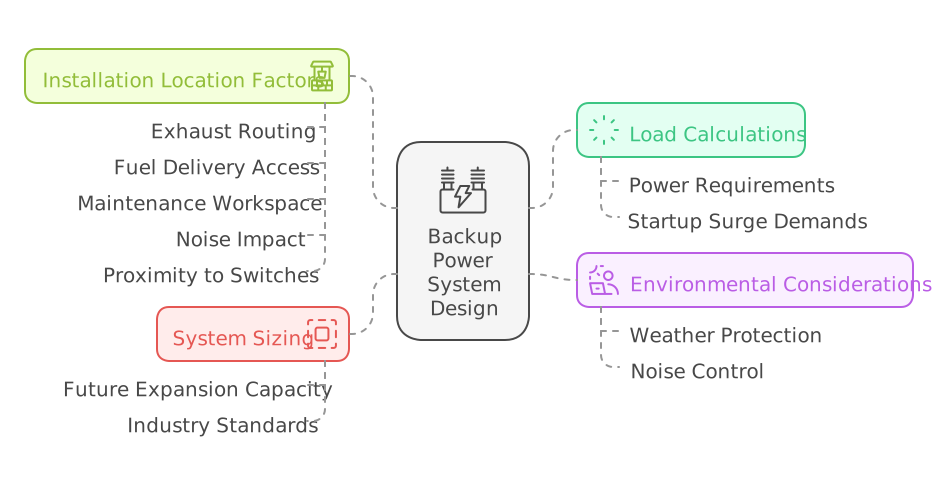
The success of a backup power system begins with proper planning and implementation. Load calculations must account for both connected equipment power requirements and startup surge demands. Environmental factors significantly impact system design, particularly for outdoor installations where weather protection and noise control become critical considerations.
System sizing requires careful analysis of both current and future needs. Industry standards recommend including 20-30% additional capacity for future expansion. Installation locations must consider factors such as:
- Generator exhaust routing requirements
- Fuel delivery access
- Maintenance workspace requirements
- Noise impact on patient areas
- Proximity to transfer switches
- Weather protection needs
Testing and Maintenance Requirements
Proper maintenance forms the cornerstone of reliable backup power operation. Following industry standards for maintenance and testing is crucial. Our weekly inspection protocol is comprehensive, covering everything from fuel system evaluation and battery condition assessment to cooling system inspection, control system verification, and general mechanical inspection. A thorough approach catches issues before they become problems.
Environmental Considerations and Compliance
Environmental compliance has become increasingly important. Emergency generators are subject to EPA and local air district limits on non-emergency running time for testing and maintenance; confirm the current rules for your equipment. Facilities should keep records of generator run times, fuel use, emissions and maintenance. Our testing results are meticulously recorded to demonstrate ongoing compliance.
Environmental considerations go beyond emissions. Noise control, fuel containment and storm water protection all need planning. We also carefully plan heat dissipation requirements and exhaust routing compliance to minimize environmental impact while maintaining system efficiency.
Technology Integration and Monitoring
Modern backup power systems include monitoring that makes them easier to manage. Building automation systems can connect to power monitoring for real-time data, maintenance alerts and fuel tracking. The historical trend analysis and remote monitoring capabilities we now have at our disposal have revolutionized system management. These systems help with compliance through automated record-keeping.
Emergency Response Protocols
Emergency procedures should cover complete utility loss, partial failures, weather events, equipment malfunctions and extended outages. Response plans should include steps to verify the system starts and to manage loads. Facility teams need clear communication procedures, equipment priorities and staff responsibilities. This comprehensive approach ensures that everyone knows exactly what to do when an emergency occurs.
Future Trends and Innovations
Several trends are worth watching. These include renewable energy paired with traditional backup systems, battery storage and smart grid capabilities. For healthcare facilities considering Medical Office Leasing, these innovations are particularly relevant when evaluating potential spaces. The future of medical backup power is moving toward enhanced monitoring and predictive maintenance, improved efficiency, and reduced emissions.
FAQs
What are the types of power backup systems?
What are the hospital generator requirements?
What’s the hospital generator cost?
How long do hospital backup generators last?
Are hospitals required to have backup generators?
Conclusion
At the end of the day, backup power in medical facilities isn’t just about keeping the lights on – it’s about protecting lives. While the technical details matter, what’s most important is having a system you can count on when you need it most. Whether you’re managing a large hospital or a small medical office, investing in reliable backup power is one of the most important decisions you’ll make. Don’t wait for an emergency to think about your power needs.
It’ll help ensure your backup power systems meet both current demands and future growth.Schedule a consultation with Tolj Commercial.


